Industrialized Housing: A Passivhaus Family Case Study
From dream to reality: how one family achieved a connected Passivhaus
They bought a sloped plot, set a tight budget and demanded near-zero energy bills — and in 14 months they were living in a finished Passivhaus delivered by an industrialized housing process. This story cuts through marketing to show concrete results: timelines, costs, energy metrics and lessons you can apply if you plan to self-develop a modular home in Spain.
Initial context: needs, plot and sustainability goals
The clients were a family of four seeking low operational costs, healthy indoor air and a modern Mediterranean aesthetic. Their plot was 650 m² on the outskirts of Valencia with favorable solar exposure but a strict municipal envelope limit. Their brief was clear: Passivhaus performance, connected home features and a turnkey delivery under a fixed price.
Why they chose industrialized housing over traditional build
They prioritized predictability and speed. Key reasons:
- Shorter on-site time: most work completed in factory conditions.
- Fixed-price contracting: fewer surprises than open-ended traditional tenders.
- Quality control: repeatable processes and controlled environments reduced defects.
Initial budget and timeline expectations
The family set a target budget of €210,000 (excluding land). They expected design and permitting to take 4–6 months and on-site works 3–5 months. Their headline goal was a finished handover within 12–16 months from project start.
Challenges and key decisions during the project
Choosing the structural system: concrete, timber or steel frame
Selecting the right system balanced thermal performance, cost and speed.
- Industrialized concrete: excellent thermal mass and durability, but heavier logistics and higher initial cost.
- Light timber frame: fast assembly, low embodied energy, good thermal performance when detailed correctly.
- Steel frame: high precision and speed; needs careful thermal bridging treatment.
The project chose a hybrid approach: a prefabricated insulated concrete ground slab and timber-framed upper modules. This delivered robust foundations and the fast enclosure benefits of timber.
Passivhaus requirements and connected home adaptation
To meet Passivhaus targets the team addressed three pillars: airtightness, thermal continuity and ventilation. For connectivity they embedded sensors and a home automation gateway with non-intrusive integration. The result: a home that meets rigorous energy targets while delivering everyday convenience.
Managing permits, plot constraints and turnkey coordination
Municipal limits required a compact volume and setback adjustments. The turnkey team handled everything: geotechnical survey, adaptations to the project, factory production scheduling and final commissioning. Centralized communication and a single point of responsibility were decisive to keep the project on track.
The 'turnkey' process explained with real data
Project phases: design, factory prefabrication, on-site assembly and handover
Phases and responsibilities:
- Concept & permit design (10 weeks): schematic design, energy model and permit submission.
- Factory production (8–12 weeks): off-site fabrication of walls, floors and service modules.
- On-site assembly (4 weeks): foundations, craning modules, connections and finishes.
- Commissioning & handover (2 weeks): airtightness test, MVHR balancing and client training.
Closed schedules: real timeline and milestones
The actual timeline from contract signature to keys:
- Week 0–10: Design & permit approval
- Week 11–22: Factory production
- Week 23–26: Site assembly and utilities connection
- Week 27–28: Commissioning and handover
Total: 28 weeks (7 months) from contract to occupancy after permits were approved. Including permits, the elapsed time was 14 months.
Practical advantages: fixed price, quality control and fewer surprises
Because the majority of work was off-site, variation orders were limited. The turnkey contract included tolerance clauses and a final defects period. The family reported fewer surprises compared to anecdotal traditional builds.
Measurable results: efficiency, costs and satisfaction
Passivhaus energy metrics: demand, actual consumption and carbon reduction
Key measured figures in the first 12 months:
- Heating demand: 12 kWh/m²·year (modeled target 15)
- Primary energy consumption: 42 kWh/m²·year
- Airtightness: 0.36 ACH@50Pa (Passivhaus standard <0.6)
Compared to a conventional new-build in the same climate, estimated operational emissions were reduced by ~65% annually.
Measured performance validated the design: low demand, tight envelope and a balanced MVHR system produced comfort and real energy savings.
Cost comparison: modular investment vs traditional construction and payback
Final delivered cost (turnkey, excluding land): €225,000. For an equivalent-size traditional build in the area the estimated cost was €235,000–€260,000 after delays and extras. Key takeaways:
- Industrialized route closely matched or undercut realistic traditional costs when accounting for time savings and fewer overruns.
- Energy savings and lower maintenance improved lifecycle economics. Estimated simple payback on incremental efficiency investment: 9–13 years depending on energy prices and usage.
Client satisfaction: delivery time, aftercare and ratings
The family rated the experience 9/10. Highlights:
- Handover transparency and training on systems.
- Fast resolution of minor snags during the 2-year defects period.
- Satisfaction with indoor comfort and lower bills compared to previous rental housing.
Technical and value comparison: what sets this industrialized home apart
Thermal and acoustic performance by materials and assemblies
The hybrid concrete slab + timber modules delivered a balanced performance: thermal mass at the base and lightweight, high-R envelope above. Acoustic separations used resilient mounts and double-stud partitions. The result: comfortable temperatures and good sound attenuation for a suburban setting.
Home automation and connected home integration: practical daily benefits
Integrated systems included:
- MVHR control with humidity and CO2 sensors for automatic boost.
- Smart thermostatic control per zone optimized for occupancy patterns.
- Remote monitoring of energy and system status for preventive maintenance.
Benefits reported by the family: reduced manual intervention, proportional heating consumption and quicker fault detection.
How it compares to competitors: objective data and transparency
This project demonstrates that industrialized housing does not mean lower quality. With transparent metrics and documented timelines, it compares favorably to local traditional offers. For a broader technical perspective, see our analysis in Vivienda industrializada: el futuro del hogar en España.
Images and visuals to communicate the project (Findnido guide)
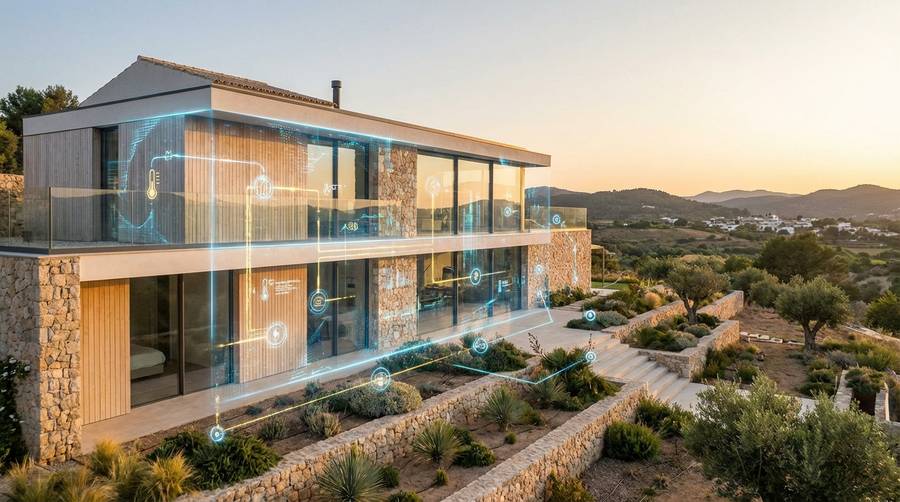
AI image description: Mediterranean contemporary finished home
Generate a high-quality architectural photograph of a finished Mediterranean contemporary single-family home in Spain. The house should look real and lived-in, not experimental. Features: light stone and warm wood finishes on the façade, smooth light-coloured render, and a polished concrete element. Large floor-to-ceiling windows open to a sunlit terrace with potted plants and a small garden. Scene at golden hour with warm natural light. Human presence is subtle: a family bike and two chairs on the terrace. Emphasize sustainability through design cues (deep eaves, sun shading, greenery) but avoid showing construction details. Photographic style: architectural magazine quality, balanced framing, natural colors, aspirational and achievable mood consistent with Findnido brand.
Key visual elements to include
- Facade with natural materials: wood, light stone and concrete.
- Large windows and terraces facing south-west for warm light.
- Garden and Mediterranean planting; an everyday lifestyle scene.
- Soft golden-hour lighting, realistic shadows and high detail.
Photographic tone and brand fit
Keep the mood trustful and comfortable. The image should feel premium but attainable. Avoid any imagery that evokes low-cost prefab stereotypes. The home must appear finished and welcoming.
Lessons learned and advice for self-builders
What to repeat: decisions that sped the project and improved outcomes
- Engage a turnkey provider early to align design with factory constraints.
- Choose a hybrid structural approach when the site demands it.
- Prioritize airtightness and MVHR early in the design to avoid rework.
What to avoid: common mistakes and mitigation
- Avoid late changes to scope once factory production starts; they are costly.
- Don’t under-estimate permit timelines — they shape the overall schedule.
- Plan for utility coordination early to prevent on-site delays.
Next steps: financing, self-build mortgages and preparing for 2026
Autopromoters benefit from specialized self-build mortgages that release funds by milestone. Prepare a robust cashflow plan and detailed turnkey contract. For energy-focused builds consider linking incentives and long-term financing assumptions to projected operational savings.
Final reflections
This case proves that industrialized housing in Spain can deliver high-performance Passivhaus outcomes with real cost and time advantages. The keys were early alignment, factory control and a single accountable partner for turnkey delivery. If you’re planning a self-built home, use these metrics to set realistic timelines and contracts.
If you want practical templates or a checklist to plan a turnkey industrialized project in Spain, we can share a tailored starter pack to help you compare systems and lenders for 2026.