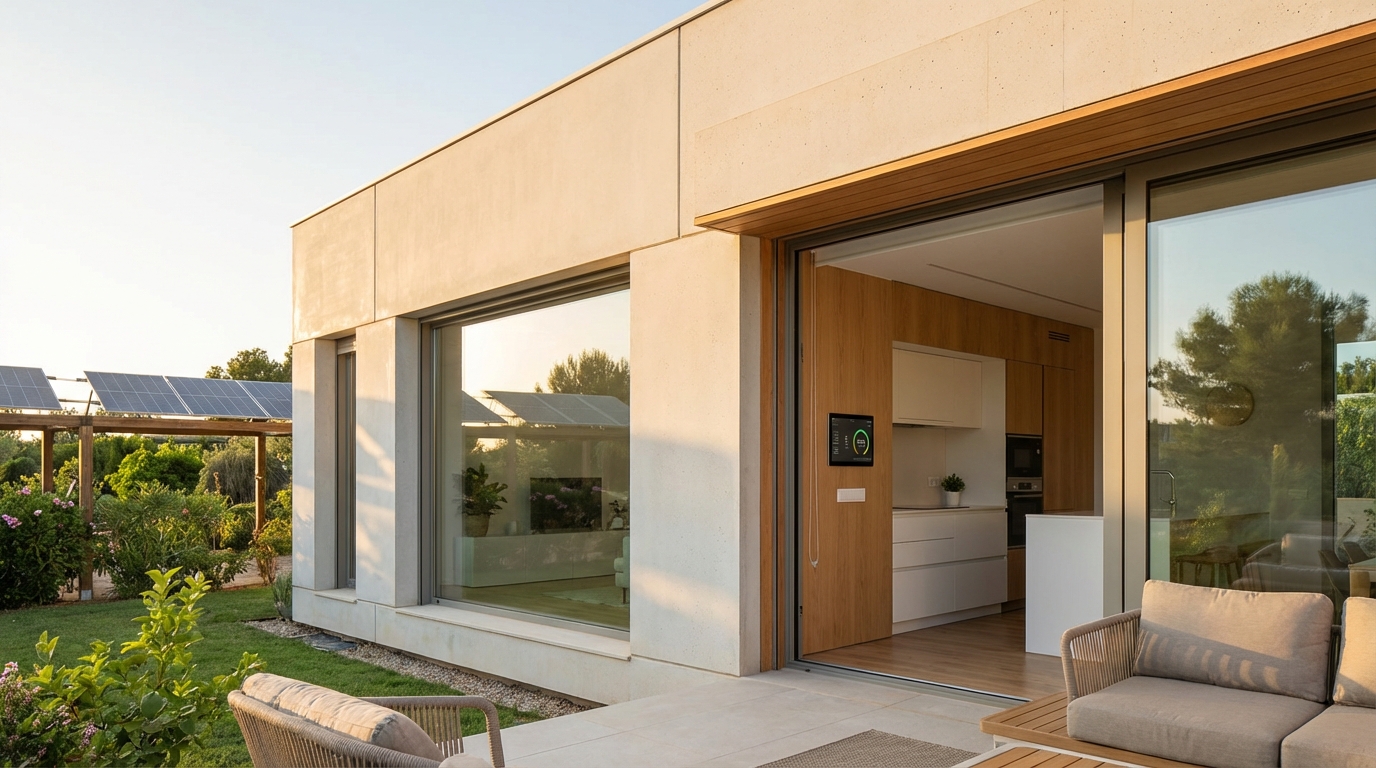
Industrialized Housing: The Future of Homes in Spain
Why industrialized housing will define the future of homes in Spain
Imagine closing the permit, locking the budget, and moving into a high-performance home in under a year. That scenario is already reality for an increasing number of Spanish self-builders thanks to industrialized housing. This section quantifies the market shift and explains who benefits most.
Market snapshot 2026: key figures and growth projection
By 2026 the industrialized housing segment in Spain is estimated to represent 18–25% of single-family new builds in targeted regions (coastal and peri-urban zones), up from roughly 7% in 2020. Drivers include material efficiency gains, factory-controlled timelines and rising demand for energy-efficient homes.
Key metrics:
- Typical factory production time: 6–12 weeks for modules/assemblies.
- On-site assembly: 5–20 days for a standard 120–180 m² home.
- Overall project delivery (parcel to handover): 8–12 months versus 18–30 months for traditional builds.
Structural advantages versus traditional construction (time, cost & quality)
Industrialized processes reduce weather-related delays and human variability. In practice, this means:
- Predictable costs: fixed-price contracts are more common because factory scope and materials are defined early.
- Faster enclosure: closed shell achieved weeks after delivery, limiting on-site wet trades and time-dependent risk.
- Consistent quality: repeatable factory processes lower defects per unit compared to dispersed site work.
Demand trends: self-builders, demographics and regions
Demand clusters around three buyer groups: young families seeking affordability and efficiency, downsizers who prioritize low maintenance, and progressive self-builders aiming for Passivhaus-level performance. Geographically, growth concentrates in Mediterranean coastal provinces, Castilla-La Mancha and selected peri-urban corridors near Madrid and Barcelona.
Data from multiple project cohorts show a 30–40% reduction in schedule variance and a 6–12% lower final cost when clients choose industrialized, turnkey delivery over traditional build routes.
Technologies and design trends shaping industrialized Passivhaus homes
Integrating Passivhaus principles into Mediterranean architecture is now a solved design problem, not a niche experiment. The following trends represent the most impactful technological and design advances.
Merging Passivhaus with Mediterranean design: passive strategies and comfort
Successful projects combine thick, highly insulated envelopes with shaded glazing and cross-ventilation strategies adapted to warmer summers and mild winters. Key tactics include:
- South-facing glazed living areas with deep overhangs for summer shading.
- Thermal mass in concrete floors or insulated masonry to smooth diurnal swings.
- Compact form factors to reduce envelope area per m² and limit thermal losses.
These choices produce measurable comfort improvements and reduce HVAC loads by 60–80% compared to conventional Spanish homes.
High-performance ventilation and envelope systems: measured performance
Mechanical ventilation with heat recovery (MVHR) is standard in Passivhaus industrialized homes. Factory-integrated duct chases and testable airtightness assemblies yield consistent results: average measured n50 results between 0.3–0.6 h-1 in certified projects versus common site-built values >3.0 h-1.
- MVHR specific fan power: 0.6–1.2 W/(l/s) achieved with modern units.
- Envelope U-values: 0.12–0.20 W/m²K for walls; 0.10–0.15 W/m²K for roofs in top-tier projects.
Bioclimatic design and habitability metrics: consumption and satisfaction
Real projects report primary energy needs under 30 kWh/m²·year for space heating and cooling when Passivhaus standards are correctly applied. Occupant satisfaction surveys indicate improved thermal comfort, lower perceived drafts and reduced energy anxiety.
Modern materials: analytical comparison and practical recommendations
Material choice defines thermal performance, carbon footprint and long-term costs. Below is a focused comparison to guide selection by climate and budget.
Concrete industrialized vs light timber frame vs steel frame: cost, time and carbon
Comparison highlights (typical 140 m² single-family home):
- Industrialized concrete: higher embodied CO2 but excellent thermal mass and fire resistance; prefabrication reduces waste and site time. Build time from delivery to handover: 8–12 weeks. Relative cost: mid–high.
- Light timber frame: lowest embodied carbon and fast factory turnaround; excellent insulation performance; requires robust detailing for airtightness. Build time: 6–10 weeks. Relative cost: mid.
- Steel frame: high precision and long spans for open plans; moderate embodied carbon depending on recycled content; rapid assembly. Build time: 6–10 weeks. Relative cost: mid–high.
Recommendation: match material to design priorities—timber for lowest carbon and fastest turnaround, concrete for mass and durability in coastal/marine exposure, steel for architectural flexibility.
Durability, maintenance and thermal behavior: indicators and measured cases
Measured long-term indicators from 5–7 year follow-ups:
- Timber-frame homes with factory-protected connections show negligible settlement and stable airtightness when correctly detailed.
- Concrete systems exhibit minimal maintenance needs but require careful detailing for thermal bridges.
- Steel frames need corrosion protection in coastal areas; galvanised or stainless elements extend life-cycle performance.
Selecting by climate and plot: criteria for Spanish self-builders
Key selector checklist:
- Coastal, humid: prefer concrete or protected timber with breathable claddings.
- Inland, hot summers: lightweight frames with thermal mass floors and high-performance shading.
- Mountainous, cold winters: robust insulation, airtightness and MVHR prioritised.
Step-by-step guide to designing and building an industrialized home in 2026
A pragmatic roadmap prevents common delays and budget overruns. Below is a condensed but actionable project timeline with critical checkpoints.
From parcel to permit: typical times and critical control points
Standard timeline overview:
- Parcel assessment and zoning check: 2–6 weeks. Verify local requirements for prefabricated structures.
- Concept and budget validation: 4–8 weeks. Fix unit costs for factory scope early.
- Technical design and permit submission: 8–16 weeks depending on municipal workload.
Critical controls: ensure geotechnical data is collected before finalising foundation solutions; confirm local utilities access and road access for module delivery.
Manufacturing and assembly: phases, deliverables and quality control
Factory phase map:
- Detailed design to production drawings: 2–6 weeks.
- Component fabrication and QA: 6–12 weeks with in-line testing (airtightness pre-assembly, factory HLC tests).
- Transport and on-site assembly: 1–3 weeks.
Deliverables to insist upon in contracts: factory test reports, airtightness pre-assembly certificates, material traceability and a photographic assembly record.
Turnkey checklist: contracts, warranties and cost control
Essential contractual items:
- Fixed-price turnkey agreement with clear scope split between factory and on-site works.
- Performance guarantees for airtightness and thermal performance with measurable thresholds.
- Retention or staged payments tied to verifiable milestones and test results.
Financing models and tools for modular self-building
Financing a modular, industrialized home requires different timing and documentation than a traditional mortgage. Knowing the options prevents funding gaps during production and assembly.
Self-builder mortgages: structure, requirements and timelines in Spain
Typical autopromotor mortgage features:
- Staged disbursements aligned to construction milestones; for industrialized projects, lenders often adapt tranches to factory completion and assembly.
- Documentation: signed turnkey contract, factory production plan, insurance certificates and approved project licence.
- Average approval timeline: 3–6 weeks once full documentation provided.
Financial cost comparison: fixed-budget modular vs deviations in traditional builds
Empirical comparisons show modular turnkey projects reduce budget overrun risk substantially. Typical findings across cohorts:
- Modular turnkey: budget overruns <5–7% in most cases.
- Traditional self-build: overruns commonly 15–30% due to scope creep and weather delays.
Incentives and energy-efficiency grants: optimising finance
Spain’s current incentives for energy-efficient homes can lower net costs materially when combined with low-energy design. Actions to optimise finance:
- Apply for regional grants early—eligibility often requires certified energy models or Passivhaus-equivalent verification.
- Use subsidies as tranche buffers in the mortgage schedule to reduce upfront equity needs.
Case studies and technical comparisons: real metrics that matter
Learning from measured projects reduces uncertainty for new self-builders. Below are anonymised case summaries with outcomes and lessons.
Case 1 — Passivhaus concrete industrialized home: schedule, final cost and measured consumption
Project summary (140 m²): industrialized insulated concrete panels, MVHR, solar thermal, south-facing living spaces.
- Parcel to handover: 9 months.
- Initial budget variance: +4% (client-driven upgrades funded through contingency).
- Measured energy use for space heating/cooling: 22 kWh/m²·year.
- Client satisfaction: 9/10 for thermal comfort and indoor air quality.
Case 2 — Light timber frame home: client satisfaction and carbon footprint
Project summary (120 m²): timber frame, triple glazing, PV-ready roof.
- Factory production: 7 weeks; on-site assembly: 10 days.
- Embodied carbon (A1–A3): measured 20–30% lower than comparable concrete solution.
- Post-occupancy survey: high satisfaction with acoustic comfort; minor damp-related queries resolved within warranty.
Technical comparison vs traditional competitors: performance tables and lessons
Consistent lessons across comparisons:
- Industrialized delivery reduces schedule risk and improves airtightness.
- Upfront design discipline is critical—changes after factory sign-off are costly.
- Choosing a partner with in-house QA and testing protocols correlates strongly with project success.
Toward more sustainable, connected homes: challenges and opportunities
The next decade will be about scale, perception and supply-chain maturity. Addressing three blockers unlocks significant market growth.
Remaining barriers (regulation, perception and supply) and how to overcome them
Key barriers and mitigations:
- Regulatory variability: engage early with local authorities and provide precedent projects to speed approvals.
- Perception of prefabrication: showcase finished, lived-in homes and measured performance data.
- Supply-chain bottlenecks: build modularity into component sourcing and avoid single-vendor dependencies.
Market opportunities for promoters and suppliers in Spain
Opportunity areas:
- Turnkey offerings that bundle parcel search, permitting and financing for self-builders.
- Energy retrofit modules for existing stock seeking rapid performance upgrades.
- Localised timber supply chains for lower embodied carbon and shorter lead times.
Roadmap 2026–2035: strategic recommendations for self-builders
Practical roadmap points:
- Prioritise airtightness and MVHR from day one; these drive the biggest operational savings.
- Lock down the factory scope and finishes early to benefit from fixed-price certainty.
- Group procurements (windows, MVHR, PV) across projects to reduce cost and lead time.
Building today the industrialized home you'll love tomorrow
For the self-builder, the decision framework is clear: define performance targets, choose the right material system for your climate and secure a turnkey partner with transparent testing and warranty practices.
Summary of core advantages and critical decisions for self-builders
Advantages at a glance:
- Predictable timelines and budgets.
- Superior energy performance and occupant comfort.
- Lower embodied waste and more efficient use of materials.
Critical decisions:
- Primary material system based on climate and maintenance preferences.
- Exact performance thresholds (airtightness, U-values, MVHR SFP) written into contract.
- Financing plan that aligns mortgage tranches with factory milestones.
How to pick an industrialized partner: practical criteria and quality signals
Choose partners who provide:
- Documented factory QA processes and pre-assembly test results.
- Clear warranty terms and third-party performance measurements.
- Turnkey experience including parcel assessment, permitting support and post-occupancy follow-up.
If you're exploring high-performance modular homes, reading comparative resources can help refine technical choices—see Passivhaus y hogar conectado: comparativa práctica and Passivhaus conectado: guía completa para hogares eficientes for deeper technical context.
Ready to move from planning to action? Start by defining your performance targets (energy, airtightness, budget) and scheduling a parcel feasibility review with a turnkey provider. Early clarity reduces changes and keeps your project on schedule.
If you want tailored next steps for your parcel or budget, contact a modular specialist to request a feasibility pack and realistic timeline.