Industrialized Housing Guide: Design Your Modular Home
Definitive Guide: How to Design an Industrialized House Step by Step in Spain 2026
This guide explains how to plan, design and deliver an industrialized house in Spain in 2026. It is aimed at self-builders who want clarity, realistic schedules and predictable costs. You will find system comparisons, energy strategies based on Passivhaus principles, the turnkey process and financing options. Practical case studies show real metrics for time, cost and client satisfaction.
Initial planning: choosing plot, regulations and orientation
Start with the plot. Evaluate urban planning rules, buildability and local regulations. Check maximum buildable area, roof pitch limits and façade rules. Consider orientation carefully. South-facing living spaces reduce heating needs and improve daylight. Take into account shading from neighbouring buildings and mature trees. Early site surveys will avoid delays later.
Selecting construction system: industrialized concrete, light timber frame and steel frame
Choose the system that best fits budget, schedule and performance goals. In Spain, the main modern options are industrialized concrete, light timber frame and steel frame. Each has strengths. Industrialized concrete offers robustness and thermal mass. Light timber frame delivers lightness, speed and good thermal performance. Steel frame provides precision and long clear spans. Consider acoustic requirements, façade choices and integration with Passivhaus strategies.
Schedule and cost control: estimating and managing the budget
Create a clear schedule with milestones for design, permits, off-site production and on-site assembly. Industrialized projects often close the building shell faster than traditional builds. Fixed-price contracts are common for modular packages. Still, plan contingencies for site access, utilities and landscaping. A transparent budget differentiates what the supplier includes and what remains the responsibility of the client.
Advantages of Industrialized Housing Compared with Traditional Construction
Faster delivery and reduced uncertainty
Industrialized housing shortens the wet-work period on site. A prefabricated house reduces exposure to weather delays. Factory-controlled production means predictable lead times. For self-builders this reliability translates into faster move-in times and fewer on-site decisions during the build phase.
Fixed price and budget control: what is included and what to plan for
Many modular suppliers provide a fixed-price package. This typically covers design, manufacturing, transport and assembly. Clarify inclusions such as finishes, landscaping, connections to utilities and appliance specifications. Define allowances for optional upgrades. With a fixed price you reduce financial risk, but maintain a contingency for unexpected site work or regulatory changes.
Build quality and durability: modern materials and finishes
Modern industrialized systems use high-quality materials and precise factory processes. Industrialized concrete panels come with controlled curing and consistent finishes. Light timber frame systems use engineered timber and multi-layer insulation. Steel frame solutions provide tight tolerances and minimal on-site cutting. All systems can achieve high durability and refined interior and exterior finishes.
Sustainability and Energy Efficiency: Designing Passivhaus Industrialized Homes
Passivhaus principles applied to industrialized housing
Passivhaus principles focus on airtightness, thermal insulation, heat recovery and solar gain management. Industrialized construction supports these objectives due to controlled production tolerances. Prefabricated wall panels and floor elements can integrate continuous insulation and airtight membranes. Mechanical ventilation with heat recovery (MVHR) is often easier to coordinate when service cavities are planned during design.
Materials and solutions to reduce carbon footprint
Choose low-embodied-carbon materials and avoid heavy transport distances. Engineered timber reduces embodied emissions compared with conventional concrete. When using industrialized concrete, specify mixes with supplementary cementitious materials and recycled aggregates. Include energy-efficient windows, high-performance insulation and renewable systems such as solar thermal or PV with battery storage.
Measuring performance: energy use and certifications
Monitor in-use energy with metering and commissioning protocols. Aim for realistic performance targets and document them for certification. Certifications such as Passivhaus, energy rating or local sustainability labels help communicate quality. Use post-occupancy evaluations to confirm performance and guide future projects.
Turnkey Process: From Plot Search to Handover
Turnkey service phases and the self-builder’s responsibilities
A typical turnkey service includes concept design, approvals, factory production, site assembly and final commissioning. The client’s main responsibilities are plot acquisition, securing finance and making timely decisions on finishes. A professional turnkey provider will coordinate subcontracts, handle logistics and offer a single point of contact throughout the process.
Permits, licenses and coordination with utilities
Early permit work is essential. Submit complete packages to the local town hall to reduce review cycles. Coordinate utility connections—water, sewage, electricity and communications—early in the schedule. Delays in supply connections are a common cause of extended timelines. A turnkey provider often manages these formalities on behalf of the client.
Final delivery, warranty and after-sales service
At handover, perform a joint inspection and create a snagging list. Confirm warranty terms for structure, systems and finishes. Retain documentation for maintenance schedules and commissioning reports. Reliable post-sale service ensures long-term satisfaction and preserves the building’s performance.
Financing for Self-Build: Mortgages and Alternatives for Modular Homes
Mortgage options for self-builders and bank criteria
Spanish banks offer specialised products for self-build projects. Lenders evaluate the borrower’s experience, project budget and turnkey contracts. A fixed-price contract with clear milestones increases lender confidence. Present a realistic cashflow plan showing drawdown stages aligned with production and assembly timelines.
Finance lines specific to industrialized housing
Some lenders recognise the lower construction risk of industrialized housing. This can result in staged disbursements during factory production and on-site assembly. Consider construction-to-permanent loans or specialised self-construction mortgages that convert to a standard mortgage at completion.
Key tips to present a strong project to lenders
Provide a complete dossier: plot deed, turnkey contract, detailed budget, timeline and professional references. Include performance targets such as expected energy consumption and relevant certifications. Transparent documentation accelerates approvals and may improve loan conditions.
Case Studies and Technical Comparisons: Real Metrics and Lessons
Case 1: Mediterranean concrete industrialized home — timeline, cost and satisfaction
Project overview: a 180 m² single-family home using industrialized concrete panels. Timeline: design and permits 6 months; factory production 8 weeks; site assembly and finishes 10 weeks. Total delivery from contract: 10 months. Cost: competitive with traditional masonry when including quality finishes and external works. Client feedback: high satisfaction with thermal comfort and acoustic performance.
Case 2: Light timber frame house — energy performance and schedule
Project overview: 140 m² timber-framed home with high insulation and MVHR. Timeline: design and permits 5 months; off-site manufacture 6 weeks; assembly and finishes 8 weeks. Delivered in under nine months. Measured energy consumption in the first year was significantly below national averages for similar-sized homes. Owners highlighted speed of execution and interior comfort.
Neutral technical comparison: costs, times and quality versus competitors
Comparison summary: industrialized housing often reduces on-site time by 40–70% compared to traditional builds. Costs vary by system and finishes, but fixed-price modular contracts reduce budget uncertainty. Quality is a function of factory standards, design detailing and installation precision. In neutral technical comparisons, the main advantages are predictability, improved thermal performance potential and faster delivery.
Practical Steps to Start Your Industrialized Housing Project in Spain
Step-by-step checklist for self-builders
- Confirm plot suitability and local regulations.
- Define performance targets: Passivhaus ambition or energy rating goals.
- Choose the construction system that matches goals and context.
- Request fixed-price proposals with clear inclusions.
- Plan finance and present a complete dossier to lenders.
- Coordinate permits and utilities early.
- Agree on commissioning, warranty and post-delivery support.
Common pitfalls and how to avoid them
Common pitfalls include unclear scope, late decisions on finishes, underestimated site works and delayed utility connections. Avoid these by documenting inclusions, setting deadlines for choices and maintaining contingency funds. Work with experienced advisors and verify supplier references.
Further reading and related topics
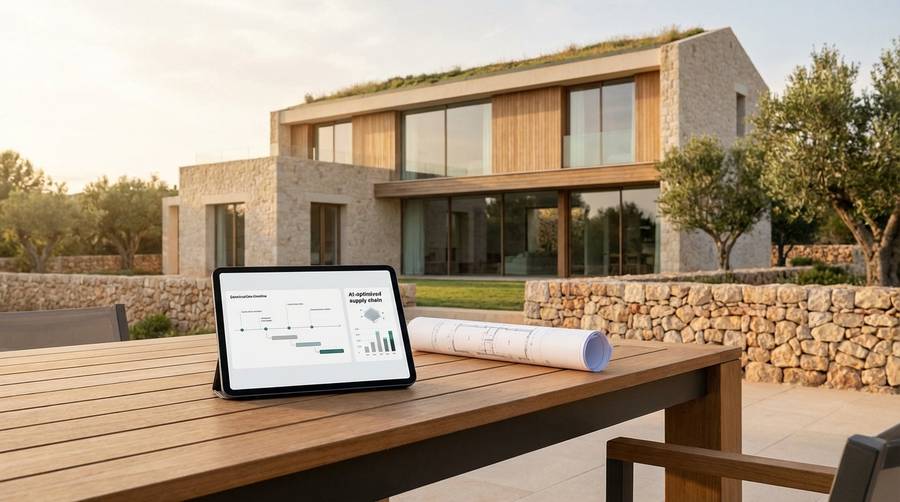
For insights on how AI improves supply chains and operational efficiency in modular construction, explore Optimización IA en la cadena de bienestar and Optimización cadena suministro con IA en construcción. These articles show how digital optimisation complements industrialized housing by reducing waste and improving delivery predictability.
Conclusion: Why Choose Industrialized Housing for Your Self-Build in Spain
Industrialized housing offers a modern, transparent path to delivering high-quality homes in Spain. It balances speed, predictability and performance. With the right planning, a turnkey approach and well-chosen systems you can achieve strong energy performance and a clear budget. This approach is particularly attractive for families and self-builders who value certainty, sustainability and a professional process.
If you are ready to explore options, begin with a feasibility review of your plot and performance goals. A focused brief will allow suppliers to provide accurate proposals and shorten the path to a finished home.