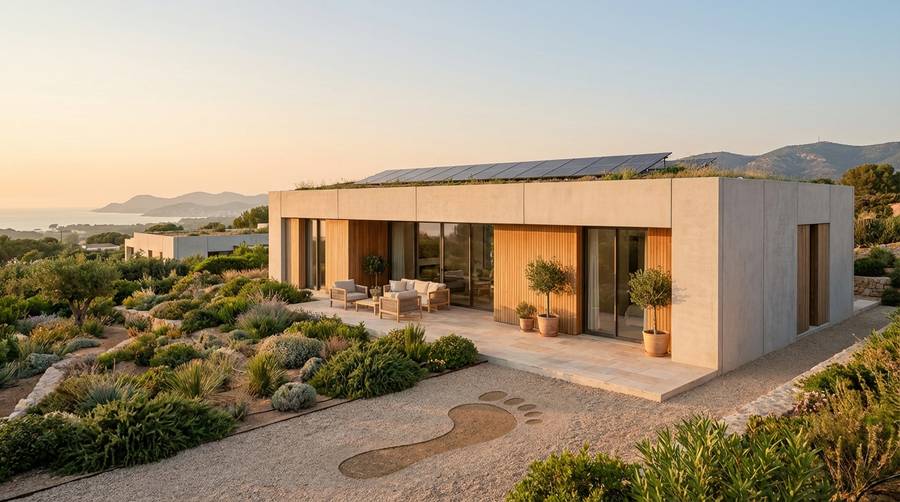
Industrialized Housing: Materials That Cut Carbon and Cost
Introduction — Hook: Why materials decide the future of industrialized housing
Hook: By 2030, building-related emissions must fall sharply if Spain is to meet its climate targets. For self-builders and developers, the single biggest lever is not solar panels or LEDs: it's the materials and processes chosen at the design table. This article gives a practical, data-driven map for reducing both embodied carbon and delivery risk in industrialized housing.
We focus on actionable guidance: material selection, production and logistics strategies, energy-performance alignment with Passivhaus principles, finance implications for turnkey projects, and a replicable checklist for projects in Spain through 2026–2035.
Choosing the right structural system can reduce embodied carbon by 20–45% and shorten on-site duration by 50%—a decisive combo for sustainability and cost control.
Why material choice redefines the footprint of industrialized housing
Climate impact: embodied emissions from cradle to delivery
Embodied carbon—emissions from extraction, manufacturing, transport and assembly—accounts for a growing share of a building's lifecycle emissions as operational energy decreases. In industrialized housing, the factory stage concentrates those emissions but also offers control. Key facts:
- Factory consolidation reduces variability: standardized batching, optimized cuts and quality control lower waste and rework emissions by up to 30% compared with in-situ processes.
- Transport matters: component distance to site can add 5–15% to embodied carbon for heavy systems like concrete.
- Material intensity: steel and conventional concrete typically carry higher embodied carbon per m2 than timber systems unless low-carbon binders or recycled content are used.
Comparative advantages: industrialized vs traditional construction
Industrialized housing delivers three decisive advantages for sustainability and client certainty:
- Shorter on-site time: closed-site timelines reduce ancillary emissions (site machinery, temporary facilities) and disturbance, often halving on-site duration.
- Price certainty: fixed-price manufacturing contracts limit exposure to labor and material inflation typical of long on-site builds.
- Waste reduction: panelized production enables offcut recycling and tighter inventory control, cutting construction waste by 20–40%.
Relevance for self-builders (autopromotores)
Early material decisions set the project trajectory. Choosing systems with predictable lead times and clear lifecycle metrics reduces budget overruns and eases mortgage underwriting for self-build financing. If you are autopromotor, prioritize systems with:
- Transparent Bill of Materials (BoM) and fixed manufacturing costs.
- Proven on-site assembly times to align with loan drawdown schedules.
- Documented embodied carbon data to access green financing or incentives.
- Industrialized concrete (precast): High durability and thermal mass; moderate to high embodied carbon unless low-carbon mixes or SCMs (supplementary cementitious materials) are used; excellent fire resistance and long lifespan; good recyclability of aggregates.
- Light timber frame (LTF): Low embodied carbon per m2, fast assembly, excellent thermal performance when combined with insulation; requires careful detailing for moisture control; high recyclability and potential for carbon storage in the structure.
- Steel frame: High strength-to-weight ratio, great for spans and seismic resilience; higher embodied carbon than timber but improving with recycled content; components are recyclable; thermal bridging must be addressed.
- Thermal control: Timber and insulated panel systems facilitate continuous thermal envelopes; concrete benefits from mass but needs careful insulation layering to avoid thermal bridges.
- Seismic performance: Steel frames and engineered timber systems can outperform traditional masonry in seismic resilience when correctly detailed.
- Hygrothermal risks: Prefabrication reduces onsite moisture exposure but requires strict factory and site sealing protocols to avoid mold risks in timber systems.
- Coastal Mediterranean (mild winters, humid summers): Light timber frame with ventilated façades and breathable membranes; emphasis on moisture control.
- Interior continental zones (cold winters): Timber or insulated concrete panels with robust thermal insulation to optimize seasonal storage and reduce heating demand.
- Seismic areas: Steel frame or cross-laminated timber (CLT) with engineered connections for ductility.
- Standardize module widths (e.g., 1200/2400 mm) to reduce cuts.
- Use repetition in plan to amortize tooling and jig costs.
- Design for material nesting in the factory to minimize offcuts.
- Implement closed-loop waste streams: wood offcuts for panels, crushed concrete for inert fill.
- Use digital QC (BIM + automated QA) to reduce rejects and rework.
- Prefer suppliers with verified EPDs (Environmental Product Declarations).
- Optimize plant location relative to key markets to cut heavy transport emissions.
- Adopt reusable packaging for panels to reduce single-use materials.
- Plan assembly windows that match crane and labor availability to keep on-site days minimal.
- Design factory-installed airtight layers with tested junction details.
- Use triple-glazed, low-e windows specified for the climate zone.
- Integrate thermal bridge-free connection details between modules during design stage.
- Prioritize materials that minimize embodied carbon without compromising longevity.
- Calculate payback in carbon terms: e.g., a timber-framed, Passivhaus-level envelope can offset higher initial embodied carbon of some elements through decades of operational savings.
- Install mechanical ventilation with heat recovery (MVHR) sized for the modular layout.
- Integrate PV-ready roofs and pre-wired EV infrastructure during manufacture.
- Specify high-performance airtight tapes and factory-tested junctions to reduce on-site variability.
- Clear milestones for loan drawdowns tied to factory and delivery stages.
- Lower contingency percentages when using proven material systems.
- Documented lifespans and maintenance profiles;
- Factory guarantees and third-party certifications (EPDs, Passivhaus certifications);
- Acquisition: parcel purchase and site readiness reserve.
- Design & permits: fixed-fee design windows to lock BoM.
- Fabrication: deposit and final manufacturing timeline tied to component QA.
- Delivery & handover: final payment on successful airtightness and commissioning tests.
- Factory production: 6 weeks.
- On-site assembly and finishing: 4 weeks.
- Total delivered cost (turnkey): €1,650/m2.
- Embodied carbon reduction vs in-situ masonry: ~38%.
- Occupant satisfaction (survey at 12 months): 4.6/5 for thermal comfort.
- Precast route reduced on-site time by 60% and enabled earlier sale/occupancy.
- Precast with supplementary cementitious materials (25% SCM) lowered embodied carbon by 18% compared to standard cast-in-place mixes.
- Client satisfaction: lower unexpected costs and faster handover improved perceived value.
- Target manufacturing lead times, not just on-site durations, when evaluating suppliers.
- Require EPDs and airtightness test guarantees as part of procurement.
- Track metrics: cost/m2, embodied carbon kgCO2e/m2, on-site days, client satisfaction index.
- Invest in improved envelope performance first—airtightness and insulation yield the best combination of carbon and cost savings.
- Choose low-embodied-carbon primary structure where lifecycle analysis shows net benefit over 30 years.
- Negotiate supplier EPDs and warranty terms to reduce long-term risk.
- Carbon reporting requirements for buildings and public tenders.
- Increased lender appetite for homes with verified energy and carbon metrics.
- Emerging incentives for low-carbon binders and reused materials.
- Pre-purchase: check local zoning for modular delivery and crane access.
- Design phase: lock module dimensions, request EPDs and airtightness details.
- Procurement: require fixed BoM, delivery windows and QC certifications.
- Fabrication: monitor waste streams and request progress carbon reporting.
- Delivery: perform airtightness, MVHR commissioning and final snag lists before final payment.
Comparative analysis: industrialized concrete, light timber frame, and steel frame
Performance matrix: durability, cost/m2, embodied carbon, recyclability
Below are generalized performance bands—project specifics will vary by supplier and design:
Risks and technical benefits: thermal control, seismic resistance, hygrothermal behavior
Recommended use-cases by typology and Spanish climate (2026)
Match system to site and program:
Strategies to minimize footprint: design, production and logistics
Efficient modular design: optimize panels and reduce waste
Design choices that lower embodied carbon and cost:
Industrialized production: quality control and circular waste streams
Factory benefits translate to sustainability when coupled to circular practices:
Logistics and assembly: routing, packaging and fixed timelines
Logistics decisions influence both cost and emissions:
Sustainability and energy efficiency: marrying Passivhaus with modular systems
Material compatibility with Passivhaus and construction details
Passivhaus principles are fully compatible with modular construction if attention is paid to continuity of insulation and airtightness. Practical moves:
Long-term energy balance: embedded energy vs operational savings
For many industrialized homes, embodied carbon is a larger share of lifecycle emissions than in older builds. Therefore:
Complementary measures: envelope, MVHR and renewables
Turnkey delivery and financing: how materials shape cost, mortgages and viability
Price transparency: materials that stabilize budgets
Turnkey modular projects benefit from fixed bills of materials and factory schedules. Materials with stable supply chains (locally sourced timber, standardized steel sections) reduce price volatility. For autopromotores, this means:
Impact on mortgage underwriting for self-builds
Banks evaluate risk around completion certainty and residual value. Material systems that provide:
—improve the likelihood of favorable mortgage terms and release schedules.
Financial phasing: parcel, project, fabrication and delivery metrics
Create a financial control plan with measurable KPIs:
Case studies and real metrics: lessons from Spanish projects
Case 1 — Light timber frame single-family home
Project snapshot: 140 m2, coastal Catalonia. Key metrics:
Case 2 — Precast concrete panels vs cast-in-place
Project snapshot: two semi-detached homes in central Spain. Key outcomes:
Replicable lessons and KPIs
Roadmap 2026–2035: reduce footprint in industrialized housing
ROI-first sustainability recommendations
Priorities for promoters and self-builders:
Policy, certification and market signals to watch
Regulatory and market shifts that will shape material choice:
Practical checklist for autopromotores: decisions by phase
Conclusion — A pragmatic path to lower carbon, lower risk homes
Takeaway: Material choice in industrialized housing is the multiplier that controls embodied carbon, delivery certainty and financing outcomes. By prioritizing modular design efficiency, verified low-carbon materials, and turnkey procurement with clear KPIs, self-builders and developers can deliver homes that are faster, cheaper to finish, and far lower in lifecycle emissions.
If you are planning a self-build or modular development in Spain, start your project brief with three non-negotiables: an airtightness target, verified EPDs for major systems, and a fixed manufacturing timeline. Those three items collapse risk and create options for green finance and faster occupancy.
Call to action: Reflect on which of these three non-negotiables you already have—and which you need. If you want a short checklist tailored to your plot and budget, contact a specialist who can translate these metrics into a project-ready plan.