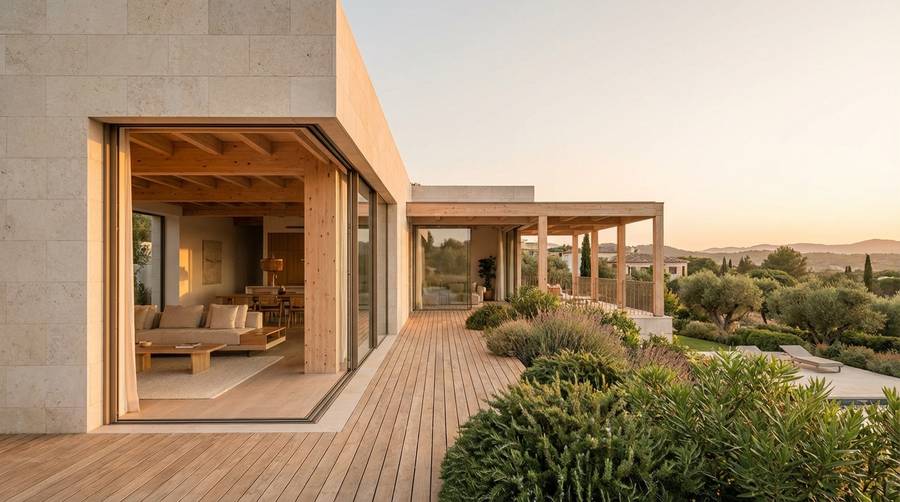
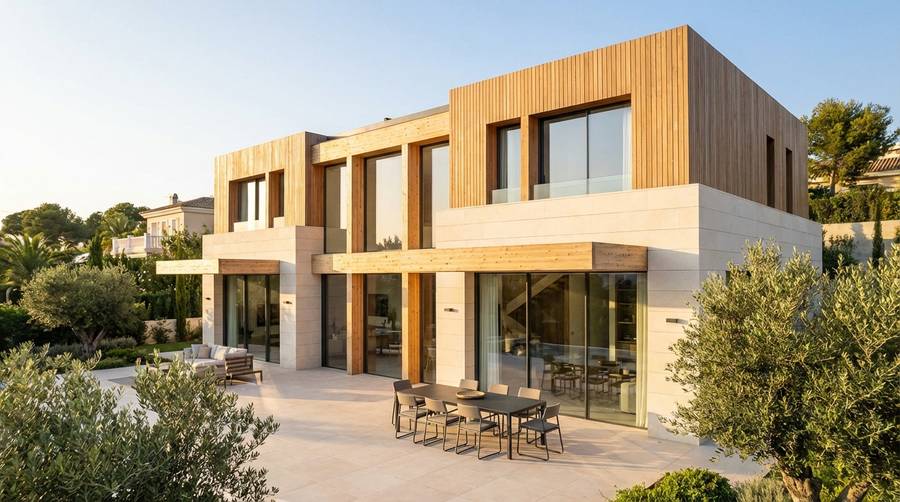
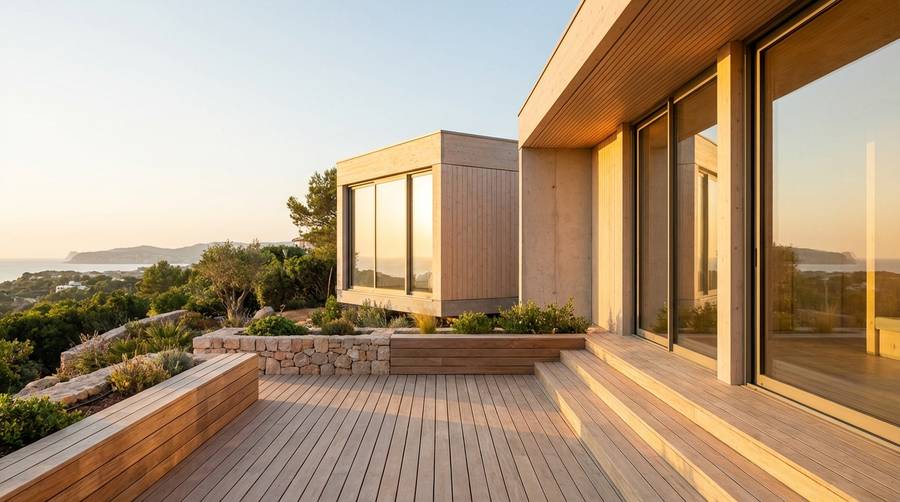
Advanced Structural Timber in Prefabricated Homes
What is advanced structural timber and why it matters for industrialized housing
Advanced structural timber refers to engineered wood products such as cross-laminated timber (CLT), glued laminated timber (glulam), and light-frame timber systems. These systems are designed for structural use in modern prefabricated and modular construction. In Spain they combine traditional material benefits with industrial precision.
Definition and types: CLT, glulam and light-frame
CLT is a large-panel system built from stacked cross-laminated boards. It offers dimensional stability and speed of assembly. Glulam consists of layered, bonded laminations used for beams and arches. Light-frame timber uses studs and sheathing for flexible, lightweight walls. Each type suits different structural and architectural needs.
Advantages versus other materials: weight, insulation, carbon footprint
Timber systems have lower structural weight than concrete and comparable stiffness to steel when engineered correctly. They provide inherent thermal performance and excellent moisture buffering. Life-cycle analyses typically show timber with substantially lower embodied carbon than reinforced concrete or steel, thanks to wood’s carbon storage.
Compatibility with industrialized systems: concrete panels and steel frame
Advanced timber integrates well with industrialized technologies. Hybrid assemblies pair timber floors or walls with concrete cores for thermal mass. Timber frames work with steel connectors and prefabricated concrete elements. This compatibility enables mixed-material strategies that optimise cost, performance and architectural expression.
Benefits of using advanced structural timber in prefabricated homes
For self-builders and developers, timber brings fast schedules, predictable budgets and elevated energy performance. Below are the main benefits with examples and metrics from completed projects.
Efficiency and reduced construction time: examples and metrics
Prefabrication of timber panels and components transfers labour to controlled factory conditions. Typical on-site assembly times for a single-family timber-prefab home in Spain range from 2 to 6 weeks for the shell. Total turnkey delivery times averaged 6 to 9 months in recent projects, compared with 12–18 months for equivalent traditional builds.
- Example metric: a 160 m2 house assembled in 18 days on site after factory production.
- Example metric: average site labour reduced by 40–60% versus masonry builds.
Predictable cost and control: fixed-price turnkey projects
Industrialized workflows reduce variability. Factory production yields fewer surprises and clearer quotes. Many turnkey offers include a fixed-price contract that covers permits, manufacture, transport, and assembly. For autopromoters, that translates into more reliable financing and fewer change orders.
Benefits for energy performance and Passivhaus compliance
Advanced timber systems are well suited to high-performance envelopes. Tight panel joints and continuous insulation help achieve low thermal bridging. In practice, timber-prefab homes often meet or surpass passive-house inspired targets with heating demands below 15 kWh/m2·year when combined with high-performance windows and ventilation with heat recovery.
Practical guide: how to design an industrialized timber house (Spain 2026)
This step-by-step guide outlines a modern autopromoter workflow, from land search to turnkey delivery. It emphasises practical checks for Spanish regulations and market trends for 2026.
Step 1 — From plot to project: planning rules and feasibility
Begin with due diligence. Check local urban regulations, building ratios, permitted uses, and connection capacity. Commission a topographical survey and a geotechnical report. These documents determine siting, foundations and the most suitable timber system.
- Tip: ask the town hall for a cadastral extract and applicable building ordinances early.
- Tip: evaluate access for large transport vehicles if panels will be trucked to site.
Step 2 — Design, structural system selection and energy certificates
Choose the timber type that matches your design intent and budget. For open interiors and long spans, consider glulam or CLT. For flexibility and cost efficiency, light-frame timber works well. Early energy modelling guides insulation thickness and orientation. Aim for a clear target: compliance with Passivhaus or a national nearly-zero energy standard.
Step 3 — Factory production, transport and site assembly (typical schedule)
After approvals, manufacturing begins in the factory. Typical milestones include components produced in 8–12 weeks. Transport windows must be coordinated with the site schedule. On-site assembly often follows a 2–6 week timeline for the envelope. Finish trades then proceed under controlled sequencing to minimise weather risk.
Typical turnkey timeline:
- Feasibility and permits: 8–16 weeks
- Design and certification: 8–12 weeks
- Factory production: 8–12 weeks
- Site assembly and finishes: 12–24 weeks
Real case studies: projects using advanced structural timber
Below are two anonymised case studies with measured metrics to help prospective autopromoters understand real outcomes.
Case 1: Mediterranean single-family home — timeline, cost and client satisfaction
Project: 175 m2 single-family home near Valencia. Structure: CLT walls and floors, light-frame roof. Key metrics:
- Factory production: 9 weeks.
- On-site assembly (envelope closed): 3 weeks.
- Total turnkey delivery: 7 months from contract to handover.
- Final construction cost (turnkey): €1,450/m2 including land improvement but excluding plot cost.
- Client satisfaction (survey at 6 months): 92% highly satisfied with comfort and delivery time.
Notes: The project reached a measured heating consumption of 11 kWh/m2·year in its first winter.
Case 2: Residential modular development — energy performance and emissions reduction
Project: 24-unit modular row housing in a peri-urban site. Structure: light-frame timber modules with prefabricated concrete stair cores. Key metrics:
- Average factory cycle per module: 6 weeks.
- On-site installation of all modules: 6 weeks.
- Average operational energy demand: 28% lower than local code baseline.
- Embodied carbon reduction: approximately 35% lower than an equivalent concrete-build baseline (cradle-to-gate assessment).
Lessons learned and recommendations for self-builders
- Engage a design team experienced in timber prefabrication early.
- Prioritise clear interfaces between trades to reduce on-site delays.
- Consider hybrid systems to optimise cost and thermal mass.
- Request real thermal performance data from suppliers, not just theoretical values.
Technical comparison: advanced structural timber versus alternatives (industrialised concrete and steel frame)
This section compares key performance areas using measured data and standard metrics relevant for Spanish autopromoters.
Thermal and acoustic performance: measured data and relevant metrics
Timber panels combined with continuous insulation often achieve U-values below 0.18 W/m2·K for walls in high-performance builds. Acoustic performance depends on mass and layering; solutions with resilient layers and double skins achieve sound reductions similar to lightweight steel systems. Concrete offers superior thermal mass, which smooths indoor temperature swings, but timber’s insulation advantage often results in lower heating demand.
Durability, maintenance and fire performance
Properly detailed timber structures are durable. Protective claddings, ventilated façades and moisture control are essential. Engineered timber chars predictably in fire, allowing structural design for required resistance. Regular maintenance must focus on rain control and junctions with wet areas.
Environmental impact and life-cycle carbon footprint
Timber stores biogenic carbon and often shows lower embodied emissions than steel and concrete. A full life-cycle assessment including transport and finishes still typically favours timber for mid-rise residential projects. Hybrid strategies can combine timber’s low embodied carbon with concrete’s thermal mass to optimise whole-life performance.
Financing and the turnkey process for self-builders
Access to appropriate finance and a clear turnkey model are crucial for autopromoters. This section explains common options in Spain and contract checkpoints to protect your project.
Financing options in Spain: self-build mortgages and public support
Banks now offer specific mortgages for self-builders and modular housing. These loans are often staged, with disbursements linked to milestones such as permit approval, factory production, and completion. Public grants for energy-efficient homes may be available at regional or national levels. Document your energy targets and construction plan to access these incentives.
Turnkey model explained: from plot search to handover
A turnkey contract typically covers the following phases: feasibility, design, factory manufacture, transport, assembly and final finishes. Ensure the contract lists deliverables, timelines, penalties for delays, and performance guarantees for energy consumption where applicable.
Contracts, warranties and how to evaluate manufacturers and promoters
Key contractual items to request:
- Detailed fixed-price breakdown and exclusion list.
- Factory quality control documentation and third-party certifications.
- Performance guarantees for airtightness and energy demand.
- Warranties on structure, waterproofing and finishes with clear durations.
Evaluate suppliers by visiting completed homes and requesting measured performance data. For more on practical benefits and a step-by-step guide to timber homes, see Casa prefabricada: ventajas y guía práctica.
Conclusions and action points for self-builders in Spain
Advanced structural timber offers a compelling combination of speed, predictable costs, and sustainability for prefabricated housing. When paired with industrialised processes and a clear turnkey model, it reduces risk for autopromoters. Prioritise early planning, energy modelling and robust contractual terms. Visit finished projects when possible and request measured performance records.
If you are considering building with timber in 2026, start with a feasibility check for your plot, request sample contracts from manufacturers, and set clear energy and budget targets. With the right team, industrialized timber can deliver a beautiful, high-performance Mediterranean home on time and on budget.
Artículos relacionados