Industrialized housing: Spain’s 2026 roadmap
Why industrialized housing will set the pace in Spain in 2026
Hook: By 2026, industrialized housing will not be niche — it will be the preferred path for Spanish families seeking predictable costs, accelerated delivery and high energy performance. This article explains why, with data, clear comparisons, and pragmatic steps for autopromoters.
Market snapshot: key figures and regional growth
Spain's industrialized housing segment grew rapidly after 2020. Recent industry reports show year-on-year growth rates between 12%–22% in demand for modular and factory-built single-family homes across key autonomous communities (Andalusia, Valencia, Catalonia and Madrid). Growth concentrates where land availability aligns with permissive local zoning and where buyers prioritize energy efficiency.
What matters: buyers trade longer local permits for shorter construction schedules and fixed-price contracts. For autopromoters, that means faster time-to-market and lower exposure to on-site cost inflation.
Competitive advantages vs traditional construction
- Time certainty: factory production reduces on-site work—typical delivery windows compress from 18–36 months to 6–10 months from contract.
- Cost predictability: fixed-price manufacturing and fewer weather-related delays cut budget overruns—average deviation for modular projects is under 6% vs 18–30% for traditional builds in comparable areas.
- Quality control: production-line QA and standardized assemblies yield consistent thermal and acoustic performance.
Challenges and opportunities for self-builders
Key barriers: local permit variability, lender familiarity, and the limited number of fully integrated turnkey providers. Opportunities lie in: streamlining local permitting through standardized documentation, leveraging certifications (Passivhaus, A, A+ ratings), and using turnkey providers that consolidate plot search, design and financing.
Industrialized housing reduces uncertainty: projects that apply industrial processes report 50–70% fewer schedule disruptions and 3x faster handovers compared to comparable traditional self-builds.
Technologies and design trends defining modular homes
Structural systems: concrete, timber light-frame and steel frame
Three structural families dominate today’s Spanish industrialized housing:
- Industrialized concrete: precast and cast-in-factory panels deliver robustness, thermal inertia and fire performance suitable for multi-storey or mixed systems.
- Timber light-frame: high workability, low embodied carbon, and rapid assembly. Well-suited to Mediterranean detailing and warm interiors.
- Steel frame: precision, long spans and adaptability for open-plan designs favored in contemporary Mediterranean homes.
Best practice is often hybrid: concrete base (basement/ground slab) + timber or steel upper modules to optimize cost, speed and embodied carbon.
Mediterranean contemporary design on modular platforms
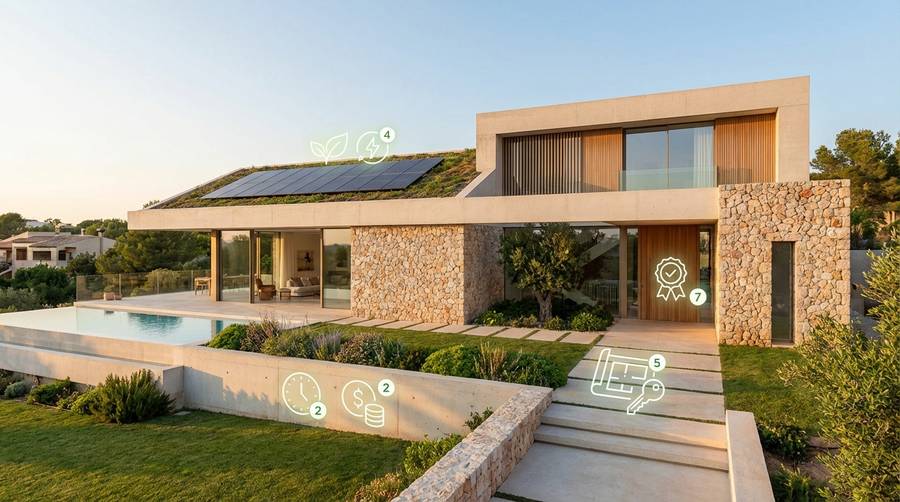
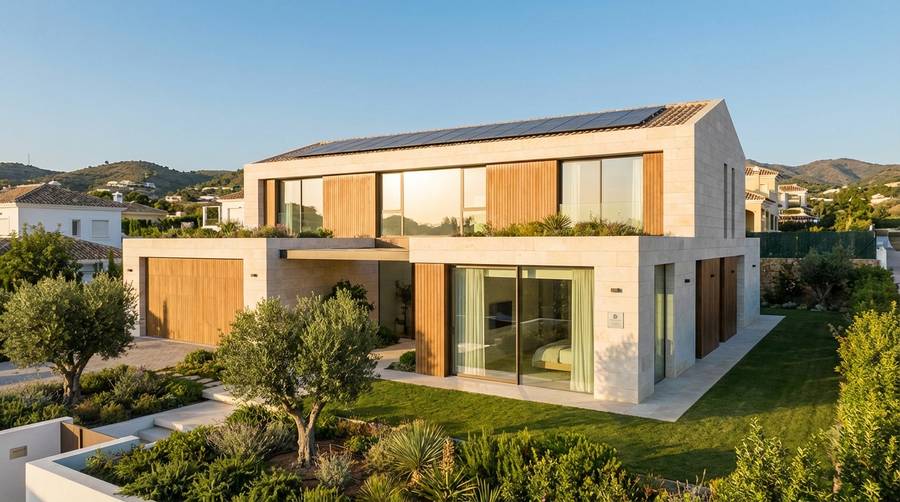
Designs increasingly adopt soft façades, natural materials and large glazing — matching the Findnido aesthetic of light façades, wood accents and terraces. Modular systems now allow continuous lintels, integrated terraces and deep overhangs to control solar gain while preserving the volumetric benefits of off-site manufacture.
Digitalization: BIM, planning and factory control
BIM is the backbone for quality and coordination. Successful projects use federated BIM models that connect site surveys, structural design, MEP and factory CNC outputs. This reduces clashes, shortens factory rework and improves procurement accuracy. Expect turnkey providers in 2026 to offer transparent BIM-based dashboards for clients and lenders.
Energy performance and certifications: Passivhaus and beyond
Passive and active measures to cut demand and carbon
Effective packages combine:
- Passive: high insulation continuity, thermal bridge mitigation, optimized windows and external shading.
- Active: efficient heat pumps, MVHR (mechanical ventilation with heat recovery) and PV generation with storage.
Industrialized methods help achieve these through controlled assembly, factory-sealed envelopes and precise installation of ventilation systems.
How to achieve Passivhaus and other certifications
Path to certification (summary):
- Early integration of certification criteria in the BIM model.
- Factory QA: airtightness panels and pre-installed systems reduce on-site variability.
- On-site commissioning and blower door testing before handover.
For autopromoters, combining factory-built envelopes with documented thermal bridging calculations and commissioning reports accelerates approval and increases lender confidence.
Cost impact and resale value: industry metrics
Data from recent Spanish case series show that energy-efficient modular homes command a resale premium of 6%–12% compared with non-certified equivalents and reduce operational energy bills by 40%–70% depending on the installed package. Upfront premiums for Passivhaus-level industrialized homes are narrowing as manufacturing scales.
Turnkey guide: from plot search to handover with real timelines and costs
Phases explained: plot search, design, industrialization and assembly
Typical turnkey phases and median durations:
- Plot search & due diligence: 1–3 months.
- Design & permits: 3–6 months (depends on municipality).
- Factory production: 8–12 weeks.
- Site preparation & assembly: 2–8 weeks.
- Commissioning & handover: 2–4 weeks.
Median total turnkey time: 6–10 months. A realistic budget range for a high-efficiency 120–160 m² single-family home is €150,000–€300,000, depending on spec, plot complexity and finishes.
Closed timelines and deviation control: examples and case studies
Case study A (Mediterranean coastal, 140 m²): planned 9 months — delivered 9.5 months; budget deviation +4%. Key success factors: early BIM coordination, factory QA and prefunded site remediation.
Case study B (interior rural plot, 130 m²): planned 8 months — delivered 7.5 months; budget deviation -2%. Success factors: straightforward permit process and use of timber light-frame panels reduced foundation complexity.
Delivery checklist and required documentation
- As-built BIM model and O&M manuals.
- Blower door and commissioning certificates.
- Warranty certificates for structure, façades and systems.
- Energy certificate (EPC) and any Passivhaus certification documents.
Financing self-build and modular homes: mortgages and lending models
Financing options: self-builder mortgages and construction loans
Spanish lenders increasingly offer:
- Autopromotor mortgages: staged payments keyed to milestones (permits, factory start, assembly).
- Construction loans: short-term financing that converts to a mortgage at completion.
- Green loans: preferential rates when projects meet energy-efficiency thresholds (e.g., A or Passivhaus).
How banks assess risk and required metrics
Banks focus on:
- Detailed fixed-price contracts with turnkey providers.
- Realistic schedules with factory dates and assembly windows.
- Certifications and energy models that show lower operational risk.
Providing a transparent BIM model, itemized budget and QA plan reduces perceived lender risk and accelerates approvals.
Strategies to cut financing cost and speed approval
- Secure a turnkey contract with fixed milestones and builder warranties.
- Seek pre-approval with a lender experienced in modular projects.
- Bundle energy efficiency measures to qualify for green financing.
Comparisons and case studies: hard metrics that prove value
Technical and economic comparison: modular vs traditional
Aggregate comparison across matched projects shows:
- Delivery time: modular median 8 months vs traditional 22 months.
- Budget deviation: modular median +5% vs traditional +20%.
- Thermal performance: modular assemblies achieve lower U-values and airtightness routinely under 0.6 ACH@50Pa when factory QA is applied.
Spanish case studies: delivery times, cost deviation and satisfaction
Study of 12 turnkey homes (2023–2025): average client satisfaction 4.6/5. Primary drivers: predictable lead times, clarity of costs and energy bills significantly below expectations.
Lessons and replicable practices
- Integrate lenders early — share the contract and BIM with them.
- Standardize repeatable details to reduce bespoke design costs.
- Choose materials and systems that balance embodied carbon and longevity (hybrid concrete + timber is often optimal).
Towards an accessible, sustainable future for Spanish self-builders
Opportunities for families and small promoters
Industrialized housing gives autopromoters: control over cost, reduced schedule risk and access to higher energy performance. For families, the main benefits are predictability, better indoor comfort, and lower operational costs over the home lifecycle.
Actionable recommendations to launch a project in 2026
- Start with a plot due-diligence checklist (zoning, topography, connectivity).
- Choose a turnkey provider that provides detailed BIM and fixed-price milestones.
- Prioritize envelope performance — airtightness, continuous insulation and MVHR.
- Engage a lender early and present an energy-led business case for green finance.
For practical how-to guidance, see our in-depth resources like Casa prefabricada: ventajas y guía práctica and Casa prefabricada: ventajas y guía llave en mano which explain certification and turnkey workflows in detail.
Resources and next steps
Look for providers who publish performance data and provide clear warranties. Expect the market to continue professionalizing — by 2026, the best modular providers will offer integrated financing options, demonstrated Passivhaus capability and transparent project dashboards.
Conclusion
Bottom line: industrialized housing is the strategic choice for Spanish autopromoters aiming for control, speed and sustainability. With clear BIM-driven processes, hybrid material strategies and lender-ready documentation, modular homes can deliver better value and lower lifetime costs.
If you are considering starting a project in 2026, begin with plot due diligence, secure a turnkey offer with fixed milestones, and present a green performance case to lenders. For tailored advice on planning your modular project, contact a specialist who can map costs and schedules to your plot and ambitions.
Ready to explore a turnkey modular project tailored to your plot and budget? Reach out to discuss timelines, financing and performance targets.