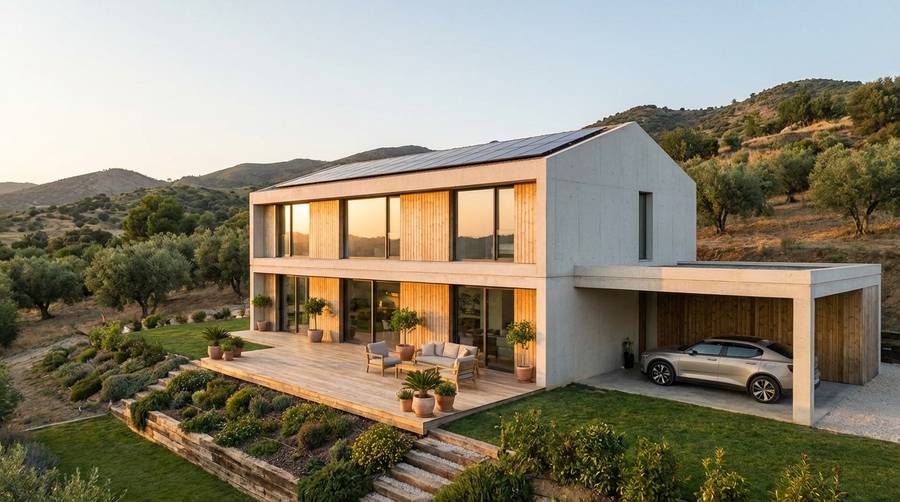
Industrialized Housing vs Traditional Homes: Pros and Cons
Introduction — a clear hook for self-builders
Building a home is the largest investment most people make. For Spanish self-builders (autopromotores), choosing between an industrialized home and a traditional in-situ build can determine costs, schedule, energy use and the house's lifetime carbon footprint. This article cuts through marketing claims and gives actionable criteria, real metrics and a decision checklist so you can choose the route that matches your priorities.
Industrialized housing can reduce on-site time by 50% and construction waste by up to 70%, while offering fixed-price contracts that protect budgets — but material choices drive the final carbon balance.
Why consider industrialized housing in Spain today
What industrialized housing is and its role in emissions reduction
Industrialized housing means manufacturing significant building elements off-site in a controlled factory environment, then assembling them on the plot. This production model enables tighter tolerances, reproducible quality, and simplified logistics. When paired with low-embodied-carbon materials and energy-efficient design (e.g., Passivhaus principles), industrialized homes can materially reduce the constructive carbon footprint compared with conventional builds.
General advantages vs traditional construction
- Predictable schedules: Parallel factory production and site work shorten total delivery time.
- Fixed or more predictable pricing: Factory quotes often limit on-site surprises that inflate costs.
- Quality control: Factory processes standardize tolerances and reduce defects.
- Lower waste: Lean manufacturing and reuse of offcuts reduce material waste and disposal costs.
What to expect from this article
This is a comparative, data-focused guide. You will find: realistic timelines, cost and risk analysis, material-level carbon discussion, Passivhaus integration strategies, a turnkey (“llave en mano”) process map for autopromotores, financing options and a practical decision checklist.
Comparative analysis: prefabricated (industrialized) vs traditional houses
Realistic construction timelines: factory vs on-site
Typical timelines (Spain, recent projects):
- Industrialized (panelized/volumetric): design to handover ~6–12 months once permitting is granted.
- Traditional in-situ: design to handover typically 12–24 months, often extended by weather and subcontractor schedules.
Explanation: while factory lead times exist, they run in parallel with foundation and site works. The on-site assembly window for an industrialized house is often weeks rather than months, reducing exposure to weather delays and on-site management needs.
Costs and economic risk: fixed price vs variability
Cost profile differences:
- Industrialized: higher initial factory costs may be offset by lower labour risk, shorter financing interest and fewer change orders. Many providers offer fixed-price contracts that include production, transport and assembly.
- Traditional: typically lower unit prices for some materials but higher exposure to cost overruns from delays, market price volatility and unforeseen site issues.
Actionable tip: request itemized cost breakdowns and a clear change-order policy. Compare total cost of ownership (construction cost + interest during build + likely defect rectification) rather than headline €/m² alone.
Construction quality and risk of defects
Quality drivers: Factory conditions control humidity, curing and tolerances, which reduces drying defects, shrinkage and workmanship variability. On-site work remains necessary for foundations, utilities and finishes — these remain risk points.
Ask for factory quality certificates, dimensional tolerance reports and photos of assembly tests. A pre-delivery inspection (PDI) checklist with the manufacturer is essential.
Materials and their impact on embodied carbon
Industrialized concrete: pros and emissions strategies
Precast and industrialized concrete deliver durability and thermal mass advantages. However, cement production drives high embodied CO2. To lower impact:
- Specify low-clinker cements and supplementary cementitious materials (SCMs) like fly ash or blast-furnace slag when regionally available.
- Use optimized structural design to minimize volume without compromising resilience.
- Prefer locally sourced aggregates and precast factories near the site to cut transport emissions.
Light timber framing: carbon sequestration and longevity
Cross-laminated timber (CLT) and light timber frames store biogenic carbon and typically have lower embodied emissions per m² than concrete or steel. Key considerations:
- Ensure sustainable chain-of-custody certification (FSC, PEFC).
- Design for moisture control and maintainability to avoid decay risks.
- Combine with durable exterior cladding and detailing suitable for Spanish climates.
Steel frame and hybrid systems: trade-offs
Steel frame offers high precision and thin structural sections, enabling flexible layouts. Steel’s embodied carbon can be higher than timber, but recycled steel and efficient design reduce net impact. Hybrid solutions (concrete foundations, timber superstructure, localized steel reinforcements) often balance cost, performance and carbon.
Energy efficiency and certifications: design through operation
Applying Passivhaus strategies to industrialized homes
Passivhaus principles (high insulation, airtightness, thermal-bridge-free details and controlled ventilation) integrate well with factory production. Factory-made panels or modules allow pre-validated junctions and airtightness features that are harder to achieve consistently on site.
- Prioritize continuous insulation detailing at factory joints.
- Factory-fitted triple-glazed units reduce on-site sealing errors.
- Measure and guarantee airtightness at handover (blower-door test).
Operational consumption and emissions
Lower operational energy reduces lifetime carbon more than small differences in embodied carbon. Pair industrialized construction with solar PV, heat pumps and efficient appliances to minimize operational emissions. Run simple life-cycle scenarios comparing expected operational energy (kWh/year) multiplied by Spain’s grid carbon factor for realistic estimates.
Evaluation tools: LCA and regulatory context
Request an LCA (life cycle assessment) or at least an EPD (environmental product declaration) for structural systems. Spain’s growing regulatory focus on embedded emissions means lenders and municipalities increasingly accept quantified assessments when prioritizing permits or incentives.
Turnkey process (“llave en mano”) for self-builders in Spain
From plot to handover: phases and responsibilities
A typical turnkey path:
- Feasibility and site survey: topography, access, utilities and constraints.
- Design and permit package: architectural design, structural engineering, CTE compliance and local permit submission.
- Factory production and site preparation: foundations and off-site module/panel fabrication.
- Assembly and finishes: on-site assembly, MEP installation, and interior finishes.
- Testing and delivery: commissioning systems, airtightness and final inspection.
In a true turnkey contract the manufacturer coordinates most stages and delivers a ready-to-occupy home. Clarify exactly which permits, site works and connections are included.
Practical aspects: permits, urban planning and final delivery
Permitting remains the promoter’s responsibility in many turnkey offers. Ensure urbanistic requirements (buildability, setbacks, volumetry) are confirmed before committing. Budget for utility connection fees and impact taxes; these vary by municipality.
Short case studies with metrics
Example A (panelized timber home, Andalusia): total delivery 9 months from permit approval; on-site assembly 3 weeks; final cost €1,650/m²; homeowner satisfaction survey: 9/10 for schedule reliability.
Example B (precast concrete hybrid, Catalonia): delivery 11 months; on-site assembly 6 weeks; cost €1,900/m²; measured airtightness 0.4 ACH@50Pa after commissioning. These examples illustrate typical ranges — always ask providers for recent, comparable project data.
For further in-depth success stories see Vivienda industrializada: caso real de éxito sostenible.
Financing and mortgages for self-construction and modular homes
Financing options: construction loans and specialized products
Common options:
- Construction-to-permanent loans: funds disbursed in stages during build, converting to a mortgage at completion.
- Specific modular/mfg home loans: some banks offer tailored products for factory-built homes, often requiring EPDs or manufacturer warranties.
- Developer or manufacturer financing: limited offers that may bundle costs but require careful contract review.
Bank criteria and required documentation
Banks will request a detailed budget, construction schedule, company solvency credentials, permits and often a technical report. Present manufacturer warranties, testing guarantees (airtightness, thermal performance) and references to speed approval.
Practical tips to secure finance
- Obtain fixed-price quotes and a clear build programme to limit lender perceived risk.
- Use manufacturers with bankable track records and insurance-backed warranties.
- Prepare a contingency buffer: lenders often expect a 5–10% reserve for unforeseen items.
How to decide: checklist to minimize your carbon footprint and risk
Key comparison criteria
- Embodied impacts: request LCAs or EPDs for major systems.
- Operational efficiency: designed performance numbers (kWh/m²·yr), HVAC strategy and airtightness target.
- Cost and schedule certainty: fixed-price clauses, liquidated damages and delivery milestones.
- Maintainability and durability: expected service life and material resilience in your climate.
Essential questions to ask providers
- Can you provide recent LCA/EPD data for this house type?
- What is included in the turnkey price — foundations, utility connections, landscaping?
- What guarantees do you provide for airtightness and thermal performance?
- Do you have bank references or projects financed by Spanish lenders?
Recommendation by autopromoter profile
- On a tight schedule: industrialized options reduce on-site time and schedule risk.
- Priority on lowest embodied carbon: timber systems with proven LCA, combined with solar and efficient systems.
- Budget-sensitive but risk-averse: choose a fixed-price turnkey industrialized supplier with transparent scope.
Conclusion — balanced final assessment and next steps
Summary of pros and cons
Industrialized housing delivers better schedule certainty, lower site disturbance, and potential reductions in waste and defects. Its carbon advantage depends strongly on material selection and logistics. Traditional builds can be competitive where local labour and materials are inexpensive and complex site conditions favor in-situ solutions.
First practical steps
Start with a site feasibility and a comparative brief: obtain two turnkey industrialized quotes (different structural systems if possible) and one traditional contractor estimate. Ask for LCA/EPD data, airtightness targets and proven delivery timelines. Prioritize suppliers who accept third-party performance verification.
For a real-case benchmark, review our documented project: Vivienda industrializada: caso real de éxito sostenible, which includes measured timelines, costs and client feedback.
Ready to take the next step? If you’re evaluating options for a self-build in Spain, gather a preliminary brief (plot, desired size, budget range) and request two turnkey proposals with LCA data — then compare them against a traditional estimate. Contact a reputable industrialized provider for a feasibility call to clarify scope and financing paths.
Contact us if you’d like a template brief for soliciting comparable quotes or assistance interpreting LCA reports.
Artículos relacionados
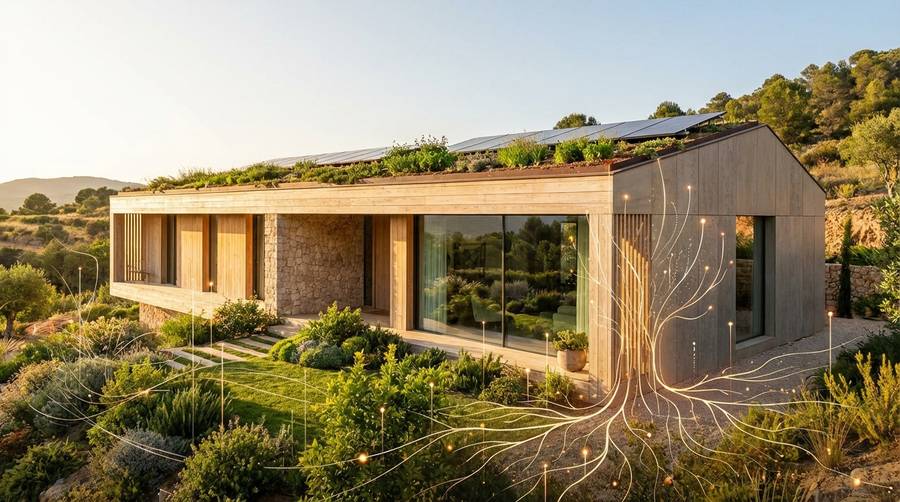
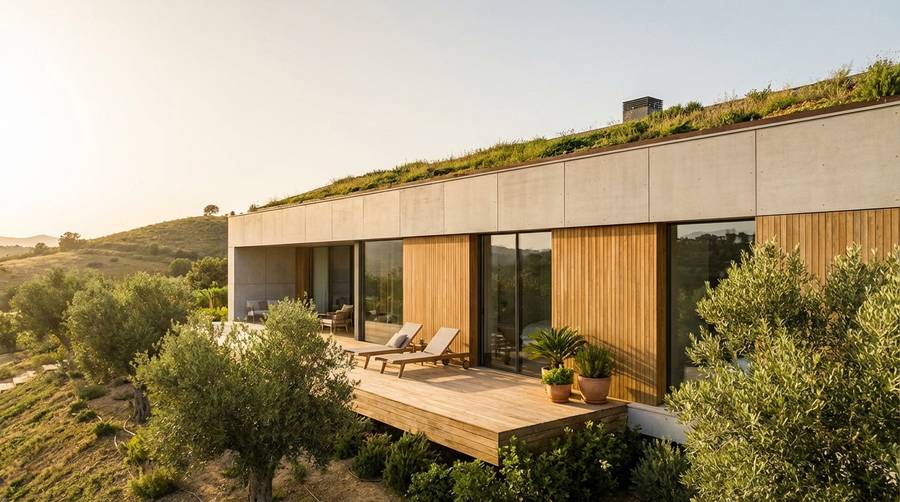
Industrialized Housing Success: Low-Carbon Home
A Spanish self-builder turned an empty plot into a high‑performance modular home that cut embodied carbon and met Passivhaus‑level efficiency — delivered on time and on fixed price. This case study walks through decisions, metrics and practical lessons to replicate the success.