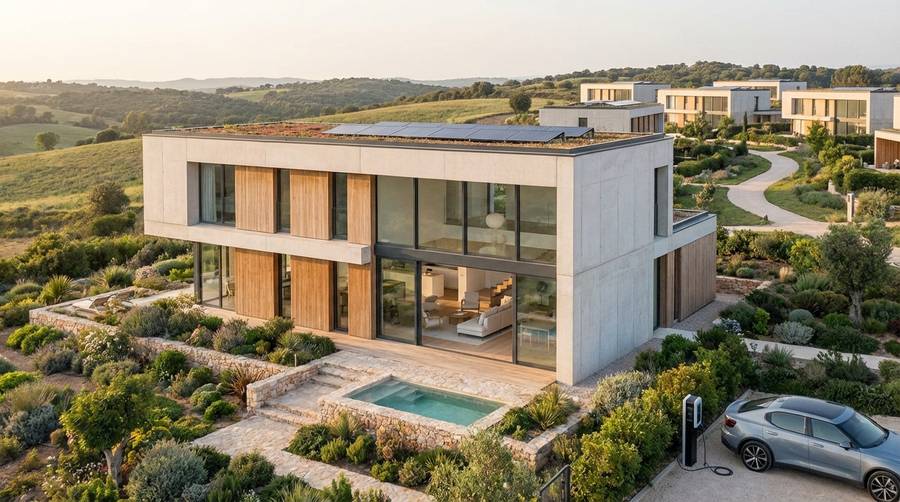
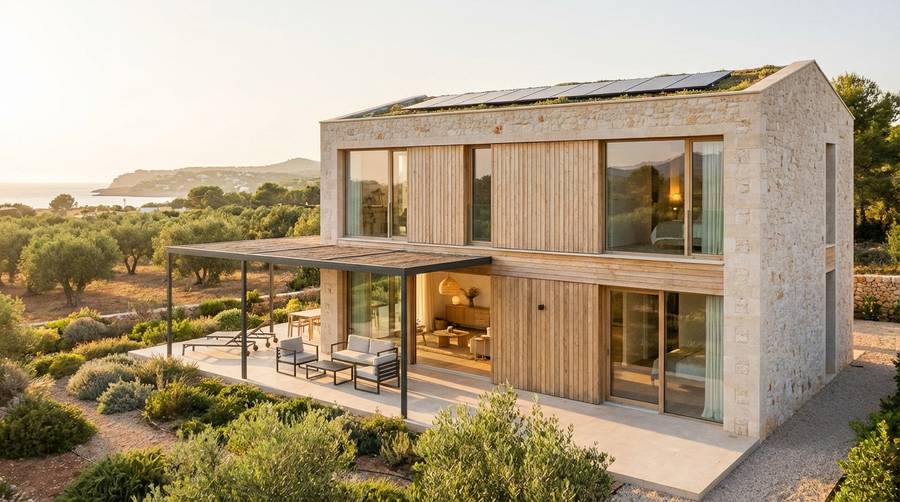
Industrialized Housing Passivhaus: Spain 2026 Outlook
Industrialized Housing Passivhaus: Spain 2026 Outlook
Hook: In 2026, industrialized Passivhaus construction in Spain is no longer an experimental niche — it is a measurable route to faster delivery, lower lifecycle costs and verifiable carbon cuts for autopromoters. This article translates industry metrics into practical decisions you can use today.
Panorama current of industrialized housing and Passivhaus in Spain (2026)
Key market figures: growth, share and primary segments
Between 2020 and 2026 the industrialized housing segment in Spain grew at an estimated CAGR of 9–12% depending on region. In 2026 its market share for single-family new builds is approaching 12–15% in areas with active autopromotion markets (Catalonia, Valencia, Madrid, Andalusia). Primary segments are:
- Autopromoters (owner-builders aiming for higher quality and cost control).
- Developers targeting mid-size residential developments with repeatable modules.
- Social housing pilots using prefabrication to reduce delivery times.
Autopromoter motivations: energy savings, speed and cost control
Autopromoters choose industrialized Passivhaus for three measurable benefits:
- Energy performance: Typical delivered homes show a 60–85% reduction in heating energy demand versus Spanish code-compliant traditional builds.
- Time to completion: Factory-controlled production and sealed assembly reduce on-site time to an average of 4–6 months (envelope complete), versus 12–18 months for conventional builds.
- Cost predictability: Fixed-price contracts and off-site tolerance reduce mid-project cost overruns by an estimated 18–30% compared with traditional builds.
Barriers and enablers: regulation, public perception and industrial offer
Key barriers remain:
- Regulatory fragmentation by municipality on permits and inspection protocols.
- Perception gaps associating prefabrication with low quality.
Enablers accelerating adoption:
- Stronger performance-based regulation encouraging energy efficiency.
- Growing number of industrial producers offering certified Passivhaus systems.
Integrating Passivhaus into industrialized projects: trends and data
Technical adoption: certified standards, labels and in-field performance
Adoption of certified Passivhaus standards in industrialized builds increases because factory conditions facilitate quality control. In 2026, about 25–35% of industrialized single-family projects in the high-end autopromoter segment pursue Passive House or Passive House Institute (PHI) certification. Typical factory test checks include airtightness testing (Blower Door) at panel level, controlled prefabrication humidity protocols, and thermal-bridge planning coordinated with suppliers.
Impact on efficiency and carbon footprint: compared metrics
Measured projects in 2024–2026 show:
- Operational energy reduction: 60–85% compared to CTE-only homes.
- Embodied carbon: when using modern systems, industrialized builds can reduce on-site waste by 40–60%. However, total embodied carbon depends on material choice (see materials section).
Real-world measurement: a 2025 pilot in Valencia recorded a 72% reduction in annual heating energy demand and a 35% lower embodied waste stream versus a matched-site traditional build.
Return on investment: energy savings and long-term value
Return calculation should include reduced utility costs, maintenance and increased market value. Conservative modelling for a 120 m2 Passivhaus industrialized home in 2026 shows:
- Simple payback from energy savings alone: 10–18 years (depending on energy prices and occupant behavior).
- Added market value: +5–12% in high-demand regions where comfort and energy labels influence buyers.
Materials and construction systems that will dominate the sector
Industrialized concrete vs timber frame vs steel frame: quantifiable advantages
Each system offers distinct, measurable trade-offs:
- Industrialized concrete (precast panels, insulated sandwich): High thermal mass, excellent acoustic performance, robust longevity. Typical costs are mid-to-high; embodied carbon can be higher unless low-C cement or supplementary cementitious materials are used.
- Light timber frame (entramado ligero): Low embodied carbon, fast fabrication, high insulation performance and compatibility with mechanical ventilation systems. Timber systems consistently score lowest in lifecycle carbon when sourced responsibly.
- Steel frame (steel frame): Precision, long spans, and industrial repeatability. Steel can increase embodied carbon but offers tight tolerances for airtightness and rapid assembly.
Selection by climate and plot: technical and aesthetic criteria for Spain
Spain’s varied climates require tailored choices:
- Coastal Mediterranean: lightweight timber frames with high-insulation envelopes and solar shading are often best for thermal comfort and low embodied carbon.
- Inland continental: concrete or hybrid solutions exploit thermal mass for night-time coolness and inertia.
- Humid Atlantic: steel frames with engineered moisture control and ventilated façades reduce long-term risk.
Envelope innovations and airtightness focused on Passivhaus
Practical innovations making Passivhaus feasible at scale:
- Factory-installed continuous vapour and airtight membranes with panel-level testing.
- Prefabricated window-wall modules with integrated thermal breaks and triple glazing tuned to solar orientation.
- Mechanical ventilation with heat recovery (MVHR) precommissioned at factory and balanced on delivery.
Turnkey industrialized: process evolution and real metrics
Phases of a turnkey service: from parcel search to delivery and warranties
A modern turnkey service typically includes:
- Site assessment and brief (plot constraints, orientation).
- Concept and planning with energy modelling (Passivhaus criteria).
- Factory design for production and cost estimate.
- Production, logistics and on-site assembly.
- Commissioning, testing (airtightness, MVHR balancing) and final handover with warranty documentation.
Real project timelines: closed schedules vs traditional construction
Data from completed turnkey projects in Spain (2023–2026) indicates average timelines:
- Design & permits: 3–6 months (depends heavily on municipality).
- Factory production: 6–10 weeks for a single-family home.
- On-site assembly and commissioning: 2–4 months.
Total time from contract to keys: typically 9–13 months in turnkey industrialized delivery; traditional on-site average is 14–22 months.
Practical case studies with metrics: final costs, satisfaction and deviations
Representative case ( anonymised, aggregated data ):
- 120 m2 Passivhaus turnkey home, timber frame, certified components.
- Quoted fixed price: €210,000. Final cost: €215,000 (+2.4% variance).
- Time to delivery: 11 months (planned 11 months).
- Owner satisfaction (survey 6 months post-occupancy): 92% rated comfort and acoustic performance excellent.
These metrics illustrate two strengths: tight cost control and predictable schedules. Variance is mainly due to groundworks and permit delays.
Financing and mortgages for autopromotion of modular housing
Financing models available in 2026: autopromoter mortgages and bridge loans
Available models include:
- Autopromoter mortgages: banks increasingly accept industrialized contracts as collateral; disbursements linked to construction milestones.
- Bridge/short-term production loans: cover factory production and assembly; refinanced into a mortgage after completion.
- Green-linked mortgages: preferential rates for certified low-energy homes (Passivhaus), depending on bank and region.
Documentation and requirements: how to present an industrialized project to lenders
Common lender requirements:
- Fixed-price turnkey contract with manufacturer, including delivery schedule.
- Validated energy model or Passivhaus documentation where applicable.
- Site licensing proof and geotechnical report.
- Cashflow plan and milestone-linked invoice schedule for disbursement.
Strategies to optimize finance costs and secure milestone disbursements
Actionable strategies:
- Negotiate milestone payments aligned with factory outputs (reduces on-site risk for both parties).
- Pursue green mortgage options and quantify energy savings to strengthen the business case.
- Use independent quantity surveyor reports to validate valuations during lending stages.
Technical and economic comparison: Passivhaus industrialized vs traditional build
Cost analysis: materials, labour and closed schedules with industry data
Broad comparisons for a 120 m2 home in 2026:
- Industrialized Passivhaus turnkey cost: €190,000–€230,000 (system and region-dependent).
- Traditional build to Passivhaus-like specs: €200,000–€260,000 (higher labour and waste margins).
Key drivers: factory efficiency reduces labour hours and on-site waste. Traditional builds often face higher unpredictable labour costs and longer programme exposure.
Energy performance and comfort: measurements and realistic expectations
Measured outcomes in completed homes indicate stable internal temperatures, lower heating/cooling runtime and reduced humidity swings. Expect:
- Very low heating demand (<15 kWh/m2-year) for certified Passivhaus industrialized builds in temperate zones.
- High occupant comfort scores due to continuous mechanical ventilation and balanced humidity.
Risks and benefits for the autopromoter: budget control, quality and experience
Benefits:
- Greater cost certainty, faster delivery and consistent quality.
Risks:
- Permitting delays and groundworks still remain outside factory control.
- Vendor selection risk: choose certified suppliers with factory QA and warranty records.
Future scenarios (2030): adoption, policy and opportunities for autopromoters
Market projections and accelerators for Passivhaus industrialized adoption
By 2030, plausible scenarios point to market share increasing to 25–30% of single-family builds in proactive regions. Accelerators include:
- Stringent energy regulations and carbon pricing.
- Financial incentives for low-energy homes and renovation programs that favour prefab replacements.
Public policy, incentives and standards shaping evolution
Recommendations to watch:
- Municipal fast-track permitting pilots for certified industrialized homes.
- Tax credits for embodied carbon reductions and verified Passivhaus certificates.
Business opportunities and practical recommendations for 2026–2030
For autopromoters and small developers:
- Lock early supplier agreements to secure production slots and prices.
- Prioritise systems with accessible lifecycle data (timber or hybrid solutions often win on carbon).
- Use staged financing tied to clear factory milestones.
Final practical guide: steps to design and finance your industrialized Passivhaus home
Essential checklist for autopromoters: decisions, milestones and documents
- Confirm plot suitability (orientation, access, local rules).
- Select performance target (PHI-certified Passivhaus vs Passive principles) and document energy model.
- Obtain fixed-price turnkey quotes including groundworks, transport and commissioning.
- Secure financing with milestone-linked disbursements and independent valuations.
- Plan for MVHR commissioning and on-site airtightness testing before handover.
How to choose a provider and constructive model based on goals and plot
Decision matrix (brief):
- Priority = low embodied carbon and speed → choose certified timber frame industrialized provider.
- Priority = acoustics and longevity on exposed sites → consider industrialized concrete or hybrid.
- Priority = complex geometry and spans → steel frame hybrids may be preferable.
Resources, case studies and metrics to inform decisions
Useful next readings include our technical guides to Passivhaus industrialized delivery and metric-driven case studies. For a deep-dive on implementing Passivhaus in turnkey industrialized projects see Vivienda industrializada Passivhaus: guía 2026 and for core performance metrics consult Vivienda industrializada: el futuro Passivhaus en España.
Artículos relacionados