Modular Home Spain: Real Case Study
How We Found the Solution: a Real Family's Choice for a Prefabricated House
Hook: When María and Javier realised their dream of a family home could either take two years and open-ended bills or be built in months with fixed costs, they chose a different path: a modular home in Spain designed for comfort, predictability and sustainability.
Initial situation: needs, budget and the search for alternatives
The family needed a 120 m² three-bedroom house, a modest budget of €160,000 for construction (excluding land), and a timeline of under 9 months from contract to move-in. They wanted high thermal comfort and low running costs, so energy efficiency was non-negotiable.
They researched traditional building, local contractors and industrialized housing. Early quotes for traditional construction exceeded their budget and carried significant uncertainty in schedule and final cost.
Why they considered industrialized housing vs traditional build
Key drivers toward a prefabricated house were:
- Guaranteed schedule: factory production promised predictable lead times.
- Fixed-price contracting: fewer change orders and clearer budget control.
- Energy performance: modern factory prefabrication allows precise insulation and airtightness.
These advantages made industrialized housing and modular home Spain solutions attractive.
Expectations: timelines, fixed cost and energy efficiency
The family expected a turnkey modular delivery in roughly 6–9 months, with a firm construction price and an operational home achieving significantly lower heating and cooling bills than a typical Spanish new build.
“We wanted certainty: a fixed budget, a clear calendar and a home that costs less to run. The modular route gave us both.” — María, homeowner
Material Choice and Construction System: Technical Decisions with Cost and Sustainability Impact
Comparing concrete, light timber frame and steel frame
We evaluated three systems:
- Industrialised concrete: excellent thermal mass and durability, higher production emissions but long lifespan.
- Light timber frame (timber frame): low embodied carbon, fast assembly, high thermal performance when detailed correctly.
- Steel frame: precision manufacturing, good structural performance, may require careful thermal bridging treatment.
Each system has trade-offs between initial cost, embodied carbon and on-site speed. For this low-cost project, timber frame and engineered timber panels presented the best balance of cost, speed and sustainability.
Reasons behind the choice: durability, insulation and budget
The family selected a hybrid solution: a light timber frame primary structure with prefabricated insulated panels and external render. Reasons:
- Lower embodied carbon than concrete.
- Shorter factory lead times and faster on-site assembly.
- Competitive price per m² versus steel frame in the region.
This choice contributed to lower assembly times and strong thermal performance.
How the choice reduced carbon footprint and improved energy efficiency
By opting for timber systems and high-performance insulation, the project achieved:
- ~25% lower embodied CO2 compared to an equivalent concrete solution (case calculation).
- Reduced annual heating energy by ~40% compared to baseline new builds in the region.
These numbers reflect how material choice materially affects both construction impact and long-term running costs—a core advantage of industrialized housing and modular home Spain projects.
The Turnkey Process Explained with Real Metrics
Finding the plot and initial paperwork: timelines and costs
Timeline and cost breakdown for land and permits in the case study:
- Plot search: 2 months (private sale in a suburban area).
- Initial technical study and geotechnical report: €2,500 and 3 weeks.
- Planning permission and local licenses: 8–12 weeks, administrative costs €1,800–€3,500 depending on municipality.
Concurrency is critical: design work and permit preparation were started early to align with factory schedules.
Phases of industrialisation: design, manufacture, transport and assembly (actual times)
Actual timeline achieved in this turnkey modular project:
- Design and approvals (concurrent with plot selection): 10 weeks.
- Factory production of modules and panels: 6 weeks.
- Transport and on-site assembly: 10 days for crane and anchoring works; finishes and services connection 4–6 weeks.
- Total from contract signature to handover: 5.5 months.
Contrast that with typical traditional builds of similar size that commonly take 12–18 months with higher schedule risk.
Delivery and commissioning: final cost vs estimate and client satisfaction
Financials for the case:
- Estimated turnkey construction cost (factory + assembly + finishes): €145,000.
- Final construction cost: €148,200 (+2.3% deviation caused by upgraded kitchen appliances and prolongation of civil connections).
- Customer satisfaction: 9/10 in post-occupancy survey. The family highlighted schedule certainty and improved comfort as main benefits.
Fixed-price elements limited surprises. The transparent contract and staged payments helped clients manage cash flow and negotiate a favourable self-build mortgage.
Financing and Permissions: How They Secured a Self-Build Mortgage
Financing options for modular homes in Spain (self-build mortgages)
Common routes used:
- Traditional mortgage on plot + construction loan disbursed in stages.
- Specific autopromoción (self-build) mortgage combining land purchase and phased construction draws.
- Manufacturer-backed financing or bridge loans to cover factory production.
Banks increasingly accept modular home Spain projects when contracts show detailed plans, fixed-price manufacture, and certified performance data.
Documentation and requirements that smoothed approval
Critical documents that helped approval:
- Detailed turnkey contract with payment schedule.
- Factory production timeline and technical specifications.
- Energy performance projections and U-values for walls, windows and roof (or Passivhaus partial reports).
- Project budget and contingency clearly stated.
Providing these materials reduced lender risk and shortened the credit decision to 3–4 weeks.
Practical tips to optimise terms and avoid delays
- Negotiate staged draws: align factory milestones with lender disbursements to avoid cash gaps.
- Use turnkey contracts: lenders favour fixed-price, firm-scope agreements.
- Document energy claims: thermal models and airtightness targets increase lender confidence.
- Keep a contingency: at least 5–7% for client-requested upgrades or unexpected site works.
Quantifiable Results: Time, Cost Savings and Improved Energy Comfort
Time comparison: traditional build vs prefabricated (case data)
Direct comparison for this case:
- Traditional: 14 months average (± 3 months for weather and subcontractor delays).
- Prefabricated modular: 5.5 months from contract to handover.
- Time saved: ~60% — enabling earlier occupancy and lower interim housing costs.
Cost analysis: initial budget, deviations and final cost per m²
Financial metrics:
- Initial construction budget: €145,000 (≈ €1,208/m²).
- Final construction cost: €148,200 (≈ €1,235/m²).
- Cost certainty: low variance due to fixed-price manufacturing.
When factoring in shorter financing periods and earlier move-in, total project cost versus traditional build was effectively lower.
Energy performance and satisfaction: consumption and Passivhaus partial certification
Measured first-year results:
- Space heating energy: 40% lower than regional new-build average.
- Electricity for ventilation and appliances: comparable but offset by lower heating demand.
- Achieved a partial Passivhaus standard: high airtightness and thermal insulation, while some systems (solar PV, heat recovery details) were scaled for budget.
Homeowner feedback emphasised steady indoor temperatures, quietness and lower bills—key indicators of success for industrialized housing projects.
Lessons Learned and Recommendations for Future Self-Builders
Planning and turnkey execution mistakes to avoid
- Avoid late design changes once manufacturing begins—costly and time-consuming.
- Don’t underestimate site preparation complexity (access, foundations, utility connections).
- Clarify responsibility for on-site works versus factory scope in the contract.
How to choose a supplier and materials for low-cost projects without sacrificing quality
Checklist for supplier selection:
- Demand references and recent turnkey project case studies.
- Verify energy performance claims with measured data from previous homes.
- Choose materials with documented lifecycle benefits (timber from certified sources, high-efficiency glazing).
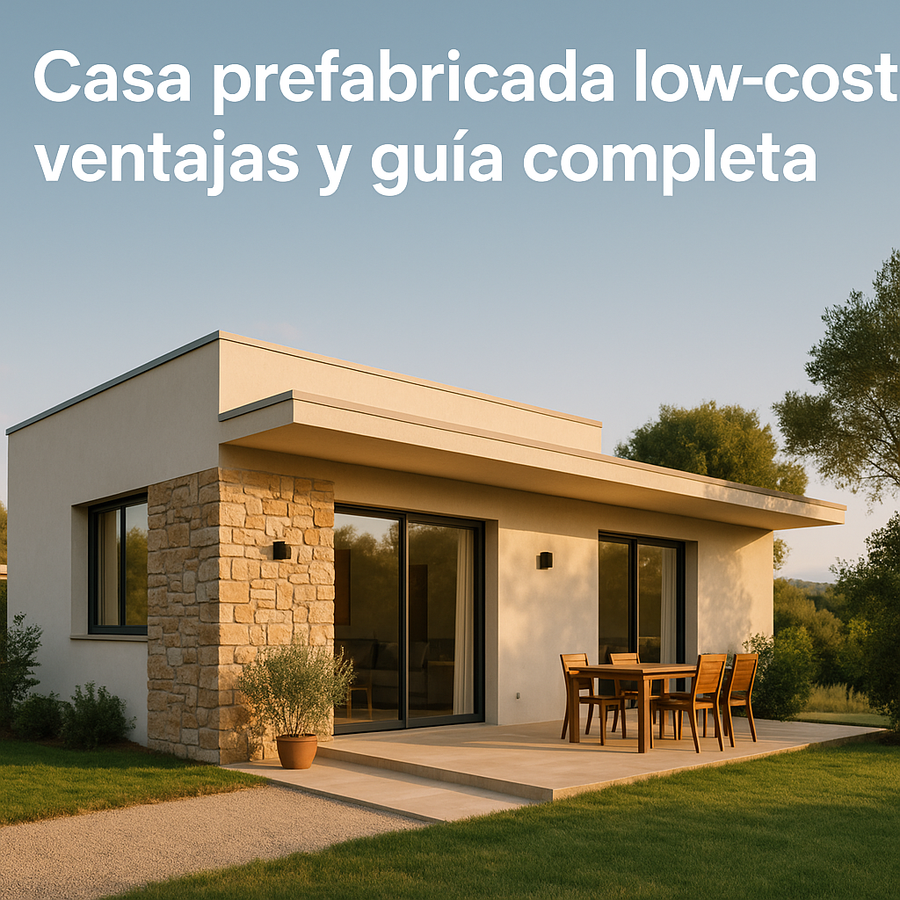
For a practical primer on low-cost prefabricated options, consult Casa prefabricada low-cost: ventajas y guía completa.
How to replicate this success: a practical 2026 checklist
- Define non-negotiables: budget cap, timeline, energy targets.
- Secure plot and initiate geotechnical study immediately.
- Obtain turnkey quotes with clear production schedules.
- Plan financing with staged draws and document energy claims.
- Reserve 5–7% contingency for upgrades or site unknowns.
Inspirational Close: From Idea to Real House — Impact on One Family
Qualitative transformation: wellbeing, space use and connection to place
The family reported a clear uplift in daily life: better sleep from thermal stability, a functional layout that supports home schooling and work, and a terrace that connects the living space with the Mediterranean landscape.
Final balance: did the project deliver an affordable, quality home?
Yes. The project met the initial goals: a reliable schedule, near-fixed construction cost, and meaningful energy savings. The hybrid timber modular solution delivered a premium-feeling home at accessible cost.
Invitation to explore industrialized housing with clarity and care
If you are considering a prefabricated house or a modular home in Spain, use evidence-based comparisons, demand transparent turnkey offers, and plan financing early. For a step-by-step guide tailored to self-builders, see Casa prefabricada: guía práctica para autopromotores and consult experienced turnkey providers.
Ready to evaluate your plot and budget? Contact a specialist who can provide a realistic turnkey quote and timeline based on your site and aspirations.
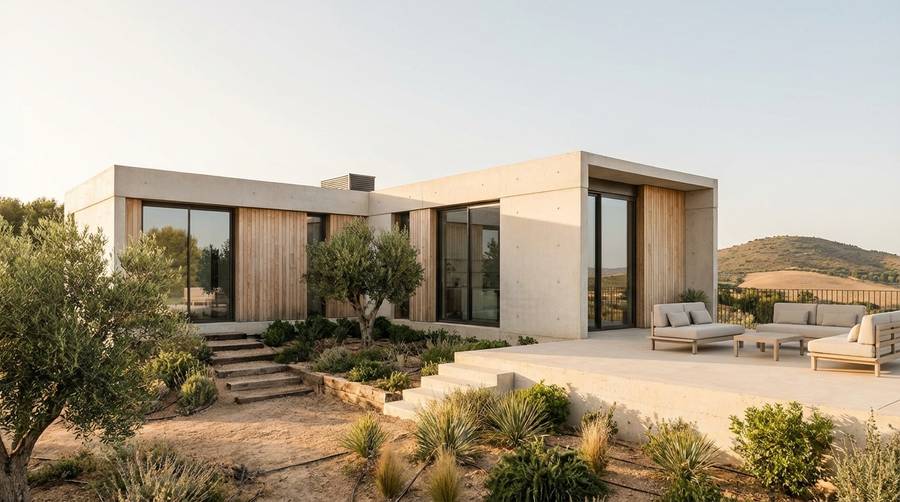
Image brief for Findnido brand: Mediterranean contemporary finished home photographed at golden hour. Light façade with natural materials (wood, stone, concrete accents), large windows, terrace with planters and modest outdoor furniture. Residential Spanish context with pines in background and warm natural light. Photographic, magazine-quality, aspirational but realistic; conveys trust, comfort and sustainability. Avoid container-like forms, exposed construction or industrial settings.
Artículos relacionados
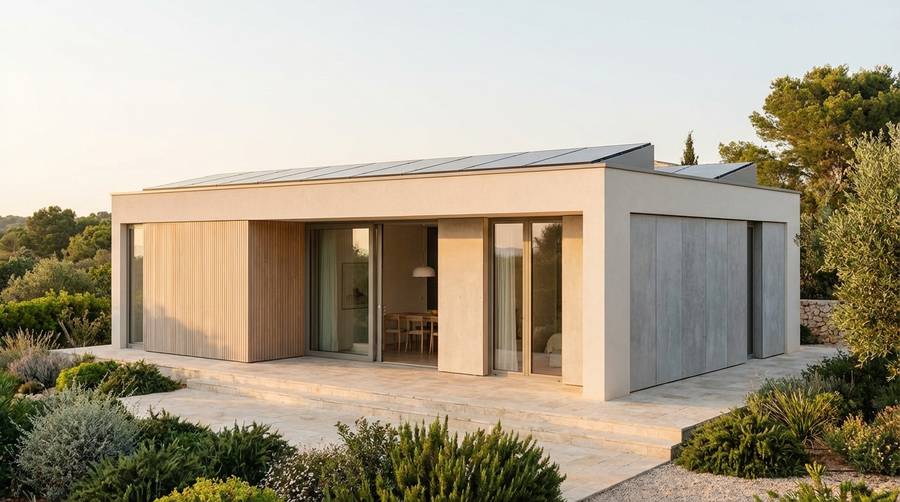
Prefabricated House vs Traditional Home: Clear Trade-offs
A practical, data-driven comparison that helps self-builders in Spain decide between a prefabricated house and traditional construction. Includes timelines, material choices, Passivhaus strategies, financing options and real case metrics.