Industrialized Housing: Complete Guide for Self-Builders
Why industrialized housing is the opportunity for your self-build
Hook: If you want faster delivery, predictable costs and high energy performance for your new home in Spain, industrialized housing gives you those advantages when executed correctly.
Industrialized housing (also referred to as modular homes or a prefabricated house) is no longer an emerging niche. For autopromoters who value time, budget control and sustainability, it is a compelling alternative to traditional on-site construction.
Industrialized housing can cut on-site construction time by 50–70% while achieving equal or better energy performance than traditional builds.
Key advantages vs traditional construction: time, fixed price and quality
Shorter build timelines: Factory production runs parallel to site works such as foundations and permits. On average, assembly and weather-sensitive finishes are completed in weeks rather than months.
Predictable cost: Factory environments reduce variability. Clear scope and standardized modules lower the risk of change orders that typically inflate budgets.
Controlled quality: Manufacturing under controlled conditions enables better tolerances, consistent insulation installation and improved airtightness—factors that matter for long-term performance.
Efficiency and sustainability: lower carbon footprint and Passivhaus compatibility
Modern systems—concrete panels, light timber frame and steel frame—are compatible with high-efficiency targets. When designed for airtightness and thermal continuity, industrialized homes can meet or approach Passivhaus metrics.
Material efficiency: Off-site fabrication optimizes cutting patterns and reduces waste. Combined with efficient mechanical systems, this reduces operational emissions.
Who benefits most: profile of the autopromoter
- Families seeking a fixed budget and fast move-in.
- Owners with a clear plot and a defined brief.
- Clients prioritizing energy performance and low maintenance.
Materials and structural systems: choosing the right approach
Choosing between concrete, timber frame and steel depends on climate, budget, architectural aspirations and energy goals. Below are the practical trade-offs you should consider.
Industrialized concrete: thermal mass and durability
When to choose it: Urban plots or coastal areas where robustness, acoustic performance and longevity are priorities.
Benefits: Excellent thermal mass helps stabilise indoor temperatures. Prefab concrete panels can integrate insulation, finishes and service cavities for a compact envelope.
Considerations: Higher transport and crane costs for large panels. Design must anticipate joints and connections to avoid thermal bridges.
Light timber frame and steel frame: speed, lightness and lower embodied carbon
Timber frame: Rapid assembly, low embodied carbon, good thermal performance and an aesthetic that suits Mediterranean contemporary homes.
Steel frame: Very precise tolerances and long clear spans, ideal for open-plan configurations and designs requiring larger cantilevers.
Selection criteria: climate, plot, budget and energy target
- Match material thermal behaviour to local climate (coastal vs continental).
- Factor in transport logistics and crane access for your plot.
- Balance upfront cost vs lifecycle energy and maintenance.
- Prioritise airtightness and continuous insulation if aiming for Passivhaus.
Modular financing: how to secure mortgages and construction credit
Financing a modular home combines elements of self-build mortgages and standard home loans. Understanding the lender perspective will speed approval and improve terms.
Self-build mortgages vs traditional mortgages
Self-build (autopromoción) mortgages often disburse funds in stages tied to construction milestones. For modular projects, the factory production schedule and on-site assembly sequence must be mapped to these stages.
Financing models for prefabricated houses and disbursement phases
- Pre-production deposit: covers design and factory slot reservation.
- Factory production draw: staged payments as modules are completed and QA checked.
- On-site assembly draw: payment after transportation and structural completion.
- Final retention: small holdback after final inspection and handover.
Clear documentation of factory quality control and a fixed-price turnkey contract improves lender confidence.
Required documentation and improving bank viability
- Permits and urban planning certificates.
- Turnkey contract with warranty clauses and production timeline.
- Detailed cost breakdown and contingency plan.
- Manufacturer quality certificates and thermal/structural test reports.
Proactively presenting this package accelerates approval and can secure better rates.
Turnkey process: step-by-step from plot to handover
A turnkey delivery reduces coordination tasks for the autopromoter. Below is the practical sequence and what to watch for in each stage.
Plot search, planning checks and permits
Before committing, confirm:
- Zoning and maximum buildable area.
- Setbacks, height limits and connection points for utilities.
- Ground investigation to size foundations and drainage.
Early feasibility reduces later variations.
Design, factory fabrication and quality control
Design must coordinate with factory module dimensions, transport limits and on-site interfaces.
- Design freeze: fix layouts and technical specifications before production starts.
- Factory QA: request inspection records for structure, insulation, airtightness and services.
- Mock-ups: for key junctions or finishes, a small test assembly in the plant can prevent on-site surprises.
Transport, on-site assembly, finishes and handover
Plan for logistics windows, crane access and temporary protections. Good coordination shortens the final on-site phase.
- Sequence: foundations → module delivery → structural connections → service connections → finishes → commissioning.
- Commissioning checklist: airtightness test, HVAC balancing, electrical and plumbing verification.
- Warranty handover: ensure written guarantees for structure, envelope and systems.
Real case studies in Spain: timelines, costs and client satisfaction
Here are three anonymised, factual case sketches to illustrate realistic outcomes and lessons learned.
Industrialized concrete home: schedule, final cost and energy savings
Project summary: 180 m² single-family home using insulated concrete panels. Factory lead time: 8 weeks. On-site assembly and finishes: 12 weeks. Final cost: competitive with traditional build after accounting for lower overruns.
- Delivered airtightness: 1.2 ACH@50Pa after commissioning.
- Measured energy consumption: 40% lower than a comparable conventionally built home in the same zone.
- Client feedback: high acoustic comfort and low maintenance.
Timber frame house: assembly time and client experience
Project summary: 140 m² timber-frame modular home. Factory production: 6 weeks. On-site assembly: 5 days for modules; 8 weeks for finishes and services. Final cost advantage came from shorter financing period and fewer weather delays.
- Client satisfaction: appreciated speed and natural material aesthetic.
- Key issue: needed additional detailing on external plaster to prevent staining—resolved during warranty period.
Practical lessons: budget deviations and solutions
Common deviations arise from scope changes, unforeseen groundworks and bespoke finishes. Mitigation steps that worked in these cases:
- Lock major trades and finishes before production starts.
- Keep a 5–8% contingency for site-specific surprises.
- Use a single turnkey contract to align responsibilities and warranty coverage.
Technical comparisons and final recommendations
Below is a concise comparative summary and a practical checklist you can use before signing any contract.
Performance, cost per m² and maintenance: summary comparison
- Concrete panels: higher upfront cost, excellent thermal mass, low maintenance.
- Timber frame: lower embodied carbon, fast assembly, requires careful moisture detailing.
- Steel frame: precise construction, ideal for open layouts, slightly higher insulation detailing needs.
Common risks and mitigation: contracts, timing and warranties
Reduce risk by insisting on:
- Clear milestone-linked payments tied to deliverables.
- Penalties for late delivery and remedies for defects.
- Documented factory QA and third-party testing when possible.
Final checklist for autopromoters before signing
- Confirm site constraints and foundation design.
- Fix design and finishes prior to factory production.
- Secure staged financing and provide lenders with factory QA evidence.
- Agree on commissioning tests and final acceptance criteria.
- Ensure written warranties and a defined after-sales path.
Where to learn more and next practical steps
For practical walkthroughs of the turnkey workflow and financing options, see our related guides: Vivienda industrializada: ventajas y guía llave en mano and Vivienda modular: ventajas y guía llave en mano. These complement the technical and financing topics covered here with checklists and sample contracts.
Good planning, a fixed-price turnkey contract and verified factory QA are the three factors that most reliably deliver on time, on budget and to the promised energy performance.
Conclusion
Industrialized housing offers autopromoters in Spain a realistic route to faster delivery, fixed budgets and high energy performance—when you select the appropriate materials, secure tailored financing and insist on robust factory quality control.
If you are planning a self-build project, start with a plot feasibility check, a detailed turnkey contract and a financing package that aligns payment to production milestones. For tailored support and a practical feasibility review, contact our team or explore our financing guides and turnkey process articles linked above.
Call to action: Ready to evaluate your plot or request a production timeline? Contact us for a no-obligation feasibility review and financing checklist.
Image brief for AI generator (Findnido brand)
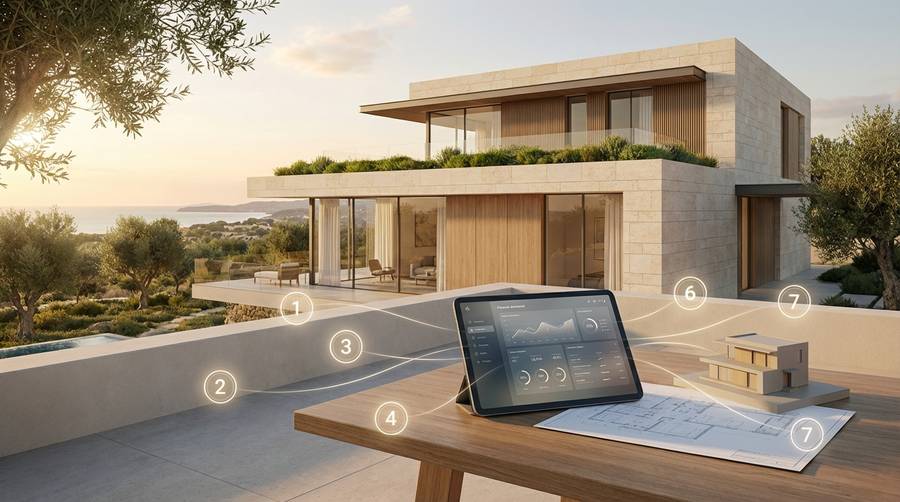
Create a high-quality, realistic architectural photograph of a finished Mediterranean contemporary detached home typical of Findnido projects. The house should be a premium, livable residence with light façades, natural wood and concrete accents, large windows and warm golden-hour light. The setting is a small garden/terrace in a Spanish residential context—olive or Mediterranean shrub planting, stone paving and a comfortable outdoor seating area. Composition: frontal three-quarter view, balanced framing, no exposed construction, no modular crates or factory scenes. Mood: trust, comfort and sustainable modern living. Photography style: architectural magazine quality, natural colors, soft daylight. The image must avoid box-shaped container aesthetics and instead show a refined, finished home that feels aspirational yet achievable.