Industrialized Housing: Spain’s Turnkey Future 2026–2035
Why industrialized housing will dominate Spain (vision 2026–2035)
A single trenchant fact frames the next decade: industrialized housing shortens effective construction time by 40–60% while improving predictability, and that advantage is decisive in a market with limited land and rising costs. Read on for evidence, practical steps and metrics you can use today.
Industry data: market growth, shares and projections
Between 2021 and 2025 Spain saw an accelerated uptake of industrialized homes in both single-family and multi-family segments. Conservative market analyses for 2026–2035 predict annual growth rates in the modular/industrialized segment of 8–12%—driven by demand for faster delivery, labor scarcity and cost certainty.
- Time to completion: Typical turnkey industrialized projects report 6–10 months from groundworks to handover for single-family homes—compared to 12–24 months in traditional builds.
- Cost predictability: Fixed-price contracts reduce variation: industrialized projects commonly report final cost overruns <5% vs historical averages of 10–25% for traditional builds.
- Quality control: Factory assembly reduces rework and defects, lowering post-delivery corrective costs by an estimated 30–50%.
Macro drivers: urbanization, land scarcity and the need for speed
Spain’s demographic and planning trends concentrate demand in peri-urban and secondary-city zones where speed and efficiency matter most. With limited developable parcels, developers and self-builders prefer models that maximize site productivity and minimize on-site labor.
- Regulatory pressure: Faster compliance and repeatable modular solutions fit better with evolving municipal permitting processes.
- Supply-side constraints: Labor shortages push builders towards off-site fabrication.
Competitive advantages vs traditional construction
Industrialized housing is not simply an alternative; it is a system optimized for certainty.
- Cost control: Economies of systemized production and materials pooling reduce per-unit cost variance.
- Speed: Parallel workflows (site works + factory build) compress schedules.
- Performance: Factory conditions enable strict thermal and acoustic tolerances.
In practice, industrialized workflows convert uncertainty into managed stages—reducing the three biggest risks for self-builders: time, price, and final performance.
Materials and systems that will define scalable turnkey homes
Industrialized concrete: durability, quality control and energy performance
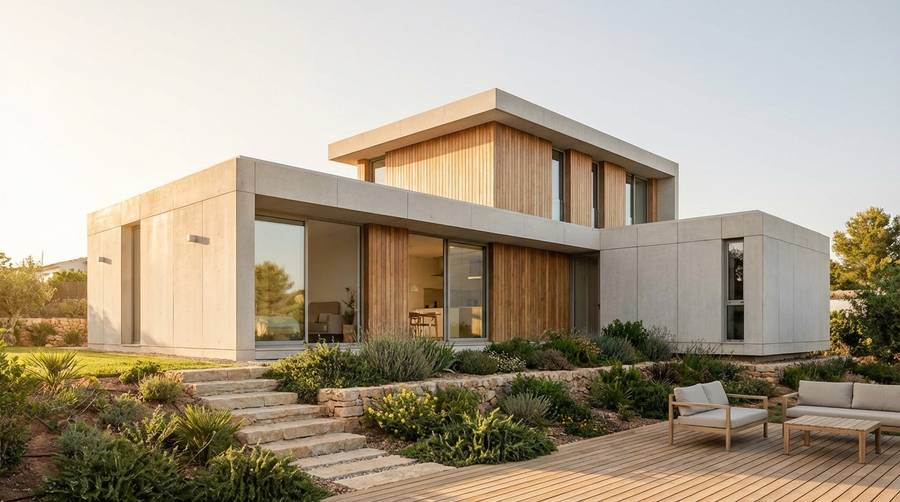
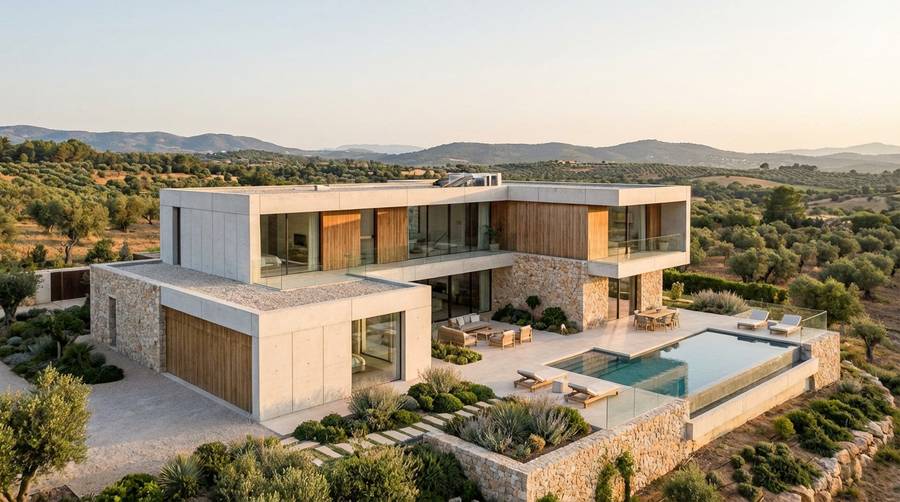
Precast and industrialized concrete systems bring predictable structural behavior and thermal mass advantages. For Spain’s diverse climates, concrete modules provide inertia that smooths internal temperatures and works well with passive strategies.
- Benefits: high durability, low maintenance, excellent fire resistance.
- Design implications: combine concrete panels with continuous insulation and thermal breaks to avoid thermal bridging.
Light timber framing and CLT: speed, sustainability and comfort
Timber systems—light-frame and cross-laminated timber (CLT)—are fast to assemble, have a lower embodied carbon profile, and deliver high occupant comfort.
- Construction speed: timber panels and modules can be installed in days, reducing on-site exposure.
- Sustainability: responsibly sourced timber significantly lowers lifecycle CO2 compared to steel or concrete.
Steel frame: versatility, precision and modular compatibility
Steel framing offers dimensional precision and design flexibility. It integrates well with mechanical systems and allows larger spans for open-plan living, important in contemporary Mediterranean architecture.
- When to choose steel: where long spans, fine tolerances, or repeatable modular grids are required.
- Integration: steel pairs effectively with prefabricated panel systems and factory-installed services.
Energy efficiency and sustainability: from Passivhaus to reduced carbon footprint
Passive design and high-performance envelopes: technical keys and expected metrics
In 2026 the baseline for high-performance industrialized housing includes airtightness levels near 0.6 ACH (50 Pa) or better and U-values for opaque walls in the 0.15–0.20 W/m²K range. Combining these targets with mechanical ventilation with heat recovery (MVHR) delivers predictable energy performance.
- Target metrics: heating demand <15 kWh/m²·year is realistic for well-designed turnkey homes in many Spanish climates.
- Monitoring: embed simple BMS or data loggers at handover to validate performance and build trust with buyers.
Life cycle assessment (LCA) and reduction strategies
To materially reduce carbon footprint, decisions must be evaluated across the full life cycle.
- Material choice: prioritize low-embodied-carbon materials (local timber, optimized concrete mixes, recycled steel).
- Operational savings: optimizing envelope and systems reduces emissions over decades—often offsetting higher upfront costs within 10–20 years.
Certifications and returns: operational savings and market valuation
Certifications such as Passivhaus, BREEAM or local energy labels increase buyer confidence and resale value. Empirical data show energy-efficient homes command price premiums and lower utility volatility for occupants.
The optimized turnkey process for self-builders
From plot search to delivery: phases, typical times and milestones
The optimized turnkey journey can be summarized in parallelized stages:
- Phase 0 — Feasibility (1–2 months): plot analysis, regulatory check, budget alignment.
- Phase 1 — Design & permits (2–4 months): schematic design, technical package, building permit submission.
- Phase 2 — Off-site manufacture & site works (3–6 months, overlapping): factory production while groundworks and foundations proceed.
- Phase 3 — Assembly & commissioning (1–2 months): module erection, finishes, systems commissioning and quality checks.
- Phase 4 — Handover & aftercare (ongoing): final inspections, user briefings, warranty period.
Permitting, technical coordination and transparent communication
Successful turnkey delivery depends on early coordination with authorities and a transparent client communication plan:
- Start permit checks during feasibility.
- Deliver monthly progress reports with photos and a simple risk register.
- Use digital models and clash detection to prevent on-site surprises.
Contract models and guarantees: fixed price, schedules and post-delivery support
For self-builders, the most attractive commercial model combines a fixed-price contract with a clear staging of payments tied to objective milestones. Extended performance warranties (thermal, structural, and systems) are critical to transfer confidence.
Financing for self-building and modular housing in Spain
Self-build mortgages: how they work and what banks expect in 2026
Banks increasingly recognize modular turnkey projects as lower-risk when backed by proven providers. Typical expectations include:
- Approved technical dossier and fixed-price contract.
- Stage releases tied to verified milestones (foundations, assembly, completion).
- Independent cost-to-complete certificates for larger projects.
Hybrid financing structures: deposits, guarantees and staged payments
Hybrid models blend a mortgage tranche with supplier financing or staged draws. Key elements:
- Upfront client contribution to secure factory slots.
- Supplier guarantees or completion bonds to satisfy lenders.
- Clear cashflow calendars to avoid idle capital on site.
How to make a modular project bankable
Present a concise dossier focusing on risk reduction:
- Fixed-price turnkey contract with a reputable provider.
- Program with parallel activities and a clear timeline.
- Energy performance estimates and maintenance forecasts.
Case studies and real metrics: lessons from scalable projects
Case A — Single-family turnkey home: time, final cost and satisfaction
Project highlights (representative):
- Timeline: 9 months total (3 months design & permitting, 4 months factory production overlapping with site works, 2 months assembly).
- Cost outcome: final variance under 4% against the fixed-price contract.
- Satisfaction: client NPS above 70; positive feedback on clarity of process and energy performance.
Case B — 10-unit modular development: construction efficiency and economies of scale
Representative metrics:
- Per-unit time: average 8 months completion after permits.
- Cost savings: 10–15% lower per-unit construction cost compared to small-site traditional builds due to material batching and repeatability.
- Construction variability: reduced rework and defects, improving developer margins and delivery predictability.
Comparison vs traditional builds: schedules, deviations and customer NPS
Across multiple projects, industrialized approaches show reliably lower schedule deviations and higher buyer satisfaction. The consistency of factory production translates into fewer surprises at handover and better post-occupancy performance.
How to prepare your modular project for 2026: practical checklist and next steps
Key decisions before signing
- Confirm plot zoning and buildability with a technical check.
- Choose structural system (concrete, timber, steel) aligned with your climate goals and aesthetic preferences.
- Set energy performance targets and required certifications early.
Team you need and criteria to choose a turnkey provider
- Experienced architect familiar with modular detailing.
- Turnkey supplier with factory capacity evidence and references.
- Independent technical reviewer or project manager to protect your interests.
Success indicators and a roadmap to delivery
Trackable indicators:
- Milestone adherence (design approval, permit, factory start, site completion).
- Airtightness and thermal test results at commissioning.
- Post-occupancy energy consumption compared to modeled estimates.
Start by securing a feasibility review for your plot, defining performance targets, and requesting a fixed-price proposal that includes a clear staging plan.
For a deeper operational comparison of turnkey models, see our detailed guide Vivienda prefabricada llave en mano: comparativa y guía 2026. If you want to avoid common mistakes, check Vivienda industrializada: errores comunes y soluciones. For design and materials recommendations, read Guía 2026: modelo llave en mano escalable.
Next step: align your brief to measurable performance goals and request staged fixed-price proposals. A focused feasibility study will reveal whether industrialized housing delivers the best risk-adjusted outcome for your project.
If you’re ready to evaluate a specific plot or need a concise financial and technical feasibility, contact a specialist—starting early reduces cost and schedule risk.
Imagen prompt (Findnido style): Photographic, Mediterranean contemporary finished home in Spain for an article titled "Industrialized Housing: Spain’s Turnkey Future 2026–2035". Show a high-quality real residence with clean lines, light stucco façades, wood and natural stone details, large windows with warm golden-hour light. Front terrace and planted garden with subtle Mediterranean landscaping and terracotta pots. Include a small family (two adults and one child) casually enjoying the terrace to convey comfort and trust. Photographic, architectural magazine quality, natural colors, premium and realistic. No exposed construction, no container-like modules, no industrial settings. Horizontal format, high resolution, balanced framing showing façade and outdoor living area.