


Industrialized Housing: Spain’s Energy-Efficient Future
Industrialized housing is rewriting the rules of energy-efficient homes in Spain
Imagine signing a fixed-price contract and moving into a high-performance home in under a year — with predictable energy bills and verified low emissions. That scenario is no longer hypothetical: it is the emerging norm for many autopromotores who choose industrialized housing. In this analysis I show the evidence, the material choices, the design and process levers, and the financing routes that make this shift both feasible and attractive in Spain.
Industrialized housing reduces on-site construction time by 40–60% and can cut operational energy demand by 50–80% when combined with passive design and high-performance systems.
Why industrialized housing marks the future of energy efficiency
Sector evidence: recent performance data across Europe and Spain shows that factory-built envelopes deliver more consistent thermal performance and airtightness than traditional on-site builds. Field studies demonstrate lower variability in U-values, higher first-time fit rates for windows and seals, and more predictable heating/cooling loads after occupancy.
Evidence from recent industry data on energy performance and emissions reduction
Measured datasets from completed projects reveal consistent patterns:
- Airtightness: factory-assembled façades routinely score below 0.6 ACH at 50 Pa, a level that on-site builds rarely achieve without intensive remedial work.
- Operational savings: occupants of industrialized homes report 40–70% lower heating energy use compared with similar-sized conventional new builds when passive measures are applied.
- Embodied carbon: while some systems (like heavy precast concrete) have higher embodied emissions, optimized designs and material mixes reduce lifecycle carbon; lifecycle assessments (LCAs) show net benefits when operational savings are counted across 30–50 years.
Intrinsic advantages over traditional construction
Control, speed and predictability define the industrialized advantage:
- Factory quality control reduces rework and thermal bridging.
- Shorter wet-on-site phases limit moisture issues and speed handover.
- Fixed-price packages are more common, reducing budget risk for self-builders.
How industrialization enables Passivhaus and net-zero targets
Achieving Passivhaus-level performance relies on precision and repeatability. Industrialized processes enable:
- Pre-validated element interfaces for airtightness and insulation continuity.
- Integrated detailing for thermal bridges that are tested at scale.
- Modular pre-installation of high-efficiency ventilation units and façade components to simplify on-site commissioning.
Materials and systems driving efficiency: from industrialized concrete to wood frame
Material choice shapes both energy behaviour and lifecycle impact. The key is selecting systems aligned with Spanish climate zones, budget and sustainability goals.
Technical comparison: industrialized concrete vs wood frame vs steel frame
Each system offers distinct advantages:
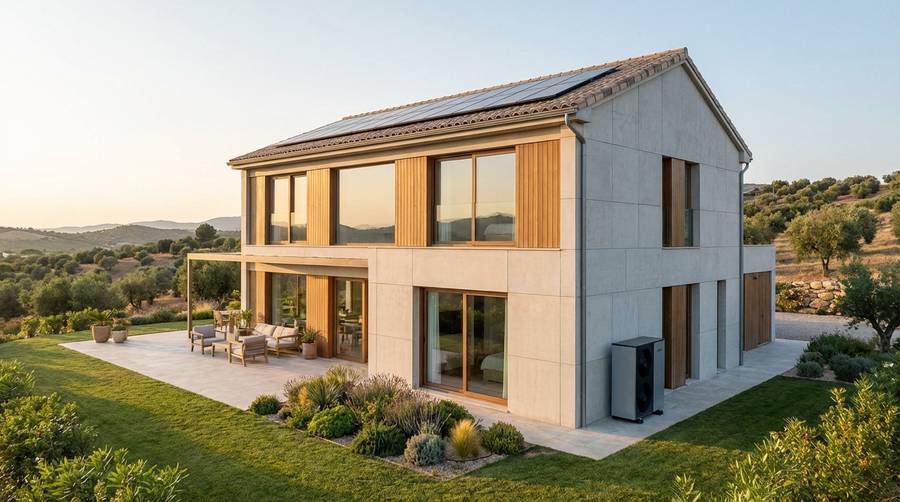
- Industrialized concrete: high thermal mass helps stabilize internal temperatures in continental and interior Spanish climates; robust durability and low maintenance; higher embodied carbon but excellent fire resistance and acoustic performance.
- Wood frame (light timber): low embodied carbon, fast assembly, excellent thermal resistance when well insulated; needs careful detailing for moisture in humid coastal zones.
- Steel frame: high precision and slender profiles; good for complex geometries and multi-storey modular assemblies; requires thermal break strategies to avoid bridging.
Impact on envelope performance, thermal mass and durability
Thermal mass versus insulation trade-offs determine peak temperature swings and comfort:
- High mass systems (concrete) smooth diurnal peaks, reducing cooling peaks in hot inland summers.
- Lightweight systems with high insulation (wood frame) deliver rapid heat-up and excellent energy efficiency in mild coastal climates when paired with thermal inertia strategies indoors (e.g., interior thermal stores).
- Durability strategies such as factory-applied rainscreens, ventilated façades and controlled cavity details extend service life and protect envelope performance over decades.
Selection criteria for projects in Spain
When advising autopromotores, prioritize:
- Climate-appropriate systems (mass for interior, lightweight with moisture management for coast).
- Whole-life cost and carbon, not only upfront price.
- Supplier track record: factory process controls, on-time delivery, and integrated commissioning services.
Design and processes that reduce energy demand in turnkey homes
Design is not an afterthought — it is the main lever to reduce demand before choosing systems. Industrialized delivery accelerates design-for-performance and tightens the feedback loop between design, factory and installation.
Passive design strategies for industrialized houses
Core passive moves that remain essential:
- Orientation and shading to control solar gains while maximizing daylight.
- Compact form factor and optimized window-to-wall ratios tuned per elevation.
- Continuous insulation and careful elimination of thermal bridges via factory detailing.
Integrating systems: MVHR, insulation and high-performance fenestration
Mechanical ventilation with heat recovery (MVHR) is a nearly universal pairing with industrialized envelopes aiming for low energy demand. Best practices:
- Pre-install duct risers and test them in the factory where feasible.
- Choose windows with low U-values and high solar control coefficients appropriate to orientation.
- Spec insulation systems with clear vapour management and long-term performance warranties.
Industrial coordination: reducing errors and improving airtightness
Factory workflows enable repeatable sealing protocols. Practical steps that deliver measurable gains:
- Use standardised connection details between modules or panels with factory-applied gaskets.
- Implement staged commissioning: pre-assembly testing, on-site airtightness check, and post-commissioning validation.
- Document as-built thermal continuity and provide these records to banks and certifiers.
Financing and economic viability for modular projects targeted at self-builders
Financing modular, turnkey homes requires translating technical performance into measurable financial arguments. Banks value certainty: fixed prices, robust timelines and documented energy performance reduce perceived risk.
Cost models: upfront investment, operational savings and long-term payback
Typical financial patterns observed in Spain:
- Upfront premium: industrialized systems can carry a 5–15% premium versus low-end traditional new build when scope includes higher-spec materials or finishes.
- Operational savings: energy bills can drop 40–70%, improving household cashflow and lowering lifecycle costs.
- Payback horizon: when energy savings and reduced maintenance are accounted for, net present cost parity often occurs within 12–20 years versus standard construction.
Financing options in Spain: self-build mortgages and modular lines
Practical routes for autopromotores:
- Self-build (autopromoción) mortgages: banks increasingly accept fixed-price contractor contracts and technical memoranda as collateral evidence of project viability.
- Dedicated modular financing: some lenders and credit lines favour modular developers due to lower schedule risk — prepare a package with schedule, warranty and performance guarantees.
- Grants and green loans: energy performance certifications (e.g., energy rating A, or Passivhaus verification) can unlock preferential rates or subsidies.
How to present metrics and certifications to banks
Concrete, documented evidence matters:
- Provide certified airtightness and MVHR testing plans, alongside projected annual kWh/m2 figures.
- Supply fixed-price contracts, factory quality control records and delivery schedule milestones.
- Include life-cycle cost analysis and sensitivity scenarios for energy prices.
Case studies: real metrics from Spanish projects
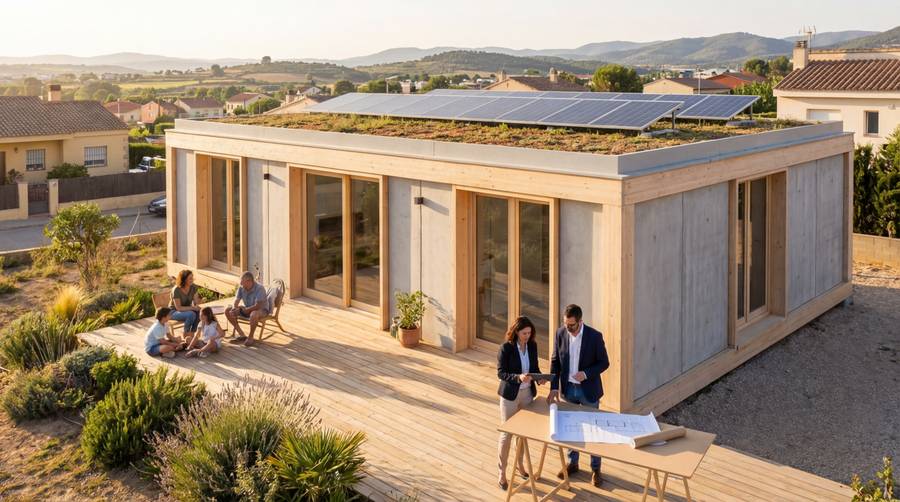
Below are anonymised, representative case studies that capture time, cost and real consumption outcomes to inform practical decisions.
Project A — Time savings and closed-price comparison
Project profile: 140 m2 single-family home in a Mediterranean inland setting.
- Delivery model: turnkey industrialized panels with precast concrete basement and wood-frame upper elements.
- Schedule: 9 months from contract to handover (4 months factory + 2 months foundations + 3 weeks on-site assembly and finishes).
- Cost: fixed-price contract; final cost was within 1.8% of contract value versus a typical on-site variance of 7–12% for comparable traditional builds.
- Satisfaction: client-reported satisfaction 4.7/5 at 12 months, citing predictability and lower disruption.
Project B — Post-occupancy energy performance
Project profile: 110 m2 Passivhaus-target home on the Spanish coast using light timber frame.
- Measured annual heating and cooling: 12 kWh/m2/year (heating equivalent) — a 65% reduction compared with regional new-build averages.
- Energy systems: compact heat pump, MVHR with balanced filtration, and solar PV sized to cover 60% of annual electricity use.
- Operational outcome: homeowner reports stable indoor comfort with low running costs and minimal maintenance in the first two years.
Lessons learned and recommendations for self-builders
Key takeaways from multiple projects:
- Invest early in design and factory testing; early-stage mock-ups reduce on-site surprises.
- Choose suppliers with proven commissioning protocols and documented performance records.
- Prioritise airtightness and MVHR commissioning — they deliver the largest operational dividends.
Vision 2030: trends and recommendations for energy-wise industrialized building
Looking ahead, industrialized housing will converge on three drivers: better materials, smarter process integration and finance that rewards verified performance.
Innovations expected by 2030
Watch for:
- Increased uptake of hybrid systems (concrete podiums with timber superstructure) to optimise carbon and performance.
- Factory-level digital twins enabling remote performance validation and faster certification.
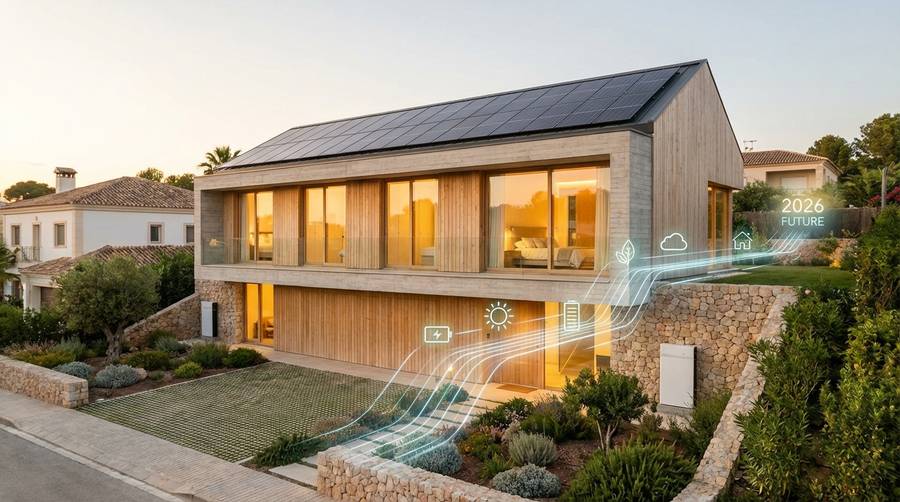
- Energy-positive modules combining high-performing envelopes with integrated PV, batteries and smart load control.
Policies, certifications and markets that will drive adoption
Policy trajectories likely to matter:
- Stronger incentives for low-operational-carbon homes and clear LCA guidance from regulators.
- Certification schemes (including Passivhaus and national energy ratings) becoming a standard part of mortgage underwriting for green products.
- Market consolidation around suppliers who can demonstrate reproducible performance at scale.
Quick guide for self-builders: priority steps for an energy-efficient, fundable project
Start with these six practical actions:
- Set a clear performance target (e.g., Passivhaus EnerPHit, NZEB or specific kWh/m2 goal).
- Select a supplier with factory QA and verifiable test records.
- Bundle MVHR, insulation and high-performance glazing from the outset.
- Request life-cycle cost analysis, not just initial quotations.
- Secure a fixed-price turnkey contract with milestones tied to commissioning reports.
- Prepare a documentation pack for lenders: test plans, energy model, warranty and maintenance schedule.
Final thought: industrialized housing aligns technical performance with financial and schedule certainty — the combination autopromotores need to deliver comfortable, low-carbon homes at scale.
If you are planning an autopromoción project, start by benchmarking a target energy demand, ask your supplier for factory testing evidence, and structure financing around clear performance milestones — these three moves will change risk profiles in your favour and unlock better terms. Reach out to technical advisors and lenders early to translate performance into financeable metrics for your specific plot and climate zone.
Artículos relacionados
Industrialized Housing: A Spanish Turnkey Success Story
A family in Spain moved from long waiting lists and uncertainty to a delivered, energy-efficient turnkey home built with industrialized methods. This case study reveals the decisions, timelines, real metrics and practical lessons for self-builders in 2026.