Prefabricated House vs Traditional Home: Clear Trade-offs
Introduction — Why this comparison matters now
Hook: If you're planning to build a home in Spain today, the choice between a prefabricated house and a traditional build will determine your schedule, budget certainty and environmental impact. This article cuts through marketing claims and delivers the facts, metrics and decision tools you need to choose with confidence.
Prefabrication can reduce on-site build time by 40–70% and deliver fixed-price contracts that limit surprises—advantages that matter most to self-builders on tight schedules and budgets.
Why choose a prefabricated house today in Spain
Key advantages over traditional construction: time, cost and control
Faster delivery: Factory production and parallel workflows compress schedules. Typical end-to-end times (project start to handover) for a prefabricated house are 6–12 months versus 12–24+ months for a traditional build, depending on complexity and permits.
Budget predictability: Many prefabricated offers come as fixed-price or phased contracts, reducing the risk of runaway costs. This is especially relevant when labour shortages or inflation affect material pricing.
Greater process control: Factory conditions improve quality control and reduce weather-related delays. For autopromoters who value clear milestones and transparent scope, this is a meaningful operational advantage.
Who benefits: autopromoter profiles and use cases
- First-time autopromoters seeking simplicity and fewer site decisions.
- Families on a schedule who need to occupy within a fixed time window.
- Sustainability-focused buyers aiming for low-energy standards with predictable assemblies.
- Cost-sensitive developers building several units where repeatability reduces unit cost.
Limitations and common myths to know
- Myth: Prefabs are low quality. Reality: modern industrialized methods achieve equal or superior precision and airtightness when specified correctly.
- Site constraints: Access, slope or unusual foundations can add cost and limit modular benefits.
- Design flexibility: Custom architectural moves are possible but may increase lead time and price.
Objective comparison: prefabricated house vs traditional home
Execution timelines and stage-by-stage metrics
Below are representative timelines for a single-family home (90–120 m²) in Spain under average permitting conditions:
- Traditional build: Site preparation 1–2 months, foundations 1 month, structure 4–8 months, finishes 3–6 months. Total: 12–24 months (permits often add 2–6 months).
- Prefabricated house: Design & approvals 2–4 months, factory production 8–12 weeks, site works & assembly 1–3 months, finishes & commissioning 1 month. Total: 6–12 months.
Actionable tip: Ask manufacturers for a Gantt chart showing parallel factory and site activities; it reveals where time savings actually occur.
Total cost: fixed budgets, contingencies and numerical examples
Costs vary by spec, but two comparative examples (Spain, 2025 market averages) illustrate trends for a 90 m² two-bedroom home:
- Traditional: €1,500–€1,900/m². Budget range: €135,000–€171,000 (ex. land). Common extra: 10–20% contingency for overruns.
- Prefabricated house (low-cost industrialized model): €1,200–€1,600/m². Budget range: €108,000–€144,000 (ex. land). Typical contingency: 5–10% when final contract is fixed price.
Important caveat: Site-specific costs (access cranes, foundations on slope, utility connections) can shift both ranges by €5k–€30k. Always get a site-adjusted quote.
Constructive quality and durability: standards and guarantees
Quality depends on design, materials and assembly control. Key differentiators:
- Airtightness and thermal continuity: Factory-assembled envelopes typically achieve higher airtightness levels; that translates into lower heating/cooling needs.
- Material performance: Engineered components (precast concrete panels, cross-laminated timber or high-grade steel frames) carry documented strength and long-term performance.
- Warranties: Verify structural and waterproofing guarantees, often 10 years for structural systems and shorter terms for finishes.
Materials and construction systems for affordable prefabricated houses
Industrialized concrete: when it pays off
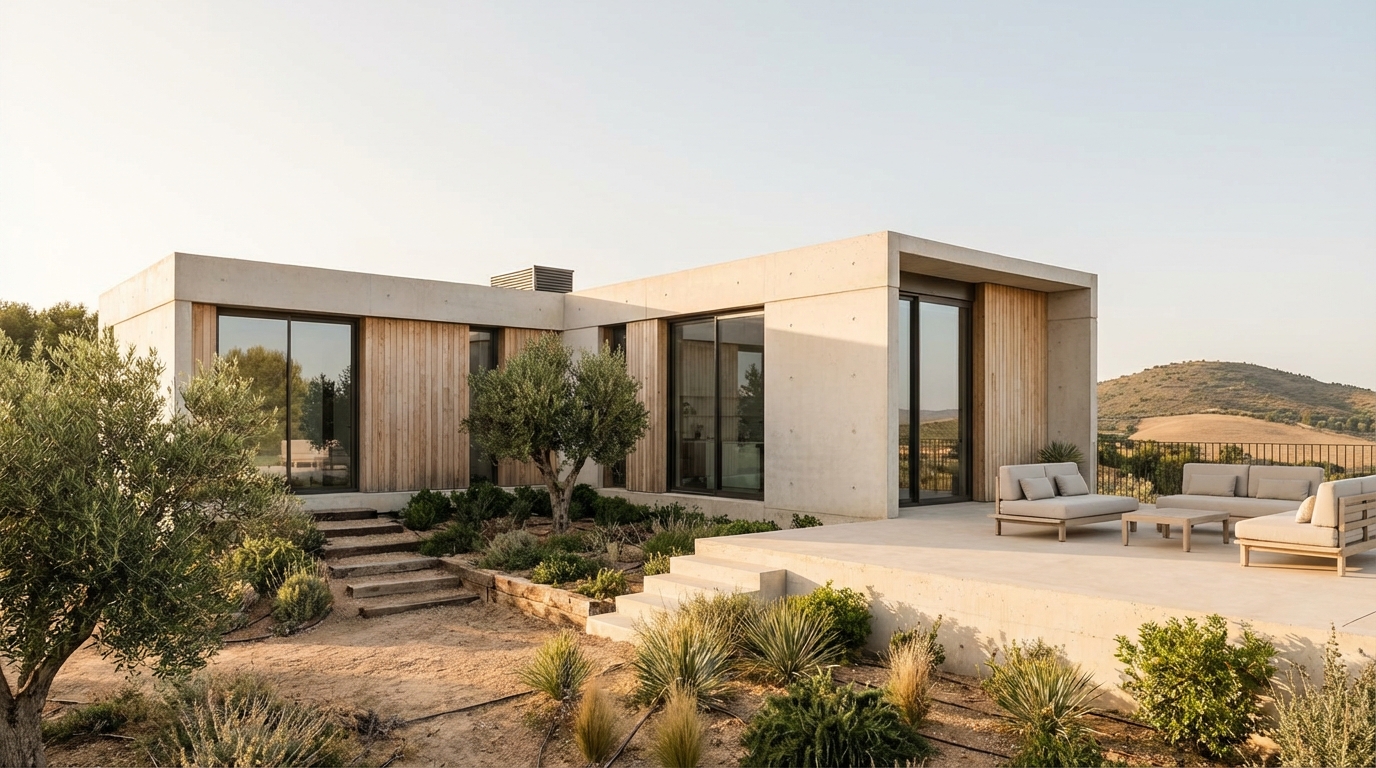
Benefits: Precise panels, high thermal mass and excellent durability. Best suited for medium-scale builds or where fire resistance and robustness are priorities.
When to choose it: Sloped lots requiring heavy foundations, coastal areas with durability concerns, or when you want the look and permanence of concrete with factory control.
Light timber framing: thermal efficiency and sustainability
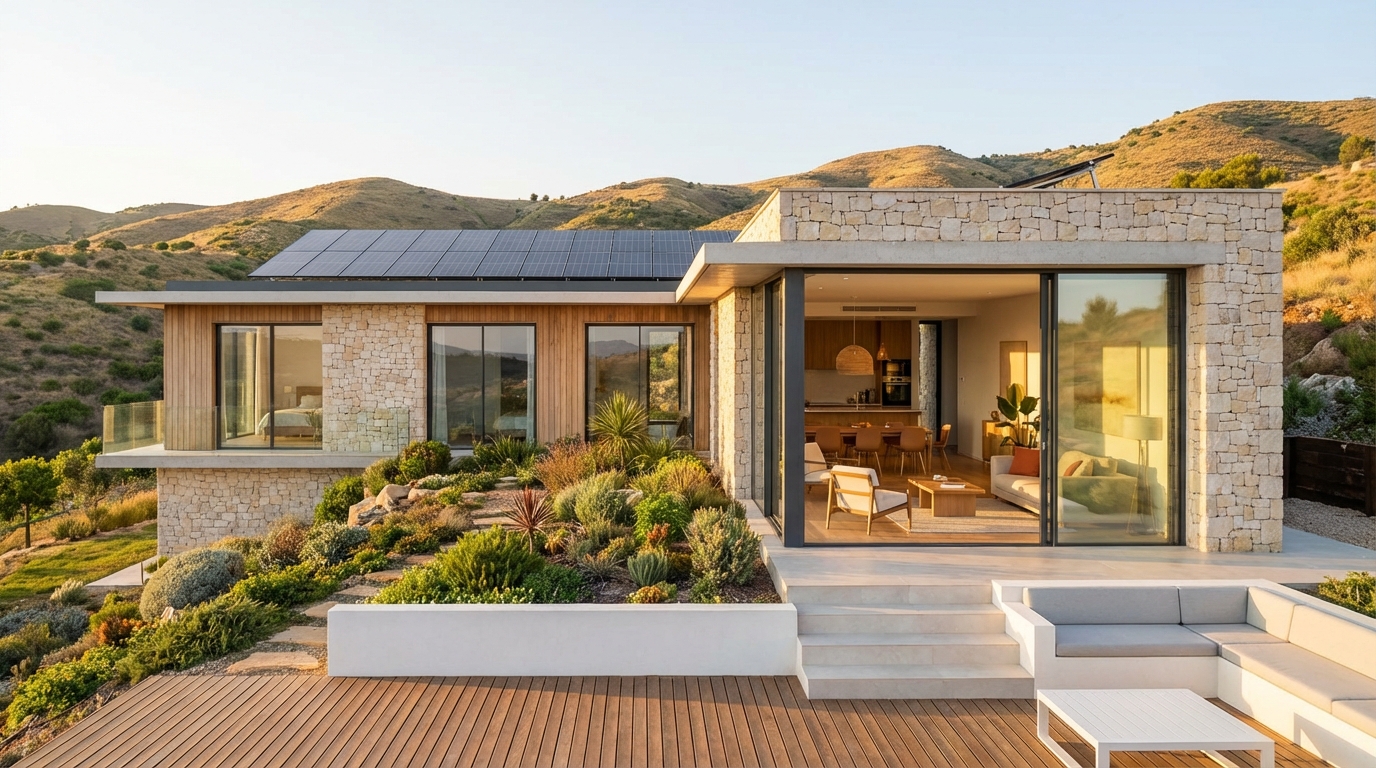
Advantages: Low embodied carbon, excellent thermal performance and quick on-site assembly. Timber frame is compatible with Passivhaus-level envelopes when executed with correct airtightness and insulation.
Considerations: Ensure proper detailing for moisture control and long-term maintenance. Look for kiln-dried, certified timber and industrial precision connections.
Steel frame: speed and structural clarity
Strengths: Very fast erection, slim profiles for open plans, consistent tolerances.
Key issues: Thermal bridging needs careful mitigation; include continuous insulation layers and certified vapour control systems.
Sustainability and energy efficiency in affordable prefabrication
Passivhaus strategies adapted to tight budgets
- Prioritise: airtightness, continuous insulation, and thermal-bridge-free connections.
- Choose measured glazing: high-performance windows only where needed; reduce cost with optimized orientation and shading.
- Factory-controlled assembly: reduces mistakes that compromise energy performance.
Practical approach: Aim for a programme where passive measures reduce the heating load by ~60–80% compared with typical Spanish code buildings—then add a compact mechanical ventilation with heat recovery (MVHR) sized to the reduced load.
Cutting carbon: materials and logistics
Reducing the carbon footprint is a balance of material choice and transport logistics. Timber and modular light systems often have lower embodied carbon than poured concrete, but long transport distances or inefficient factory processes can reverse benefits.
Actionable checklist:
- Ask for cradle-to-gate or EPD data when available.
- Prefer regional factories to limit transport emissions.
- Specify recyclable or low-VOC finishes for indoor air quality.
Measuring energy savings and payback example
Example: A 90 m² Passivhaus-style prefabricated house with MVHR and optimized envelope may consume 40–60 kWh/m²·year (heating + cooling) versus 100–150 kWh/m²·year for a code-built traditional home.
At an energy price of €0.25/kWh and average household heating demand, this can mean annual energy savings of €400–€900. Payback on incremental passive measures depends on upfront cost—often 7–15 years depending on incentives.
The turnkey process explained step by step
From finding the plot to project and permits: typical timelines and costs
Stages and realistic durations:
- Plot selection & due diligence: 2–8 weeks. Check access, utilities and local rules.
- Preliminary design & budget: 4–8 weeks. Includes site-adapted layouts and cost plan.
- Planning & licences: 2–6 months depending on municipality.
Cost pointers: Budget for geotechnical reports and utility extensions early—these often surprise autopromoters.
Factory production and transport: quality control and fixed schedules
In a true turnkey model, the factory delivers element-ready components according to a strict schedule. Key controls to require:
- QA documentation for factory inspections.
- Transport protection schedules (to avoid damage to finishes).
- On-site assembly timetable and contingency planning for crane availability.
Handover, aftercare and guarantees: what a good turnkey includes
A professional turnkey contract should include:
- Detailed snagging list and correction timeline.
- Minimum structural warranty and water-tightness guarantee.
- Post-occupancy support window (e.g., 12 months) with response SLAs.
Financing and mortgages for modular autopromotion
Mortgage options for self-build in Spain (2026 outlook)
Banks typically offer two routes:
- Construction loans: Disbursed in tranches tied to milestones. Prefab projects with fixed-price contracts and clear factory delivery schedules are often easier to stage for payments.
- Self-build mortgages: Designed for autopromoters; require technical oversight and realistic cashflow plans.
Tip: Provide lenders with the manufacturer’s production plan, fixed-price contract and a Gantt timeline to speed underwriting.
Payment models: milestones vs traditional financing
Common payment structures:
- Deposit + design & permits fee → production milestone payment → delivery & on-site assembly payment → final retention.
- Alternatively, some firms accept staged payments aligned with mortgage draws—this reduces borrower cash exposure.
Grants and incentives that improve project viability
Energy retrofit and low-energy new-build incentives (regional programmes) may apply if you target Passivhaus or net-zero-ready performance. Check local incentives early and integrate them into the financial model.
Case studies and practical lessons to decide with data
Case 1: 90 m² home — timelines, final cost and client satisfaction
Summary (anonymized composite based on recent projects):
- Size: 90 m², 2 bedrooms.
- System: light timber frame with factory-installed insulation and windows.
- Timeline: 8 months from contract signature to handover (includes 3 months permits).
- Final cost: €118,000 (excluding land). Contingency used: 6%.
- Satisfaction: Client reported fast occupancy and minimal snagging; energy bills 55% lower than previous rental.
Case 2: Passivhaus low-cost variant — efficiency metrics and payback
Summary:
- Size: 110 m², Passivhaus-inspired envelope (not certified but following principles).
- System: steel frame with continuous external insulation and MVHR.
- Timeline: 10 months total.
- Extra passive cost: +€12,000 vs standard prefab spec. Estimated annual energy savings: €700–€900. Simple payback: 13–17 years (shorter with local incentives).
Checklist to compare manufacturer proposals objectively
- Detailed scope with inclusions/exclusions.
- Fixed-price vs estimated pricing and the exact contingency rules.
- Factory QA records and sample EPDs or material specs.
- Lead times for production and specific delivery slots.
- Warranty and aftercare terms in writing.
- References and completed project visits where possible.
How to decide: pros, cons and a recommended route
Balanced summary of pros and cons by profile
Pros of a prefabricated house:
- Shorter, predictable timelines.
- Stronger cost control with proper contracts.
- Higher factory-level quality for airtightness and finishes.
- Better alignment with energy-efficiency goals.
Cons:
- Potentially higher site-specific costs (access, foundations).
- Less late-stage customization without extra cost.
- Need for careful specification to avoid thermal bridging or moisture risks.
Questions you should ask every provider before signing
- Can you provide a project Gantt with factory and site milestones?
- What exactly is included in the fixed price and what triggers extra costs?
- Do you provide EPDs, airtightness targets and test reports?
- What is the warranty scope and post-handover support SLA?
Practical step-by-step route to start safely
- Conduct plot due diligence (access, utilities, restrictions).
- Shortlist 2–3 manufacturers and request site-specific quotes with timelines.
- Review contract terms with a technical advisor; insist on QA deliverables.
- Secure financing aligned with the proposed payment milestones.
- Plan for a 10–15% contingency on top of fixed-price items for unexpected site work.
Conclusion — making a choice that matches your priorities
Bottom line: For most self-builders in Spain who prioritise schedule, budget certainty and energy performance, a well-specified prefabricated house provides a compelling path. Traditional construction still makes sense when site complexity or ultra-custom architecture dominates the brief.
If you want a practical next step, start by asking shortlisted firms for a detailed Gantt, a fixed-price breakdown, and factory QA documentation—these three documents reveal whether the proposal is realistic or not.
Ready to evaluate your plot or compare turnkey offers? Contact a technical advisor or request site-specific quotes to make an informed decision.