Modular Housing: Industrialized Homes for Self-Builders
Why choose industrialized housing with no down payment
Modular housing is changing how families build homes in Spain. It shortens schedules, fixes budgets, and improves predictability. For many self-builders, financing without a large down payment makes the dream of owning a custom home attainable. This approach suits people who want control without the stress of traditional building sites.
Advantages over traditional construction: efficiency, closed schedules and fixed price
Industrialized housing is produced in controlled environments. That reduces weather delays. It also lowers on-site labor time. As a result, delivery dates are more reliable. Builders can offer a fixed price. That helps self-builders avoid surprise costs. Energy-efficient materials and precise factory processes improve build quality and reduce waste.
How no-down-payment financing eases access to self-building
Financing options that require little or no down payment open doors. Prospective owners can secure land and project costs without large savings. Lenders assessing industrialized housing often value the reduced construction risk and timeline. That can translate into more favorable loan conditions for self-builders.
Common myths about quality and durability of industrialized homes
Some people still equate prefabricated homes with low quality. Modern modular homes use durable materials like industrialized concrete, light timber frames, and steel frame systems. They meet the same safety and durability standards as traditional builds. Properly finished modular homes are long-lasting and easy to maintain.
Materials and construction solutions: protecting your investment
Choosing the right structure matters for comfort, cost and lifespan. Today’s modular housing uses modern systems that deliver high performance. Each option has strengths depending on design goals and site conditions.
Industrialized concrete, light timber framing and steel frame: pros and common uses
Industrialized concrete provides thermal mass and robustness. It works well for ground floors and passive thermal designs. Light timber framing is fast, sustainable and ideal for complex shapes. It offers excellent insulation capacity with low embodied energy. Steel frame systems allow large spans and open interiors. They are precise and well-suited to contemporary architecture.
Efficiency and comfort: how modern materials reduce long-term costs
Modern materials lower energy demand and maintenance needs. High-performance insulation and airtight envelopes reduce heating and cooling costs. Factory-controlled builds produce tighter joints and fewer defects. That leads to lower running costs and higher resale value over time.
Compatibility with Passivhaus standards and energy efficiency improvements
Modular systems can be designed to meet Passivhaus principles. With careful detailing, factories can deliver components with very low thermal bridging. Combined with high-performance glazing and mechanical ventilation with heat recovery, modular homes can reach excellent energy ratings. This reduces carbon footprint and monthly energy expenses.
Financing options with no down payment for modular housing
Understanding mortgage and financing alternatives helps you plan the build. These solutions are evolving as lenders gain confidence in industrialized housing models.
Self-build mortgages: what they are and how they work
Self-build mortgages are loan products adapted to progressive construction payments. Instead of a single disbursement, the lender releases funds in stages. For modular projects, stages can match design, factory production and final installation. This structure helps manage cash flow and aligns payments with project milestones.
Specific financing lines for industrialized housing and their requirements
Some banks offer targeted products for modular and industrialized housing. Requirements typically include a certified plan, a turnkey contract with a recognized builder, and proof of land ownership. Lenders may ask for performance guarantees from the manufacturer. When the project is turnkey, risk is lower and approval can be faster.
Tax advantages and public incentives that can complement financing
There are regional and national incentives for energy-efficient homes. Grants, tax rebates and low-interest loans can offset costs for Passivhaus-level performance or renewable systems. Investigate local programs in Spain and consult a financing advisor early in the process.
Turnkey process: from plot search to handover
A turnkey delivery simplifies the build for self-builders. It centralizes responsibility and reduces the administrative burden. Knowing the main stages helps set realistic expectations.
Project phases: plot search, design, manufacture and installation
- Plot search: Evaluate access, orientation and planning rules.
- Design and permits: Prepare plans and secure building permits.
- Factory production: Components are manufactured under quality control.
- Transport and installation: Modules are assembled on site.
- Finishes and commissioning: Systems are tested and the home is handed over.
Each phase has clear deliverables. With a turnkey provider, one team manages coordination and deadlines from start to finish.
Fixed schedules and administrative tasks simplified by a turnkey approach
Turnkey projects reduce the number of suppliers you must manage. That simplifies permits, inspections and warranties. Since factories reduce weather exposure, projects usually follow tighter schedules. This predictability benefits mortgage staging and personal planning.
Documentation and guarantees required for no-down-payment financing
When financing without a down payment, lenders often request:
- Detailed turnkey contract with fixed price and schedule.
- Project permits and approved plans.
- Manufacturer warranties and performance certificates.
- Progress reports tied to disbursements.
Providing complete documentation speeds loan approval and protects both parties.
Sustainability, energy efficiency and carbon reduction
Industrialized housing can be inherently more sustainable than traditional builds. Factory precision, optimized materials and integrated energy systems reduce environmental impact over the home’s life.
How industrialized construction contributes to greener homes
Controlled factory production minimizes waste. Material selection favors low-embodied-energy solutions. Tight construction tolerances reduce the need for corrective work. Together, these factors lower the home’s embodied carbon compared to less efficient onsite builds.
Energy certifications and the Passivhaus approach for real homes
Passivhaus principles focus on insulation, airtightness and ventilation efficiency. Modular homes can incorporate these elements from design to delivery. Certified components and consistent factory assembly support meeting rigorous energy targets in real, livable homes.
Economic and comfort benefits for families and self-builders
Lower energy bills are immediate benefits. Improved indoor comfort follows from stable temperatures and better air quality. These advantages make modular homes attractive to families seeking long-term savings and healthier living spaces.
Frequently asked questions and next steps for the self-builder
Preparing for the financing process and selecting the right partner reduces uncertainty. Here are key questions and a practical checklist to guide the next steps.
Key questions banks will ask and how to prepare
- Do you own the plot or have a purchase agreement?
- Is there a turnkey contract with clear milestones?
- Have you gathered performance certifications and supplier guarantees?
- Can you present a realistic schedule and cost breakdown?
Gather documentation early to improve lender confidence and speed approvals.
Practical checklist before applying for no-down-payment financing
- Secure the plot or a binding reservation.
- Select a turnkey provider with strong references.
- Obtain detailed plans, a fixed-price contract, and a project timeline.
- Collect manufacturer warranties and energy specifications.
- Consult a mortgage advisor experienced in self-build loans.
How to work with an integrated platform: contact, quote and project tracking
An integrated platform centralizes design, manufacture, financing support and handover. Start with an initial consultation. Request a site visit and a comprehensive quote. Look for clear communication tools and milestone reporting. A professional platform will guide you through permits, financing and construction until delivery.
Image description for AI generation
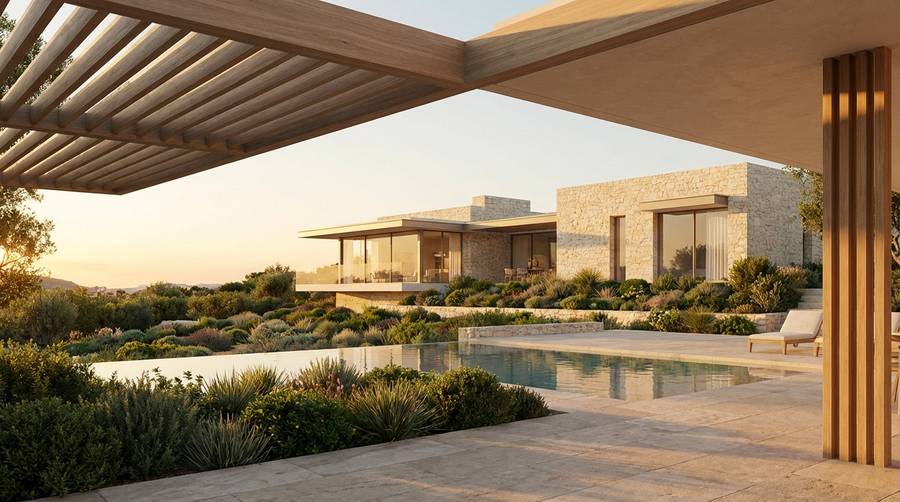
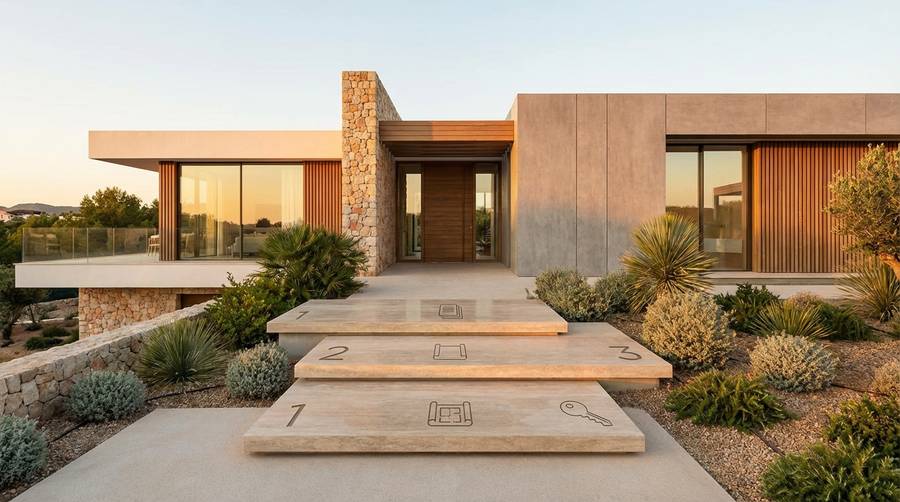
High-quality real estate photograph at golden hour of a finished Mediterranean contemporary home in Spain. The house shows light façades with stone and wood textures, large windows and warm interior light. A terrace with outdoor furniture and a landscaped garden with native Mediterranean plants sits in front. A family (couple with a child) enjoys the terrace, conveying comfort and trust. The atmosphere is premium and lived-in, with natural colors and balanced framing. Avoid exposed modular structures, container aesthetics, or construction scenes. The final image should look like a desirable, modern, sustainable Spanish home aligned with the Findnido brand identity.
Final thoughts for self-builders
Modular housing is a practical and modern route to home ownership. It combines speed, predictability and energy performance. With growing lender familiarity and targeted financing options, building a turnkey modular home without a large down payment is increasingly feasible in Spain. Choose materials and partners wisely. Focus on energy performance and clear contracts. That way you protect your investment and enjoy a comfortable, sustainable home for years to come.
Artículos relacionados