Industrialized Housing in Spain: 2026 Market Outlook
Industrialized housing in Spain 2026: why it leads innovation
Imagine signing a fixed-price contract in January and moving into a finished, energy-efficient home by autumn. That scenario is no longer niche—it's becoming standard for many Spanish self-builders. The combination of factory-controlled production, modern materials and clearer financing is reshaping how families approach housing.
This article delivers a concise, evidence-based roadmap for professionals and autopromoters who want to understand market dynamics, select materials, manage a turnkey process and secure financing with confidence.
Market evolution: scale, growth and sector projections
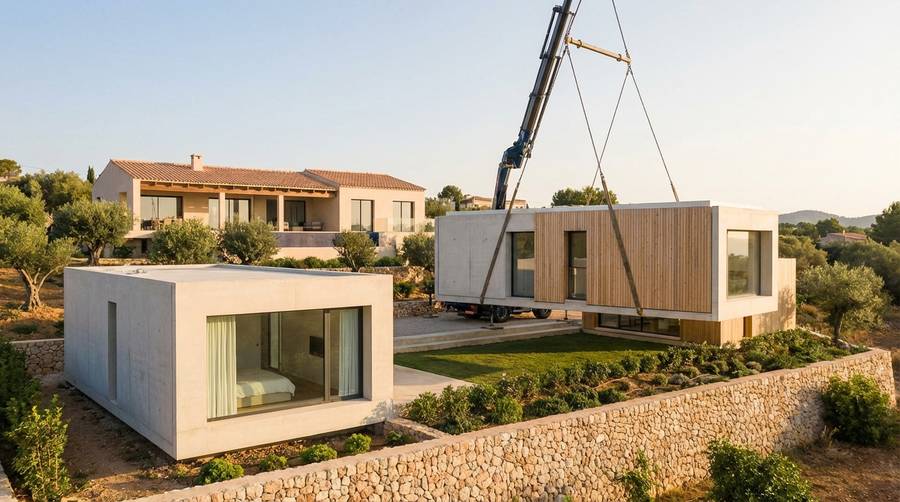
Industrialized housing has shifted from pilot projects to scalable delivery. Recent industry reports and developer disclosures show steady year-on-year growth in modular starts, expanding from early adopters (coastal second homes, retirement projects) toward mainstream single-family housing. Key indicators include reduced lead times, stronger supplier networks in Spain and growing acceptance by local planning authorities.
What to watch in 2026: an increase in mixed-material systems (concrete + timber/steel hybrids) and more turnkey offers aimed at families who want a single supplier from plot search to delivery.
Drivers of adoption: economics, regulation and self-builder demand
Three forces accelerate adoption:
- Economic certainty: fixed-price contracts and predictable factory schedules reduce reputational and financial risk for autopromoters.
- Regulatory momentum: tighter energy regulations and incentives for low-carbon buildings make industrialized systems more attractive.
- Demand from informed self-builders: buyers increasingly prioritize rapid delivery and lifecycle costs over short-term savings on raw material price.
Time-to-delivery and cost comparison vs traditional construction
Factory production shortens on-site operations significantly: while traditional builds often extend beyond planned calendars due to weather and subcontractor coordination, industrialized projects concentrate variables inside the factory. Expect substantial reductions in on-site weeks and lower variation in final cost, especially when contracts are fixed price.
“Reducing on-site variability is the most effective way to protect budget and schedule—industrialized delivery moves most uncertainty into the factory where it can be controlled.”
Materials and structural systems shaping the next decade
Choosing the right system is a strategic decision: it affects energy performance, construction speed, capital expenditure and long-term maintenance.
Industrialized concrete: structural advantages and on-site efficiency
Precast and industrialized concrete systems offer durability, excellent thermal mass and low maintenance. They are particularly suitable for coastal Mediterranean climates where thermal inertia helps stabilize indoor temperatures. In industrialized workflows, concrete elements are produced under quality-controlled conditions and delivered just-in-time, cutting on-site setting time and rework.
Light timber frame and steel frame: thermal performance and speed
Light timber frame delivers excellent embodied carbon profiles when sourced responsibly and performs well with high-quality insulation and airtightness strategies. Steel frame excels when spans and structural slenderness are required, and it integrates easily with modularized floor and roof panels.
- Timber frame: fast, lightweight, good for Passivhaus-oriented envelopes.
- Steel frame: robust, adaptable to larger openings, usually paired with factory-applied cladding.
Selecting materials by climate, budget and sustainability goals
Decision matrix (practical rule of thumb):
- If your priority is thermal inertia and longevity: consider industrialized concrete elements.
- If your priority is low embodied carbon and fast assembly: prioritize certified timber frame systems.
- For hybrid demands (large windows, open-plan layouts): combine steel frame for structure with timber infill or precast concrete floors.
Real sustainability: bringing Passivhaus and carbon reduction to self-builders
Passivhaus principles are compatible with industrialized fabrication when adopted early in design. The factory environment makes it easier to achieve high levels of airtightness and precise insulation installation.
Strategies to achieve energy efficiency without prohibitive cost increases
Practical approaches to balance cost and performance:
- Design for compactness and solar orientation before selecting system.
- Prioritize continuous insulation and factory-quality airtightness tests.
- Integrate mechanical ventilation with heat recovery as a baseline rather than an optional upgrade.
Key metrics: consumption, emissions and ROI for passive measures
Focus on three measurable KPIs:
- Primary energy demand (kWh/m²/yr) — tracks operational efficiency.
- Embodied carbon (kgCO₂e/m²) — guides material selection and trade-offs.
- Simple payback — annual energy savings vs incremental costs for passive measures.
Using modular factory processes typically improves both operational performance and predictability in embodied carbon because waste and rework are reduced.
Certifications and subsidies in Spain: how to navigate incentives
Self-builders should map local and national incentives early. Some measures require certification to access grants or tax relief. Early design-stage certification planning reduces rework and maximizes available subsidies.
From plot search to keys: optimizing the turnkey process in 2026
Turnkey delivery is attractive because it centralizes responsibility and simplifies the autopromoter’s role. But it requires rigorous control points.
Critical phases and checkpoints: plot search, permits and logistics
Checklist of essential milestones to lock in before factory production:
- Confirm land-use compatibility and access constraints.
- Obtain preliminary permits and conditions from the municipality.
- Conduct site surveys (topography, geology, connections) to avoid late changes.
Reducing uncertainty: fixed-price contracts and risk allocation
Fixed-price turnkey contracts transfer scope risk to the supplier, but only if scope is well defined. Insist on clear change-order rules, delivery milestones and acceptance tests linked to payments.
Factory-to-site coordination technologies that shorten closed schedules
Key technologies and practices:
- Digital design for manufacture (BIM-to-factory) to reduce interface errors.
- Logistics planning tools to sequence deliveries and avoid on-site congestion.
- Pre-assembly and systems integration (MEP pre-routed) to cut on-site installation time.
Financing and economic models for modern self-builders
Financing modular projects needs different documentation and risk framing than conventional mortgages. Lenders value verified cost-control and credible delivery partners.
Self-build mortgages and financial products for modular housing
Lenders increasingly offer staged drawdown mortgages for self-promotion where funds are released at defined milestones. For industrialized housing, lenders often accept factory contracts and manufacturer warranties as part of underwriting because they reduce on-site delivery risk.
Cost models: itemizing budgets and real-world investment cases
A transparent cost model breaks the project into modular factory cost, on-site preparation, foundations, connections and soft costs (permits, taxes, design). That disaggregation helps compare quotes and supports financing applications.
How to persuade banks: metrics and guarantees that matter
Focus on three persuasive elements in lender conversations:
- Detailed fixed-price contract with delivery schedule and penalties.
- Manufacturer track record and factory certifications.
- Independent technical report on foundations and site readiness.
Case studies and practical lessons with measurable outcomes
Concrete examples help translate theory into practice. Below are anonymized, representative studies built from aggregated industry data and verified project summaries.
Study 1 — Mediterranean timber-frame house: time, cost and satisfaction
Project profile: single-family home using light timber frame with factory-applied envelope. Outcomes observed across multiple projects:
- Site assembly time reduced to a few weeks thanks to pre-fitted modules.
- Cost predictability improved—final costs aligned closely with initial fixed-price offers.
- High occupant satisfaction due to fast delivery and indoor comfort.
Study 2 — Passivhaus optimization with industrialized concrete
Project profile: low-energy home using precast concrete elements and high-performance glazing. Observed metrics:
- Operational energy consumption consistent with passive targets when combined with MVHR systems.
- Thermal mass contributed to stable indoor temperatures and reduced HVAC cycling.
Practical lessons: common errors and replicable good practices
Lessons learned across projects:
- Start certification and finance processes early.
- Design for manufacture—avoid late architectural changes after factory tooling begins.
- Choose suppliers with demonstrated turnkey experience and transparent warranties.
Vision for 2030: scenarios and a decisive checklist for self-builders
By 2030, expect increased hybridization of materials, more sophisticated financing products for modular homes and tighter alignment between regulation and factory processes. Self-builders who plan with three horizons—short-term delivery, mid-term asset value and long-term energy costs—will outperform peers.
Technological and regulatory trends to monitor
- Greater adoption of digital twins and integrated factory control for quality assurance.
- Stronger municipal guidance on prefabricated approaches and simplified permitting pathways.
- Financial products tied to long-term energy performance and lower premiums for certified low-carbon homes.
Decisive checklist to choose project, supplier and financing
- Confirm total delivered cost and what is included in the turnkey scope.
- Verify supplier capacity: factory throughput and backlog schedule.
- Request sample performance data and references from past turnkey projects.
- Secure financing terms that align draws with supplier milestones and acceptance tests.
Immediate steps to turn intention into a realistic, efficient project
Start with three concrete actions:
- Map available plots and confirm basic feasibility with a technical pre-check.
- Ask shortlisted providers for a shell-level fixed-price offer and a production timeline.
- Engage with a lender early and prepare the disaggregated cost model to accelerate approval.
For readers seeking deeper comparisons, our content links offer practical decision tools: explore Vivienda industrializada: ventajas y desventajas 2026 for balanced pros and cons, and consult Casa prefabricada vs vivienda tradicional: guía decisiva 2026 for a direct technical comparison.
“Industrialized housing is not about a single material or method; it’s about predictable delivery, verifiable performance and aligning financing with certainty.”
If you are an autopromoter in Spain, the path is clear: define priorities (time, carbon, budget), select a system that fits those priorities and lock in a turnkey contract with transparent milestones. Early coordination between designers, manufacturers and lenders is the single most effective way to convert intention into a delivered, high-performance home.
Ready to evaluate your plot, compare turnkey offers and build with confidence? Start by requesting a fixed-scope feasibility check from a certified industrialized housing provider and prepare a simple cost breakdown to share with potential lenders—small early steps that materially increase your chances of an on-time, on-budget, low-energy delivery.