Euribor and Modular Home Mortgages in Spain
Why Euribor matters if you plan to build a modular home
Imagine signing mortgage paperwork and six months later seeing your monthly payment jump because the reference rate changed — that is a common fear for autopromoters in Spain today. Modular and industrialized housing reduces construction uncertainty, but financing remains exposed to interest-rate fluctuations tied to the Euribor.
In this section we explain what the Euribor is, how it translates into monthly payments and what specific issues autopromoters must anticipate when financing a prefabricated or modular home.
What is the Euribor and how it affects variable mortgages in Spain
The Euribor (Euro Interbank Offered Rate) is the average rate at which European banks lend to each other. Spanish banks commonly use it as a benchmark for variable-rate mortgages: a mortgage typically equals Euribor + differential. When Euribor goes up, the variable rate paid by borrowers increases accordingly.
Key facts:
- Reference basis: most variable mortgages in Spain revise annually or quarterly against the Euribor.
- Immediate effect: changes in Euribor feed directly to monthly payments after each review period.
- Differential: the bank margin (spread) is fixed in the contract and amplifies the final rate.
Relationship between Euribor, monthly payment and total credit cost
Loan amortization formulas convert an annual nominal rate into a monthly installment. A small change in rate can alter the annuity significantly across a 20–30 year term.
- For long terms, interest makes up a larger share of total cost — even a 0.5% shift can mean thousands of euros over life of loan.
- Early in amortization, most payment goes to interest — rate increases hit cash flow harder in initial years.
Particularities for autopromoters and buyers of prefabricated homes
Autopromotion has a different financing profile than buying an existing home:
- Staged financing: you'll often use construction loans, drawdowns or staged payments tied to milestones.
- Bridge loans: short-term funding while the house is built may carry different rates than a final mortgage.
- Valuation timing: banks may value the finished property differently than construction-stage guarantees.
Effective financial planning for modular housing must combine precise cashflow timing with a clear strategy to manage interest-rate risk.
How to calculate the Euribor impact on your mortgage — step by step
This section provides a practical calculation method and a worked example. Use it to forecast monthly installments and total cost under different Euribor scenarios.
Data you need: principal, term, differential and simulation formula
Gather these inputs before any simulation:
- Loan amount (principal) — the financed portion after down payment.
- Loan term — years to amortize (e.g., 25–30 years).
- Contract rate structure — e.g., Euribor (annual) + differential fixed.
- Revision cadence — annual, six-monthly, quarterly.
Use the standard annuity formula to compute monthly payment:
Monthly payment = P * (r / (1 - (1 + r)^-n))
Where P is principal, r is monthly interest rate (annual rate / 12) and n is total months.
Practical example: simulate with Euribor rises and falls (2024–2026)
Scenario assumptions (simple, illustrative):
- Principal: €200,000
- Term: 30 years (360 months)
- Differential: 1.20%
- Euribor scenarios: -0.5% (low), 1.0% (moderate), 3.0% (high)
Calculate the annual rate = Euribor + differential, then r = annual rate / 12.
Results (rounded):
- Low: annual rate = 0.70% → monthly ≈ €655
- Moderate: annual rate = 2.20% → monthly ≈ €835
- High: annual rate = 4.20% → monthly ≈ €1,000
Interpretation: The delta between low and high scenarios exceeds €340/month (€4,080/year). Over time, that difference compounds into tens of thousands on total interest paid.
Tools and templates recommended for financial forecasting
Use these practical tools:
- A spreadsheet with modular inputs (principal, term, differential, euribor timeline) and automatic recalculation.
- Bank simulators for quick checks — compare outputs to your spreadsheet.
- Cashflow projection that aligns drawdowns (construction payments) with interest-only periods or capitalisation options.
Tip: run three scenarios — conservative (high rates), baseline (expected) and optimistic (low rates) — and plan for the conservative case.
Financing strategies for modular housing projects
Choosing the right product can reduce exposure to rate volatility while keeping financing cost-effective. Below are practical strategies adapted to industrialized housing in Spain.
Autopromotion mortgages vs traditional mortgage: key differences
Differences you must know:
- Purpose-linked loans: mortgages for autopromoters usually combine construction and mortgage functions or require conversion when the work finishes.
- Disbursement model: staged drawdowns instead of a single lump sum.
- Documentation: project plans, budgets, licenses and completion guarantees are mandatory.
Options to mitigate Euribor rise risk (fixing rate, mixed products, swaps)
Risk mitigation options:
- Fix the rate long-term: convert to a fixed-rate mortgage to eliminate Euribor exposure. This reduces uncertainty but may cost more if rates fall later.
- Mixed mortgages: part fixed / part variable — balance predictability and potential savings.
- Rate caps or collars: financial instruments that limit maximum rate (but may include premiums).
- Interest-rate swaps: usually for larger projects or professional promoters; banks may offer tailored derivatives but review fees and complexity.
Practical rule: for households building a single modular home, a mixed approach or fixed conversion at completion often provides the best risk/cost trade-off.
How to negotiate terms with banks as a modular home promoter
Negotiation tips:
- Bring a professional file: project budget, timeline, energy certification goals (e.g., Passivhaus aspirations), and contractor credibility.
- Ask for staged disbursement tied to clear milestones and interest-only periods during construction.
- Compare offers from multiple banks and present competing quotes to improve spreads.
- Request flexibility to convert to a fixed rate at completion without heavy penalties.
Integrating mortgage cost into a turnkey (llave en mano) project
Industrialized housing shines in predictability of build time and fixed price. Still, integrating financing requires careful cashflow alignment.
Realistic budget: plot, industrialized construction and extras
Build a comprehensive budget that includes:
- Parcel purchase cost and taxes
- Construction package (factory-built modules, manufacturing and on-site assembly)
- Site works: foundations, connections, landscaping
- Permits, certifications and utility hookups
- Contingency: at least 5–10% for extras not covered by fixed-price contract
Payment plan during construction and interaction with bridge loans and advances
Common payment flow for llave en mano projects:
- Initial deposit at contract signature with manufacturer
- Staged payments: start of production, end of production, transport/assembly, completion.
- Bank bridge loan or construction financing can cover staged payments and later convert to mortgage.
Important: negotiate drawdown schedules to match manufacturer milestones so you avoid paying interest on unused funds.
Example economic timeline for a turnkey modular house
- Month 0: Sign contract, pay 10% deposit (covered by personal funds or short-term credit)
- Month 1–3: Factory production — staged payment 30% (bank bridge draws)
- Month 4: Assembly and site works — 40% draw at completion of on-site milestones
- Month 5–6: Final finishes and handover — final 20% and conversion to mortgage
This schedule allows you to forecast interest exposure and time the mortgage conversion to the point when a fixed rate becomes available if desired.
Case studies and comparisons: real impact of Euribor on modular projects
Below are anonymized cases with concrete metrics. They show how Euribor variation affects cost and client satisfaction for modular projects.
Case A: 120 m² home in a peri-urban area — timeline, cost and monthly variation
Project snapshot:
- Size: 120 m²
- Turnkey cost: €220,000 (including plot-related fees)
- Construction time: 4.5 months from factory start to handover
- Financing: €180,000 mortgage (30-year term)
Financial impact:
- If Euribor averaged 0.5%: monthly ≈ €720
- If Euribor averaged 2.5%: monthly ≈ €930
Outcome: Despite higher payments under the second scenario, clients highlighted predictability of the turnkey price and faster move-in as decisive benefits.
Case B: Autopromotion with steel frame — financing, amortization and satisfaction
Project snapshot:
- Structural system: steel frame; high thermal efficiency; Passivhaus-type envelope.
- Total cost: €260,000
- Financing: construction loan -> mortgage conversion with mixed interest (first 5 years fixed)
Why mixed worked here:
- Fixed initial period protected cashflow during highest-interest early years.
- After 5 years, the family refinanced part of the mortgage cheaply when market rates eased.
Client satisfaction was high due to comfort, lower energy bills and manageable financing structure.
Technical and economic comparison vs traditional build
Neutral comparison points:
- Time to completion: modular 3–6 months vs traditional 12–24 months.
- Cost certainty: higher in modular when using turnkey fixed-price contracts.
- Financing complexity: modular requires staged financing but reduces exposure to site delays.
- Sustainability: industrialized methods typically allow better thermal control and lower operating costs.
Practical checklist for autopromoters facing Euribor volatility
Use this compact checklist before applying for any loan or signing contracts.
Financial checklist before requesting a mortgage or loan
- Prepare a full budget (plot, build, fees, contingency)
- Project timeline and milestone-linked payment schedule
- Bank offers comparison: spreads, fees, conversion options
- Plan for a conservative Euribor scenario in cashflow forecasts
Recommendations for choosing materials and solutions to reduce economic risk
Material and design choices can reduce lifecycle costs and make mortgage serviceability easier:
- Prioritise high insulation and airtightness (Passivhaus-compatible solutions)
- Choose durable exterior finishes (reduced maintenance)
- Consider energy systems (solar, heat pumps) that lower long-term operating costs
Resources and advisors: when to call a broker, lawyer or engineer
Who to involve:
- Mortgage broker: to compare products and negotiate spreads
- Construction lawyer: to check contract clauses, conversion rights and penalties
- Engineer or technical manager: to validate budgets, milestones and performance guarantees
Closing: make informed decisions to finance your industrialized home
Priority steps to protect your project:
- Model conservative rate scenarios and align cashflow with drawdowns.
- Negotiate flexibility to convert to fixed rates at completion.
- Select energy-efficient systems to reduce operating costs and improve loan serviceability.
Modular housing offers speed and cost predictability; marry those strengths with conservative financing and you significantly reduce household exposure to Euribor swings. If you want direct help modelling your project numbers or comparing bank offers, consider contacting a specialised broker or technical advisor to run a tailored simulation and negotiation plan that fits your timeline and sustainability goals.
Featured image description for AI generator — Findnido style
Image brief
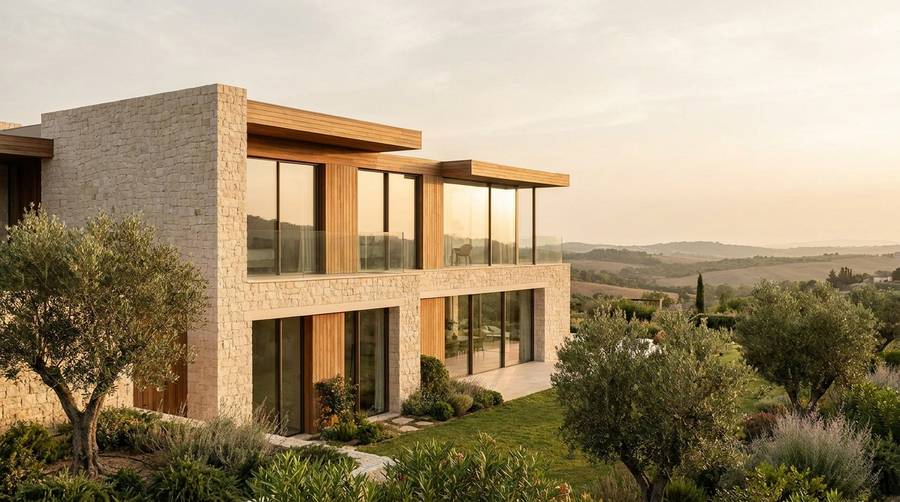
Mediterranean contemporary finished home in Spain at golden hour. A real, premium-looking single-family house built with industrialized methods but shown as a completed, lived-in home. Light-colored façade combining smooth concrete, warm wood cladding and natural stone details. Large panoramic windows with warm interior light visible, a furnished terrace with outdoor dining and potted Mediterranean plants (olive or rosemary). Soft landscaped garden, short pines or low-maintenance shrubs, and a subtle paved path. Natural, warm palette; comfortable human scale; editorial real-estate photographic quality; no visible construction, modules or technical elements. Atmosphere: trust, modern comfort and sustainability. Composition balanced for web hero image, with Findnido branding subtly reflected in a small corner palette or logo if needed.
Artículos relacionados