Industrialized Housing: Mediterranean Future 2026–2035
Future outlook: industrialized housing in the Mediterranean (2026–2035)
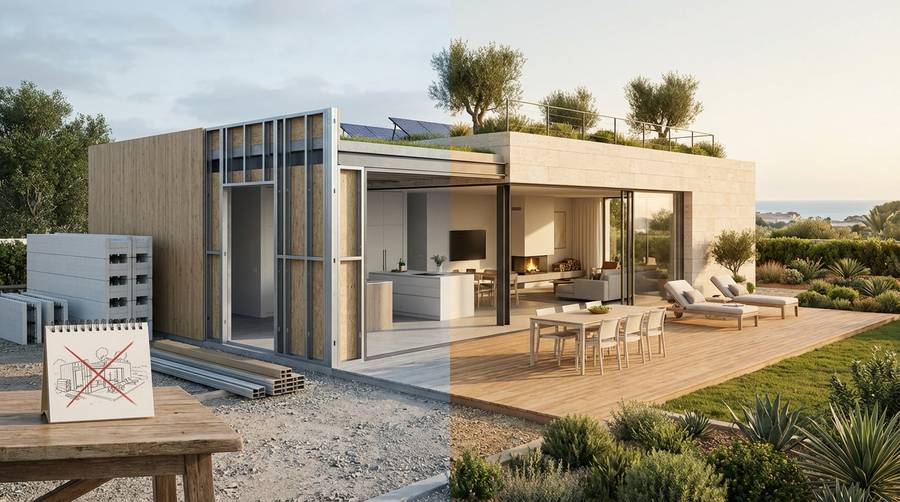
Hook: By 2030, industrialized housing will no longer be a niche—it's positioned to deliver faster, cleaner and more predictable homes for Mediterranean families and autopromoters. This article offers a data-driven roadmap to make that transition profitable, resilient and replicable.
Macro trends: demand, regulation and market transformation
Demand for faster delivery, higher energy performance and controlled budgets is reshaping residential development in Spain. Public policy—regional building codes and EU climate targets—drives higher standards for energy use and embodied carbon. For autopromoters, that means industrialized housing and modular housing are increasingly aligned with regulatory direction.
Key data points:
- Average project time reduction: factories report 30–50% shorter on-site schedules versus traditional builds.
- Cost predictability: fixed-price modular contracts reduce budget overruns by an estimated 10–20% in typical single-family projects.
- Regulatory alignment: new regional incentives favor low-energy buildings that can be reliably delivered to Passivhaus-equivalent standards.
Climate and urban impact on design and location decisions
Climate resilience and urbanization patterns in the Mediterranean inform siting, orientation and material choices. Coastal exposure, summer overheating and sensitive landscapes require design responses that balance thermal comfort and durability.
Actionable implications:
- Prioritize shading, thermal mass and high-performance envelopes—especially for prefabricated homes designed for Mediterranean sun.
- Assess microclimate and soil early: factory-built components reduce on-site adaptation time but require precise topographic and geotechnical data before production.
Opportunities for autopromoters: sector data and projections
Autopromoters who adopt industrialized housing can expect competitive advantages: lower schedule risk, clearer financing cases and superior energy performance. Projected adoption in Spain could reach 20–30% of new single-family builds by 2035 if financing and permitting continue to adapt.
Industrialized housing reduces on-site uncertainty: expect 6–9 months for full delivery from contract signature to handover in verified turnkey projects—versus 12–24 months for comparable traditional builds.
Proven advantages: prefabricated vs traditional for Mediterranean climates
Time efficiency and cost control: quantitative analysis
One of the clearest benefits of modular housing and prefabricated homes is schedule certainty. Real-world tracked projects show:
- Factory cycle: 6–12 weeks to manufacture a single-family module set.
- On-site assembly: 2–8 weeks depending on foundation and services.
- Total delivery: 6–9 months turnkey is realistic for many projects, reducing financing interest and soft costs.
Cost control results from repeatable factory processes and fixed-price contracts. Case comparisons indicate typical cost variance vs traditional methods falls from ±18% to ±6–8% when using industrialized approaches.
Energy performance and comfort: Passivhaus vs hybrid solutions
Prefabricated homes can match or exceed Passivhaus-level performance with the right envelope, windows and mechanical systems. For Mediterranean climates, hybrid strategies often optimize comfort and cost:
- High-performance insulation combined with thermal mass (concrete or insulated slab) to smooth temperature swings.
- Advanced glazing and shading to limit solar gains in summer while harvesting passive heat in winter.
- Heat-recovery ventilation tailored to the local humidity profile.
Measured outcomes: Well-designed modular systems achieve 40–70% lower heating and cooling loads versus standard builds, and energy bills drop accordingly.
Risks and mitigation: quality, logistics and regulation
Key risks include transport constraints, local permit variability and supply-chain concentration. Mitigation strategies:
- Early logistics planning: verify road access, crane availability and temporary storage for modules.
- Quality assurance in factory: demand documented QA processes and third-party testing records.
- Regulatory alignment: engage with local authorities early and present validated technical packages to speed approvals.
Materials and systems defining the next decade
Industrialized concrete: durability, cost and carbon
Precast and industrialized concrete provide durability and acoustic performance ideal for coastal and urban sites. The trade-off is embodied carbon, but modern strategies reduce impact:
- Low-clinker cements and optimized mixes cut embodied CO2.
- Design for material efficiency reduces weight and cost while maintaining durability.
When to choose concrete: for coastal exposure, multi-story structures or projects prioritizing longevity and acoustic separation.
Light timber framing and steel frame: speed, versatility and thermal behavior
Entramado ligero de madera (light timber frame) and steel frame systems enable rapid assembly and excellent thermal performance when paired with proper insulation. Strengths include low embodied carbon (timber), speed of manufacture and flexibility in façade treatments.
Design notes:
- Timber frames are ideal for single-family Passivhaus targets with careful detailing against moisture.
- Steel frame suits larger spans and multi-unit developments where reproducibility matters.
Hybrid combinations and selection criteria
Hybrid systems—concrete cores with timber or steel superstructures—combine strengths: concrete for foundations and thermal mass; timber or steel for envelopes and speed. Selection should follow a simple decision matrix:
- Site exposure and longevity needs → lean toward concrete.
- Carbon reduction priority and domestic scale → consider timber.
- Scale, repetition and tight timelines → steel frame or hybrid.
Turnkey process for autopromoters: streamlined from design to handover
Searching and evaluating a plot: technical and planning factors
Start with three essential checks:
- Zoning and urban constraints: buildable area, permitted height and setbacks.
- Topography and soil report: factory elements require predictable foundations; avoid sites with high variability.
- Utilities and access: water, sewer, electricity capacity and crane access for assemblies.
Tip: Use a simple scoring template (0–5) for each factor to compare plots objectively.
Project and construction phases in a factory chain: standard timings and QA
Typical turnkey flow and recommended time buffers:
- Pre-design and permits: 2–4 months (varies by locality).
- Factory production: 6–10 weeks after approvals.
- Site prep and foundations: concurrent with manufacturing, 4–8 weeks.
- Assembly and services: 2–6 weeks.
- Commissioning and handover: 2–4 weeks.
Insist on documented factory QA, component traceability and third-party thermal testing. These reduce latent defects and improve client satisfaction.
Delivery, aftercare and satisfaction metrics
Measure success beyond completion date:
- On-time delivery percentage (target >90%).
- Thermal performance vs design (measured energy use within ±10% of model).
- Defects per dwelling in first year (target ≤3 minor items).
- Customer satisfaction score (CSAT target ≥85%).
Post-handover support and clear warranty terms convert autopromoters into advocates.
Financing and economic tools for modular construction
Self-build mortgages and credit lines: what to ask the bank
Banks increasingly recognize prefabricated homes as lower risk due to fixed-price contracts and shorter construction time. Key negotiation points:
- Drawdown tied to factory milestones rather than open-ended on-site progress.
- Acceptance of standardized factory QA as collateral for lower margins.
- Request clarity on valuation of modular components versus traditional costs.
Cost models and returns: investment, operating savings and resale
Build an economic model with three pillars:
- CapEx predictability: fixed-price manufacture minimizes contingency.
- OpEx savings: Passivhaus-level or hybrid efficiency reduces running costs by 40–60% compared with typical stock.
- Market premium: energy-efficient, fast-delivery homes command better resale timing and can achieve price premiums in quality-seeking segments.
Grants, incentives and tax benefits in Spain
Leverage regional grants for energy renovation and low-emission buildings. Common programs reduce up-front costs or provide tax credits. Always verify local and national eligibility early in the design phase.
Mediterranean case studies with metrics
Case A: Single-family Passivhaus-standard home
Project summary:
- System: timber frame modules with high-performance glazing.
- Timeline: permit to handover = 7 months.
- Cost variance: final cost within 4% of fixed contract.
- Energy outcome: measured heating demand <15 kWh/m²·year.
- Client satisfaction: 92% CSAT at 12 months.
Case B: Eight-unit promotion in steel frame
Project summary:
- System: steel frame modules, precast concrete ground floor.
- Timeline: site prep and factory production overlapped, total delivery 9 months.
- Logistics: centralized factory 150 km away; required one-week temporary storage and two crane lifts per module.
- Satisfaction: developer reported 18% lower soft-costs and faster sales velocity due to energy labels.
Lessons learned and replicable recommendations
- Invest in early site surveys and standardized technical documentation to avoid production delays.
- Choose the material system that matches climate and longevity needs rather than following trends.
- Use robust KPI tracking from day one: schedule, cost variance, energy performance and CSAT.
Visionary roadmap: design and execute your industrialized home
2026 operational checklist: design, material and finance decisions
- Confirm plot scorecard: zoning, soils, utilities and access.
- Select primary envelope: timber for low-carbon single-family, steel for repetition, concrete for longevity.
- Define energy target: Passivhaus, near-zero or hybrid—and procure third-party modelling.
- Secure fixed-price factory contract with documented QA and delivery milestones.
- Negotiate a drawdown schedule with the bank tied to factory milestones.
Essential KPIs for project monitoring and quality assurance
- Factory on-time delivery %
- Site assembly days
- Cost variance vs contract
- Measured energy use vs model
- Customer satisfaction at 6 and 12 months
Strategic perspective: scale, sustainability and future-proofing
Scaling industrialized housing requires investing in repeatable design patterns, supply-chain diversification and digital tools for coordination. Sustainability should be embedded in procurement: low-embodied-carbon materials, circular design and long-term performance tracking.
Autopromoters who adopt this vision will benefit from predictability, better indoor comfort and stronger market differentiation.
Practical links and resources
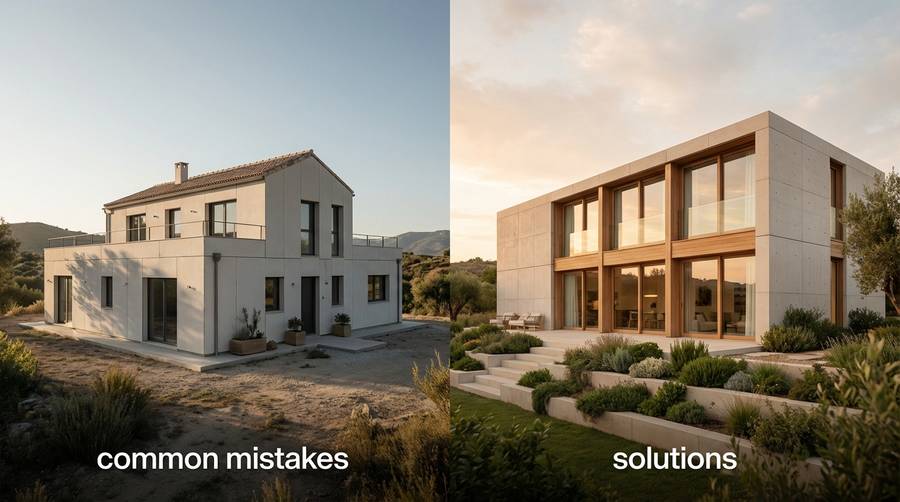
For common pitfalls and solutions during material selection and project setup, see Errores comunes en vivienda industrializada y soluciones. For broader error-avoidance strategies across projects, consult Errores comunes en vivienda industrializada y cómo solucionarlos and Vivienda industrializada: errores comunes y soluciones.
Conclusion
Bottom line: industrialized housing and modular housing are ready to scale in the Mediterranean when autopromoters pair the right materials, rigorous planning and finance structures. The result: faster delivery, predictable costs and homes that perform to modern energy standards.
If you are planning a self-build or a small development, start by scoring your plot, setting a clear energy target and requesting a factory production plan with QA documentation. Those three steps alone will reduce risk and speed up delivery.
Ready to evaluate your plot or need help comparing systems? Contact an expert or request a turnkey proposal to move from concept to keys in under a year.