Passivhaus Premium: Common Errors and Fixes
Introduction — Hook: why small mistakes cost a Passivhaus
If you aim for a Passivhaus Premium modular home, minor errors early on can undo months of effort and thousands in savings. This guide lists the predictable mistakes project teams and self-builders make in Spain and gives clear, practical solutions you can apply immediately. Read on to avoid schedule slips, performance gaps and financing headaches.
80% of project disputes in industrialized housing arise from unclear performance requirements and missing verification steps. Define, measure, document.
Why Passivhaus Premium is different — avoid initial misunderstandings
Common myths about industrialized housing and the reality of Passivhaus
Myth: A modular or industrialized house is automatically energy-efficient. Reality: Industrialization controls quality and speed, but Passivhaus performance requires deliberate design, component selection and rigorous testing.
- Action: Require a target energy demand in kWh/m2·yr in contracts, not vague promises.
- Action: Ask for a validated PHPP (Passive House Planning Package) model during design stage and keep iterations auditable.
What to expect in energy performance and comfort (and what is not immediate)
Passivhaus delivers high comfort and low energy use, but there are transition issues after handover:
- Initial indoor humidity and temperature require a short adjustment period to calibrate ventilation and occupant habits.
- Performance gains appear over the first heating/cooling season once occupancy patterns stabilize.
Action: Plan a 6–12 month post-occupancy monitoring window in your contract and require a handover report that includes baseline sensor readings.
How to set clear objectives before choosing team and budget
Define three measurable targets before signing any agreement:
- Primary: Heating demand (kWh/m²·yr) and airtightness (n50)
- Secondary: Delivered thermal comfort metrics and ventilation rates
- Schedule: factory production windows and on-site assembly dates
Action: Use these targets to compare bids and to tie payments to verifiable milestones.
Errors when choosing the structural system and how to fix them
Confusing initial price with total life-cycle cost — calculate real costs
Many clients pick the lowest quote without a life-cycle view. That leads to higher energy, maintenance and retrofit costs later.
- Fix: Request a simple life-cycle cost table from bidders spanning 30 years (construction cost, energy, maintenance, major replacements).
- Fix: Include assumed energy price escalation and discount rates used in the calculation.
Choosing a system without considering climate and plot — adapt concrete, timber or steel
Each structural system has strengths:
- Industrialized concrete: thermal mass, fire resistance; ideal for inland climates with high diurnal swings.
- Light timber frame: excellent embodied carbon profile and rapid factory assembly; suits mild Mediterranean climates and flexible detailing.
- Steel frame (steel frame): precise tolerances, long spans; useful where large open plans or heavy façades are required.
Fix: Match the system to the site microclimate, orientation and local regulations. Ask bidders to justify their choice with a 1-page climatic rationale.
Not asking for real references and metrics — demand case studies and sealed timelines
Words are cheap. You need documented projects with dates, measured airtightness, PHPP or equivalent outputs and client contacts.
- Fix: Require three completed case studies with: completion date, final n50, delivered kWh/m²·yr, and a client testimonial.
- Fix: Insist on contractually binding factory production windows and penalties for missed start dates on site (excluding force majeure).
Common failures in energy design and practical solutions
Underestimating the thermal envelope — criteria to meet Passivhaus requirements
Weak spots in the envelope are the most common path to failing performance. Focus on:
- Continuous insulation with defined U-values for roof, walls and floors.
- Detailing at junctions to eliminate thermal bridges.
- Material hygrothermal behavior to avoid condensation risk.
Fix: Require detail drawings at 1:5 for all junctions and a thermal-bridge calculation appendix before factory cutting.
Errors in ventilation and airtightness — essential checks and tests
Ventilation systems are the heart of Passivhaus indoor quality. Common mistakes include undersized ductwork, poor commissioning and missing balancing.
- Fix: Specify commissioning that includes flow measurement at each terminal and a documented balancing certificate.
- Fix: Make a blower door test contractual: pre-sealing (factory) and final on-site test with report.
Wrong window placement and shading — optimize orientation and glazing
Windows drive gains and losses. Mistakes include oversizing south glazing without shading or placing large west-facing glass without protection.
- Fix: Use solar gain calculations per orientation and specify g-values and U-values in the contract.
- Fix: Integrate passive shading (overhangs, adjustable screens) early in the design to avoid costly changes later.
Choosing materials and finishes: errors and premium alternatives
Selecting materials by looks without validating performance — key technical sheets
A beautiful cladding can hide poor thermal or moisture performance.
- Action: For every finish, request the technical data sheet: thermal conductivity, water vapor resistance, maintenance needs and fire rating.
- Action: Approve finishes only after a compatibility check with the building physics model.
Ignoring carbon footprint and durability — choose sustainable recyclable options
Sustainable choices reduce lifetime costs and regulatory risk.
- Prefer timber from certified sources for non-structural façades.
- Prefer low-carbon concrete mixes for foundations and load-bearing elements where thermal mass is beneficial.
Interior finishes that compromise efficiency — aesthetic solutions that preserve performance
Heavy interior insulation or sealing changes after finishing can degrade airtightness.
- Fix: Set airtightness and ventilation interfaces before interior finishing and protect penetrations (plumbing, electrics) with documented seal strategies.
- Fix: Use breathable finishes where hygrothermal behavior requires it (e.g., lime-based paints).
Problems in the turnkey process and how to prevent them
Lack of plot planning and permits — a Spain-specific checklist
Permitting delays are frequent and expensive in Spain. Missing local constraints can force redesigns.
- Check municipal urban plan (PGOU) restrictions: occupancy, setbacks and heights.
- Confirm connection capacity for water, electricity and wastewater with providers.
- Obtain all required licences before ordering factory production where possible.
Poor coordination between industrial supply and on-site work — keys to avoid delays
Mismatch between factory delivery and site readiness causes storage, damage and schedule issues.
- Fix: Produce a joint logistics plan with on-site readiness milestones, a handover window and a contingency storage plan.
- Fix: Nominate a single logistics coordinator to manage supplier timings and site contractor arrivals.
Incorrect financing setup (self-builder mortgage) — recommendations to secure cashflow
Autopromoter mortgages require clear cost phases. Common pitfalls: under-budgeting VAT, plot costs or unexpected civil works.
- Fix: Work with lenders experienced in modular housing and ask for staged drawdowns tied to factory milestones.
- Fix: Include a 5–10% contingency specifically for on-site civil adaptations and permit delays.
Errors at handover and commissioning: guarantees and final checks
Not performing performance tests (blower door, thermography) — when and how to demand them
Testing is not optional. Schedule tests at these stages:
- Factory-level pre-sealing test (if possible) before shipment.
- On-site blower door and ventilation balancing after final sealing and before interior finishes where feasible.
- Thermographic inspection during the first heating season to confirm expected thermal behavior.
Fix: Require certified test reports and include acceptance thresholds in the contract (e.g., n50 target and remedial plan if exceeded).
Forgetting technical documentation and maintenance guides — deliverables you must get
Projects often close without clear operation data, which reduces long-term performance.
- As-built drawings and thermal-bridge maps
- Ventilation balancing report and MEP manuals
- Maintenance schedule for mechanical systems and façades
Not planning post-delivery follow-up — maintenance contracts and measurement
Performance drifts if systems are not maintained. Include a post-delivery package:
- 12 months of monitoring with quarterly reports.
- Optional extended maintenance contract covering MVHR filters, controllers and warranty coordination.
Closing the project without surprises: a Passivhaus Premium checklist
Summary of final controls before sign-off
- Contractual performance targets met (PHPP outputs documented)
- Passed blower door and ventilation balancing tests with reports
- All permits closed and utility connections verified
- As-built documentation and maintenance manuals delivered
How to document and claim deviations from the contractor
If tests reveal deviations, follow a documented remediation path:
- Issue a formal non-conformance report with photos, measured data and a deadline.
- Agree on remedial actions and a re-test date. Hold back final payment until accepted benchmarks are met.
Usage and maintenance plan to preserve performance and value
Protect your investment with a simple living plan:
- Seasonal ventilation checks
- Filter change schedule and basic occupant guidance
- Long-term replacement plan for mechanical systems at realistic intervals
Practical case snapshot: timelines, costs and satisfaction (anonymized example)
Example project (Spain, Mediterranean): 150 m² Passivhaus Premium home using timber frame.
- Factory production: 10 weeks
- On-site assembly and finishes: 8 weeks
- Total turnkey time: 18–22 weeks (including permits)
- Initial airtightness (n50): 0.35 h−1 — blower door certified
- Measured heating demand first year: 12 kWh/m²·yr
- Client satisfaction: high — praise for fixed price and predictable schedule; minor snagging completed in 6 weeks.
Key lessons: early permit resolution and a clear logistics plan reduced on-site delays. Contractual test thresholds simplified dispute resolution.
Final recommendations: protect performance from day one
To secure a successful Passivhaus Premium modular project in Spain, prioritize measurable targets, insist on documented testing and include post-occupancy verification in contracts. Keep decisions site-led: orientation, shading and material selection must respond to the plot, not just to factory convenience.
Conclusion — a short checklist and subtle CTA
Checklist to act now:
- Define numeric Passivhaus targets and include them in the contract.
- Request PHPP and junction details before production.
- Contract blower door, ventilation balancing and thermography tests with pass/fail criteria.
- Structure financing with staged draws tied to factory and on-site milestones.
If you are planning a Passivhaus Premium modular home and want a practical audit of your project brief, permits or contractor bids, consider contacting a specialist to review your documents. A short technical review early can prevent the most expensive mistakes.
Related reading: Learn more about high-performance modular design in Passivhaus industrializada: el futuro de la vivienda modular.
Image brief for Findnido AI generation
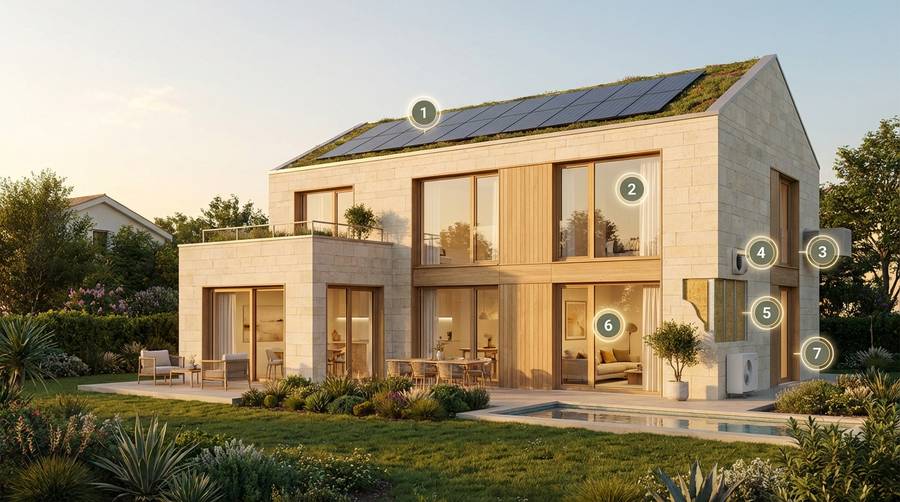
Photograph-style image for article header: Mediterranean contemporary finished home in Spain at golden hour. Premium industrialized residence with light façade, wood and concrete details, large windows and a furnished terrace with subtle family presence. Garden with Mediterranean plants; warm natural lighting, architectural-magazine framing. The home must look finished and high quality—no visible construction, no modular joints exposed, no boxy container aesthetic. Style: realistic, aspirational, trust-inspiring, consistent with Findnido brand.
Artículos relacionados