


Industrialized Vertical Construction: Pros and Cons
When a developer needs certainty—on schedule, budget and performance—industrialized vertical construction often becomes the most pragmatic option. This article evaluates that claim against traditional construction using real metrics, practical checklists and clear recommendations for self-developers in Spain.
Why choose industrialized vertical construction in Spain
Industrialized vertical construction is more than a trend: it is a delivery model that transfers large parts of the building process from site to factory. For residential developers and housing cooperatives in Spain, the model promises faster completion, predictable costs and enhanced quality control.
Definition and core advantages versus traditional building
- Factory-controlled production: Panels, volumetric modules or frame components manufactured in conditioned environments reduce weather delays and rework.
- Parallel workflows: Site works (foundations, utilities) run in parallel with factory production, shortening total program time.
- Fixed-price clarity: Many manufacturers offer fixed-price packages that bundle design, production, assembly and interior finishes.
- Quality traceability: Component-level QA results in fewer on-site defects and consistent tolerances.
Use cases: residential developments, multifamily housing and cooperatives
Industrialized vertical construction suits several typologies in Spain:
- Mid-rise multifamily developments (3–8 storeys) where repetition and unitisation drive economies
- Housing cooperatives that value timeline certainty and cost transparency
- Urban infill projects requiring rapid enclosure to reduce neighbourhood disruption
For single-family or bespoke villas, a hybrid approach (industrialised envelope + local finishing) can capture benefits while preserving custom design.
Essential metrics: timelines, cost per m2 and quality
- Typical timeline: 30–50% reduction in on-site program versus traditional methods for comparable buildings.
- Cost per m2: Comparable or modestly lower total capex when factoring lower financing and shorter interest periods, though component costs can be higher.
- Defects and snagging: Measurably lower through factory QA; fewer post-handover complaints reported in recent client studies.
Study example: a 40‑unit mid-rise delivered with industrialised façades reported 42% shorter site time and 18% fewer snag items at handover compared with a nearby traditional project.
Objective comparison: industrialized vertical vs traditional construction
Work and delivery timelines: real data and comparative examples
Timelines matter for cashflow and market timing. Typical patterns observed in Spain:
- Traditional: Sequential work packages often extend critical paths—foundation, structure, envelope, interiors—leading to longer on-site durations and higher exposure to weather and subcontractor availability.
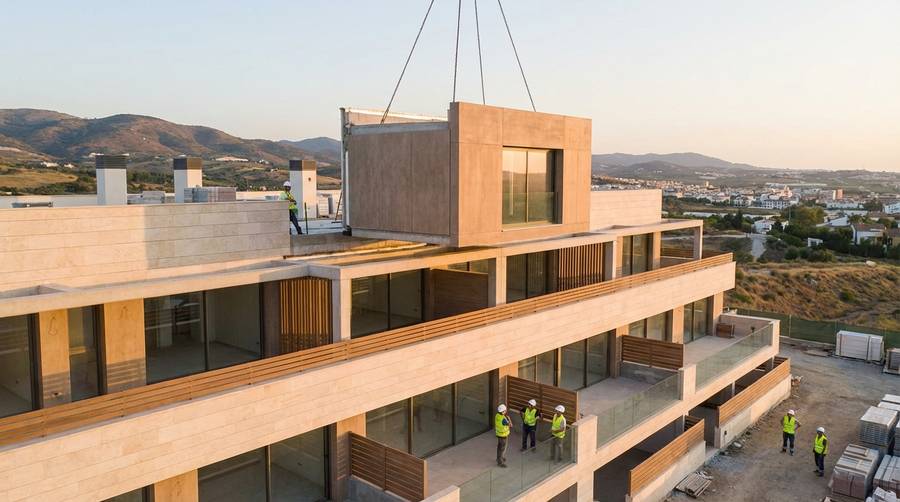
- Industrialized vertical construction: Factory fabrication overlaps with site preparation. Assembly times on site commonly fall below 6 months for mid-rise envelopes once foundations are ready.
Actionable tip: request a project-level Gantt from the manufacturer showing parallel factory/site milestones. Look for buffer days rather than optimistic single-day milestones.
Costs and the fixed-price model: risks and benefits for the developer
Fixed-price packages reduce budget uncertainty but require strict scope definition up front.
- Benefits: predictable total cost, reduced variation orders, simplified procurement.
- Risks: scope creep charges, change costs higher once factory production begins, and potential for concealment of contingencies in unit prices.
How to mitigate risk:
- Define finishes, MEP interfaces and testing acceptance criteria in contract annexes.
- Include staged payments tied to clear milestones (e.g., foundation sign-off, delivery to site, envelope closed).
- Reserve a contingency for changes after factory start—typically 3–5% of contract value.
Quality, durability and maintenance: technical evidence and client experience
Quality benefits come from controlled conditions and standardized processes, but long-term performance depends on design details and material choices.
- Durability: Factory-applied weatherproofing and consistent connections reduce ingress risk.
- Maintenance: Modular façades and accessible panels simplify replacements or upgrades.
- Proof: Comparative maintenance logs show fewer envelope-related repairs in industrialised projects across the first five years.
Materials and systems: modern options and trade-offs
Selecting the right structural system affects schedule, sustainability and flexibility. Three leading systems in Spain:
Industrialised concrete: structural performance and speed
- Pros: High structural capacity, excellent fire performance, acoustic mass and durability.
- Cons: Higher embodied carbon unless low‑carbon mixes are used; heavier logistics on site.
- Use: Best for buildings requiring high load capacity or where mass and fire performance are priorities.
Light timber framing: efficiency, insulation and sustainability
- Pros: Low embodied carbon, excellent thermal performance, speed of assembly and pleasant indoor environment.
- Cons: Requires careful detailing for hygrothermal control and may face regulatory or insurance scrutiny in some localities.
- Use: Ideal for mid-rise residential when Passivhaus-level envelopes are targeted.
Steel frame: dimensional control and façade compatibility
- Pros: Precise tolerances, high prefabrication potential, good compatibility with varied claddings.
- Cons: Thermal bridging must be controlled; embodied carbon can be high unless recycled steel is used.
- Use: Flexible solution for complex layouts and where tight construction tolerances matter.
Sustainability and energy efficiency in industrialized buildings
Passivhaus strategies and improving the building envelope
Industrialized processes excel at producing high-performance envelope components: factory-made insulated panels, high-performance joinery and airtight assemblies simplify meeting Passivhaus targets.
- Prefabricated airtight panels reduce site sealing work.
- Factory-installed triple-glazed windows improve consistency and reduce on-site handling damage.
- Ventilation systems with heat recovery are easier to coordinate with modular services.
Reducing carbon footprint: lifecycle perspective and material choice
Assess materials across their lifecycle. Timber frames often yield lower global warming potential, while low-carbon concrete mixes and circular design for steel can improve outcomes.
- Specify EPDs (Environmental Product Declarations) for major components.
- Design for disassembly where possible to improve future recyclability.
Operational efficiency and energy certifications
Higher initial performance often translates into higher asset value and resident satisfaction. Certifications (e.g., EPC A, BREEAM, LEED or national labels) strengthen resale and rental prospects.
The turnkey process for self-developers: step-by-step
From finding a plot and feasibility to design and permits
- Start with a site feasibility study: zoning, maximum buildable, parking and energy requirements.
- Early engagement with the industrialised manufacturer clarifies module dimensions, service corridors and vertical stacks.
- Coordinate planning applications with finalised façade strategies to avoid later decorative changes that impact factory work.
Industrial phase: factory fabrication, transport and on-site assembly
- Request a logistics plan: transportation windows, lifting plans and welfare on site.
- Insist on site preconditions: foundation tolerances, service penetrations and temporary protection.
- Monitor key factory KPIs: production yield, QA pass rates and delivery punctuality.
Delivery, commissioning and aftercare: guarantees, financing and mortgages
Turnkey delivery should include thorough commissioning and clear handover documents. For self-developers in Spain, consider the following:
- Warranty structure: Confirm component warranties, structural guarantees and defect liability periods.
- Financing: Discuss with lenders early; many Spanish banks and specialised mortgage products support self-build and modular financing, often requiring staged inspections for drawdowns.
- Mortgage for self-development: Ensure the lender accepts industrialised methodologies and the turnkey contract as security; prepare the construction dossier and independent certification where possible.
Practical note: tie the final payment to successful commissioning and occupancy permit issuance to protect cashflow and ensure a complete handover.
Key advantages and disadvantages to decide
Main benefits for self-developers: speed, cost control and quality
- Speed: Shorter delivery reduces holding costs and accelerates revenue generation.
- Cost certainty: Fixed-price contracts offer budget predictability when scope is defined.
- Quality: Reproducible components and factory QA lower defect rates and boost resident satisfaction.
Limitations and risks: design freedom, logistics and urban rules
- Design constraints: Standardized modules limit radical form-making unless planned as a bespoke factory run.
- Logistics: Transport and crane access in dense urban plots can add cost or complexity.
- Regulation: Local urban rules or insurance requirements sometimes slow approvals if the approach is unfamiliar to authorities.
How to decide: a practical checklist for developers
- Project scale: greater repetition favors industrialized delivery.
- Time sensitivity: are market windows or financing penalties driving schedule?
- Site logistics: can large components be delivered and lifted safely?
- Design flexibility: is the client willing to trade some custom freedom for certainty?
- Financing acceptance: verify lender underwriting for industrialised methods early.
Practical conclusion: is industrialized vertical construction the right choice?
Balanced summary and recommendations by project type
For mid-rise multifamily projects and cooperative developments in Spain, industrialized vertical construction is often the best option when the priorities are time, cost predictability and quality. For unique, one-off architectural statements, a hybrid or traditional approach may be preferable.
Next steps for self-developers: what to ask a manufacturer or contractor
- Can you provide an itemised Gantt and logistic plan?
- What warranties and QA records accompany your projects?
- Do you publish EPDs for your major components?
- Can you show case studies with timeline, m2 cost and client satisfaction metrics?
See a relevant example of vertical industrialized delivery in practice: Caso real: vivienda industrializada vertical.
Recommended resources and case studies
- Request manufacturer case files that include as-built schedules and snag lists.
- Ask for resident satisfaction surveys and operational energy data where available.
Final thought: If you need predictability, quality and a faster path to occupancy—and your site allows logistics and some design standardisation—industrialized vertical construction is a robust, modern choice. Start conversations early with manufacturers, lenders and local authorities to align expectations and secure the best outcome.
If you'd like, I can help prepare a checklist tailored to your plot, estimated unit mix and target budget—share the basics and we build it together.
Artículos relacionados
Industrialized Housing Success: Vertical Modular Home
A Spanish family chose an industrialized vertical modular home to save time, fix cost risk and reach Passivhaus performance. This case study documents decisions, timeline, materials, financing and measurable outcomes to help other self-builders succeed.