Steel Frame Homes: Economic Guide for Spain 2026
Introduction to the steel frame economy in Spain
Steel frame construction has emerged as a leading approach within industrialized housing in Spain. For self-builders and developers seeking predictable costs, shorter schedules and modern performance, steel frame offers a compelling value proposition compared with traditional masonry. This section explains what steel frame is, recent market trends and the main economic advantages that make it attractive for 2024–2026 projects.
What steel frame is and why it matters for industrialized housing
Steel frame is a light-gauge structural system in which cold-formed steel sections create a load-bearing skeleton. Wall panels, floor cassettes and roof elements are prefabricated in factory conditions and assembled on site. The industrialized process reduces on-site labour, improves quality control and speeds up construction. For families and autopromoters, that translates into clearer schedules, fewer surprises and a higher level of finish at handover.
Market trends 2024–2026: demand, costs and opportunities
Across Spain the adoption of industrialized methods has grown steadily. Demand drivers include rising labour costs, a push for lower-carbon construction and consumer preference for energy-efficient homes. Manufacturers report that off-site production helps stabilise material pricing by pooling procurement, while modular logistics and streamlined assembly reduce exposure to on-site delays.
Economic advantages versus traditional construction (efficiency, schedules and fixed price)
Key economic benefits of steel frame homes include:
- Shorter on-site periods: faster enclosure reduces weather risk and finishing delays.
- Higher cost predictability: factory workflows and defined scopes support more reliable fixed-price offers.
- Reduced errors and rework: quality control in production lowers corrective costs.
For autopromoters these advantages often mean lower contingency needs and a clearer timeline for mortgage release stages.
Step-by-step guide to designing a steel frame industrialized home (Spain 2026)
This practical guide is aimed at families and self-builders pursuing an industrialized steel frame home in Spain. It covers the planning, design and turnkey delivery stages with emphasis on energy performance and cost control.
Initial planning: plot selection, regulations and feasibility study
Begin with a realistic feasibility study. Verify urban planning rules, buildability ratios, setbacks and maximum height. A structural and geotechnical review ensures the plot suits a light-frame foundation system. Early engagement with an industrialized housing platform helps align factory module dimensions with access and crane requirements.
Design and engineering: integrating steel frame with Passivhaus principles
Designing for Passivhaus or high energy efficiency requires coordination between architectural layout, thermal envelope details and mechanical systems. In a steel frame approach this means:
- Continuous insulation strategies to avoid thermal bridging at connections.
- Airtightness planning integrated into panel joints and window installations.
- Mechanical ventilation with heat recovery sized to the domestic load.
Factory-controlled assembly helps ensure airtightness and predictable thermal performance when panels are manufactured under certified conditions.
Typical schedule and cost control: from project to turnkey delivery
A representative timeline for a turnkey steel frame single-family project often follows these stages: site preparation and permits (8–16 weeks), factory production (6–10 weeks), on-site assembly and enclosure (1–3 weeks), finishes and commissioning (6–12 weeks). Clear milestones tied to payments improve lender confidence and help secure autopromoter mortgages.
Modern materials and sustainability: technical comparison
Choosing the right structural system affects performance, lifecycle cost and embodied carbon. Below is a technical comparison to guide material selection for industrialized housing projects in Spain.
Steel frame vs light timber frame and industrialized concrete: performance, durability and cost
Each system offers strengths:
- Steel frame: high precision, strength-to-weight ratio, excellent for modular repeatability and long spans. Durable and non-combustible, but requires careful thermal break design to limit bridging.
- Light timber frame: natural thermal properties and low embodied carbon; excellent for breathing walls and integrated finishes. Susceptible to moisture if not detailed correctly.
- Industrialized concrete (precast): mass and thermal inertia that smooth internal temperatures, high durability and acoustic performance. Typically heavier with more complex logistics.
Cost depends on design complexity, finishes and transport. A competitive approach uses hybrid solutions—steel for structure, timber for partitions, and concrete for foundations or key slabs—to balance cost, performance and sustainability.
Energy efficiency and carbon reduction (Passivhaus strategies applied)
Applying Passivhaus strategies to industrialized homes reduces operational energy and carbon emissions. Core measures include high-performance insulation, elimination of thermal bridges, exceptional airtightness, efficient windows and a mechanical ventilation system with heat recovery. Prefabrication supports consistent assembly quality, making it easier to achieve Passivhaus targets and reduce lifetime energy costs.
Selecting finishes and systems to minimise maintenance and maximise value
Choose durable, low-maintenance exterior finishes like rendered mineral coatings, natural stone accents or responsibly sourced wood cladding. For roofs and terraces, use robust waterproofing systems and consider discreetly integrated photovoltaics to enhance sustainability without compromising aesthetics. Selecting accessible service routes for mechanical systems reduces future maintenance costs and protects resale value.
Case studies and real metrics
Below are anonymised examples illustrating timelines, cost ranges and client satisfaction outcomes derived from completed industrialized housing projects managed through integrated platforms.
Case 1: Single-family steel frame home — timeline, final cost and client satisfaction
Project profile: single-family home on a suburban plot using a steel frame panelised system. Key outcomes reported by the delivery team included a factory production lead time of eight weeks, on-site assembly and enclosure in two weeks and full turnkey handover within four months from mobilization. The client reported high satisfaction with predictability of costs and thermal comfort. Energy consumption measurements in the first year showed a marked reduction compared with nearby traditional-built homes of similar size.
Case 2: Turnkey modular development — cost variation by typology and plot
Project profile: small promotion of modular townhouses delivered under turnkey contracts. Costs varied primarily due to plot access, foundation complexity and interior fit-out level. The platform approach allowed consistent per-unit pricing for identical typologies, while bespoke adaptations for plot constraints were costed transparently. Delivery schedules remained stable thanks to concurrent factory production and site groundwork.
Practical lessons and KPIs for self-builders (timelines, deviations and energy savings)
Common lessons include:
- Early geotechnical investigation avoids later foundation change orders.
- Standardised module dimensions reduce custom engineering time and costs.
- Careful integration of MEP (mechanical, electrical, plumbing) systems in factory phases reduces on-site coordination hours.
Useful KPIs to track are schedule adherence (target: <10% deviation), achieved airtightness (target: Passivhaus thresholds where applicable) and first-year energy use compared to baseline estimates.
Financing, self-builder mortgages and the turnkey process
Securing finance and understanding what a turnkey service includes are essential steps for autopromoters. This section summarises available routes and practical advice to structure a viable budget and obtain a mortgage for self-build projects.
Financing options specific to industrialized housing and self-builders in Spain
Lenders increasingly recognise industrialized construction as lower risk when projects use established suppliers and fixed-price turnkey contracts. Options include:
- Self-build mortgage releases tied to defined milestones (permits, foundation, enclosure, handover).
- Personal loans or bridging facilities for plot purchase combined with a construction mortgage.
- Green mortgages or preferential rates for energy-efficient homes, when homes meet recognised standards such as Passivhaus or equivalent energy certifications.
How to structure a realistic budget and secure a self-build mortgage
Key steps to strengthen a mortgage application:
- Present a turnkey contract with a reputable industrialized housing provider showing fixed-price milestones.
- Include a schedule of payments matched to construction milestones to align with lender disbursements.
- Demonstrate technical due diligence (site studies and certified plans) to reduce perceived risk.
Realistic contingencies of 5–10% typically suffice for industrialized projects because factory-controlled processes reduce unexpected trades on site.
What a turnkey service includes and key responsibilities to hand over
A true turnkey service normally covers:
- Full design coordination and permit management.
- Factory production and logistics of panels or modules.
- On-site assembly, finishes, commissioning and certification.
Clear responsibilities should be defined in the contract regarding site readiness, utility connections and local fees so the client understands which items they must prepare before mobilisation.
Visual description for the article image (Findnido)
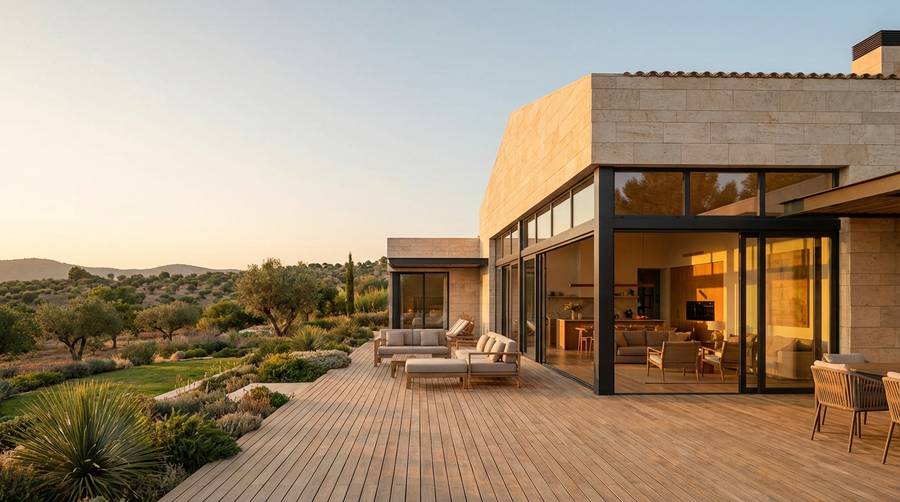
Brief: Architectural photograph of a Mediterranean industrialized steel frame home
Photograph of a finished Mediterranean-contemporary single-family house realised with industrialized construction. The home features light stone and warm wood façades with subtle concrete details, large floor-to-ceiling windows, and a landscaped terrace with Mediterranean plants. Golden hour lighting, human-scale composition and a lived-in atmosphere convey comfort, sustainability and modern family life.
Detailed AI image prompt for generator
Real estate photography of a finished Mediterranean-contemporary single-family home built using industrialized methods (category: Economía del steel frame). Style consistent with Findnido brand: premium, modern, warm and trustworthy. Exterior: light stone and warm wood cladding, subtle concrete accents, large glazed sliding doors and generous terraces. Setting: residential plot with low stone boundary, olive trees and Mediterranean shrubs, stone-paved terrace with a set table and subtle family presence (one or two people blurred or in soft focus). Lighting: golden hour soft daylight, warm interior glow. Composition: balanced architectural magazine framing, human scale, no exposed construction, no container or box-shaped modules, no industrial background. Include discreet photovoltaic panels integrated into the roof and visible sustainable landscaping. Photographic look: high-quality architectural magazine, natural colours, soft shadows, aspirational but realistically achievable Spanish home.
By following this guide, self-builders and developers in Spain can evaluate the steel frame route with confidence. Industrialized housing offers a modern, sustainable and economically sound path to building a high-quality home with controlled costs and timelines. For autopromoters seeking a turnkey solution, the focus should be early planning, solid contractual milestones and selecting materials and systems that deliver long-term comfort and low running costs.