Turnkey Modular Home Spain: Complete Guide 2026
Start with a clear vision: why a turnkey modular home in Spain is different
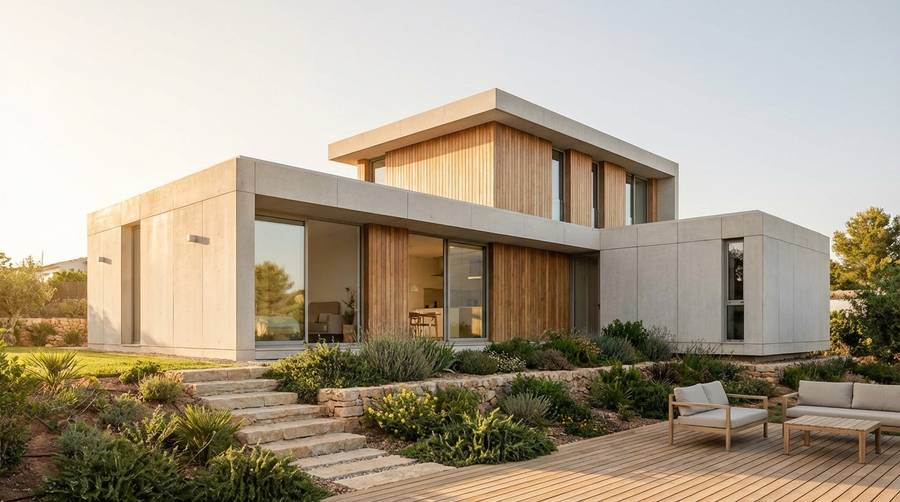
Imagine signing a single contract and seeing your finished home delivered on schedule. That certainty — predictable costs, controlled timelines and industrial quality — is the core promise of a turnkey modular home Spain solution. This guide gives self-builders a practical roadmap to assess, plan and execute a modular, industrialized house in Spain in 2026.
Choosing a turnkey modular home reduces on-site time by up to 60% and can lower unexpected cost variation by half compared to bespoke traditional builds.
Why choose a scalable turnkey model in Spain (Guide 2026)
Definition and key advantages of scalable turnkey models
A turnkey modular home Spain model means the provider manages design, factory production, site works and final delivery under a single contract. Key advantages:
- Single point of accountability: fewer coordination gaps and clearer warranties.
- Factory-controlled quality: consistent finishes, reduced rework and tighter tolerances.
- Predictable delivery: fixed schedules for manufacturing and on-site assembly.
- Scalability: modular solutions that adapt from single-family homes to paired or clustered units.
Self-builder profile: who benefits and why
Turnkey modular homes suit autopromoters who want control without managing daily construction headaches. Typical profiles:
- Professionals with limited time who prioritise schedule certainty.
- Families seeking energy-efficient, modern homes with predictable budgets.
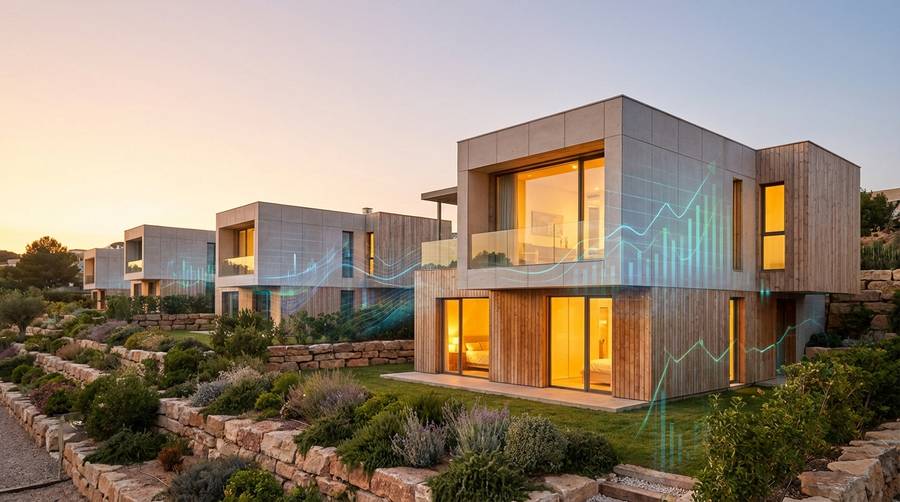
- Investors building repeatable, scalable housing prototypes on multiple lots.
Trends 2026: market, regulation and demand for industrialized housing
In 2026 Spain continues to see greater regulatory clarity and demand for industrialized housing driven by affordability and sustainability targets. Expect:
- Stricter energy codes pushing near-Passivhaus envelopes.
- Shorter permitting cycles for well-documented modular systems.
- Growing lender familiarity with modular valuations and mortgage frameworks.
Practical advantages over traditional construction
Time efficiency: closed timelines and reduced uncertainty
A properly delivered turnkey modular home Spain compresses the critical path by executing parallel processes: while foundations and site works proceed, modules are manufactured in the plant. Practical outcomes:
- On-site assembly often completed in days to weeks rather than months.
- Weather delays are minimised because most work occurs indoors.
- Better schedule predictability for moving in and financing milestones.
Costs and fixed price: predictability and reduced overruns
Fixed-price contracts are common in turnkey offers. To make them effective:
- Ensure the contract clearly defines scope, finishes and allowances.
- Use contingency and change-order clauses that protect both parties.
- Request a unitised cost breakdown (modules, site works, services) to compare providers objectively.
Industrialised quality control: finishes, warranty and less rework
Factory environments enable repeatable quality. Look for:
- Third-party inspections during production stages.
- Clear warranty terms for structure, envelope and systems.
- Photographic progress logs and factory acceptance tests as deliverables.
Recommended materials and systems for scalable projects
Industrialised concrete: when to choose it and structural benefits
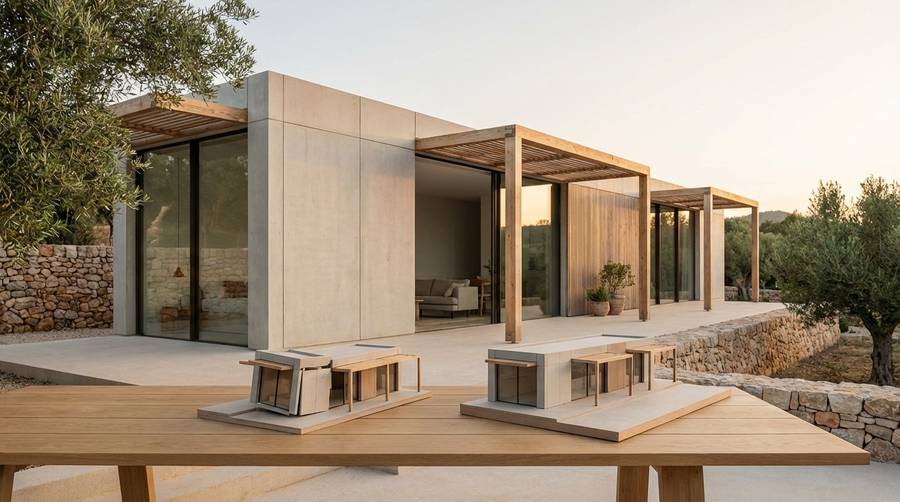
Precast or industrialised concrete offers high thermal mass, durability and fire resistance. Choose concrete when:
- The site requires long-span or robust acoustic separation.
- You prioritise longevity and lower maintenance over rental weight.
- You aim for concrete’s thermal inertia in Mediterranean climates.
Light timber frame and steel frame: performance and cost comparison
Two dominant lightweight systems are used in Spain:
- Light timber frame: excellent thermal performance, lower embodied carbon, faster finishes for domestic scales.
- Steel frame (steel frame): higher upfront cost but better dimensional stability for larger spans and multi-storey modules.
Comparison tips:
- For family homes up to two storeys, timber often provides the best balance of cost and sustainability.
- For scalable, repeatable blocks or non-standard spans, steel frame adds structural flexibility.
Selection criteria: durability, sustainability and maintenance
When choosing systems evaluate:
- Lifecycle costs: not just upfront price but maintenance, expected service life and recyclability.
- Thermal and acoustic performance: check U-values and sound insulation metrics.
- Moisture management: factory detailing must include robust vapour and capillary control.
Sustainability and energy efficiency: designing near-Passivhaus homes
Passive and active strategies: envelope, ventilation and renewables
Design for low energy use first, then add renewables. Practical measures:
- High-performance envelope: continuous insulation, thermal bridges minimised and high-performance glazing.
- Controlled ventilation: mechanical ventilation with heat recovery (MVHR) sized to the modular layout.
- On-site renewables: photovoltaic arrays paired with battery storage to maximise self-consumption.
Reducing carbon footprint in industrialised processes
Industrialised manufacturing reduces waste and enables material optimisation. To lower embodied carbon:
- Prefer certified timber or lower-carbon concrete alternatives.
- Ask providers for cradle-to-gate carbon metrics for primary components.
- Choose local suppliers to cut transport emissions.
Certifications and metrics a self-builder should require
Insist on measurable performance:
- Thermal transmittance (U-values) and airtightness test results (n50).
- Energy performance certificate projections (EPC) and, ideally, Passivhaus component compliance.
- Embodied carbon accounting (kgCO2e/m²) or third-party ecolabels where available.
The turnkey process step-by-step (from plot to handover)
Parcel search and evaluation: constraints, soils and local rules
Parcel selection defines many downstream constraints. When assessing a lot:
- Verify local planning rules: maximum footprint, heights and set-backs.
- Obtain a preliminary geotechnical report to identify foundation needs.
- Check access for crane and modular deliveries and possible traffic restrictions.
Design, factory manufacture and on-site assembly: timelines and deliverables
A typical sequence and realistic timeframes in 2026:
- Precontract design and planning: 4–12 weeks depending on complexity.
- Factory manufacture: 6–12 weeks once design is locked.
- Site works and foundations: concurrent with factory production, 3–8 weeks.
- Module delivery and assembly: 1–3 weeks on-site, plus finishing works 2–6 weeks.
Deliverables to demand:
- Production schedule with milestones and factory inspection windows.
- Test reports for envelope, electrical and HVAC systems before handover.
- As-built drawings, maintenance manuals and component warranties.
Handover, testing and client training: warranties and documentation
Handover should include:
- Functional testing of systems (MVHR, heating, PV).
- A formal snagging list with agreed remediation timelines.
- Client training session and provision of operation manuals and certificates.
Financing and mortgages for self-building modular homes
Types of financing and specifics for industrialized housing
Financing options include construction-to-permanent loans, staged drawdown mortgages and mixed schemes. Key points:
- Banks increasingly accept factory contracts as collateral evidence for staged payments.
- Ask lenders how they value modular homes post-assembly—comparable market evidence helps.
- Some institutions offer specific products for self-builders and modular construction.
What banks require: preparing documentation
Prepare a professional dossier to speed approvals:
- Signed turnkey contract with clear milestones and payment schedule.
- Detailed budget and cashflow forecast for the build period.
- Technical specifications, energy models and factory standards documentation.
Alternative financing: developers, lenders and hybrid schemes
Consider:
- Joint ventures with small local developers for parcel-plus-build packages.
- Bridge loans for land acquisition switched to mortgage after completion.
- Supplier financing where manufacturers offer staged payment plans linked to production milestones.
Case studies and objective technical comparisons
Case 1: 120 m² detached home — timelines, total cost and client satisfaction
Project snapshot (representative metrics, anonymised):
- Size: 120 m².
- System: timber frame modular components, MVHR, PV-ready roof.
- Timeline: 3 weeks foundations and site prep + 8 weeks factory + 2 weeks assembly = ~13 weeks to practical completion.
- Cost: fixed-price contract with transparent breakdown; final outturn within 2% of contract price.
- Satisfaction: clients rated their experience 9/10 citing low stress and clear communication.
Case 2: scalable semi-detached pair — energy analysis and cost per m²
Project snapshot:
- Two mirror units, 95 m² each, steel frame cores for multiple storeys.
- Energy performance: projected heating demand < 15 kWh/m²·yr with MVHR and 4 kWp PV per unit.
- Cost per m²: competitive compared with mid-range traditional builds; lower lifetime energy costs.
Objective comparison vs competitors: data without bias
When comparing suppliers, request consistent datasets:
- Factory lead times and typical assembly durations.
- Warranty length, what it covers and provider response times.
- Measured airtightness and thermal test results from completed projects.
Practical summary and next steps for your turnkey project
Short checklist to decide if a scalable turnkey model suits you
- Do you prioritise time certainty and predictable costs?
- Do you value industrial quality and energy performance?
- Can you provide a realistic budget and accept a standardized production timeline?
How to choose a provider: technical, contractual and transparency criteria
Evaluate providers using these criteria:
- Technical transparency: production photos, test certificates and clear specifications.
- Contractual clarity: fixed-price elements, change-order rules and dispute resolution.
- References and site visits: visit completed homes and speak to recent clients.
For more on contract structures and scaled model timelines see our detailed comparison: Vivienda prefabricada llave en mano: comparativa y guía 2026.
Useful resources: templates, interview questions and public support
Resources to prepare:
- Ask for a supplier-provided payment schedule template and a commissioning checklist.
- Prepare a short interview list: warranty response times, factory QA process, and post-handover support.
- Check local grants or aid for energy-efficient housing that may apply.
Also read our practical guidance on common mistakes and mitigation strategies: Vivienda industrializada: errores comunes y soluciones.
Final thought: A well-executed turnkey modular home Spain project combines industrial reliability with a modern, sustainable home tailored to your life. Start with rigorous questions, insist on measurable performance and choose a partner who documents production and testing. If you follow the steps above, you reduce risk and increase the chance of a smooth, budget-friendly delivery.
If you’re ready to evaluate options, gather your plot details and budget and request a two-page feasibility memo from two suppliers — then compare timelines, guarantees and energy metrics side-by-side.
Artículos relacionados