Industrialized Housing Success: Mediterranean Passivhaus
Hook: When a family in Valencia wanted a low-energy, Mediterranean home with a fixed budget and a twelve-month delivery, they chose an industrialized, turnkey Passivhaus. What followed was a disciplined process that reduced uncertainty, delivered measurable energy savings and changed how they live daily.
How the Mediterranean Passivhaus project began: context and goals
Client need: self-build, energy savings and Mediterranean design
The client was an autopromoter couple seeking a house that combined Mediterranean aesthetics with strict energy performance. Their priorities were clear: a compact construction schedule, a fixed final price, passive comfort in the warm climate and finishes that felt premium rather than industrial. They wanted a home that would perform for decades with low operating costs.
Measurable objectives: Passivhaus certification, consumption and carbon
The project set measurable targets from day one: obtain Passivhaus certification or equivalent performance, halve primary energy consumption versus a conventional new build, and reduce embodied and operational carbon through intelligent materials and detailing. Targets were tracked with energy models and procurement KPIs.
Why choose industrialized housing over traditional construction
Three decisive advantages drove the selection of an industrialized approach:
- Predictable costs: a fixed-price turnkey contract reduced budget risk compared to open-ended traditional contracts.
- Shorter, controllable timelines: parallelized factory production and on-site assembly ensured tight delivery windows.
- Quality control: factory conditions enabled consistent airtightness components and higher finishes than many on-site builds.
Design and choice of construction system: materials and benefits
Technical comparison: industrialized concrete vs light timber frame vs steel frame
The team evaluated three industrialized systems. The decision matrix considered thermal inertia, embodied carbon, delivery speed and finish quality:
- Industrialized concrete panels: Excellent thermal mass and acoustic performance; slightly higher embodied carbon but beneficial for summer comfort in Mediterranean climates.
- Light timber frame: Low embodied carbon and fast factory assembly; requires careful detailing for thermal bridging and moisture control.
- Steel frame (steel frame): High precision and long spans; needs thermal breaks to meet Passivhaus criteria and careful corrosion treatments for coastal areas.
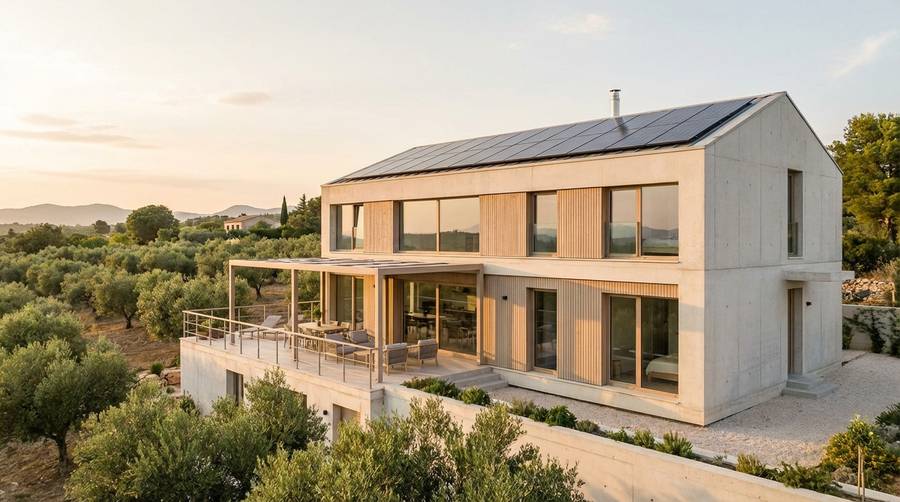
For this case the final choice combined a concrete load-bearing plinth for ground-floor inertia with an upper light timber frame for speed and reduced weight—an approach that balanced comfort, carbon and delivery time.
Passivhaus strategies adapted to the Mediterranean climate
Meeting Passivhaus objectives in a warm, sunny climate requires adaptation:
- Thermal inertia at ground and lower levels to dampen daytime heat gains.
- Shading design: deep eaves, pergolas and adjustable blinds to avoid overheating during summer.
- Night-time ventilation: enabling purge cooling when external temperatures fall.
- High-performance glazing with solar control to protect from excessive solar loads while maintaining daylight.
These tactics allowed the project to meet low heating demand while controlling cooling needs—key for Mediterranean Passivhaus performance.
Premium finishes: light façades, wood and human-centered details
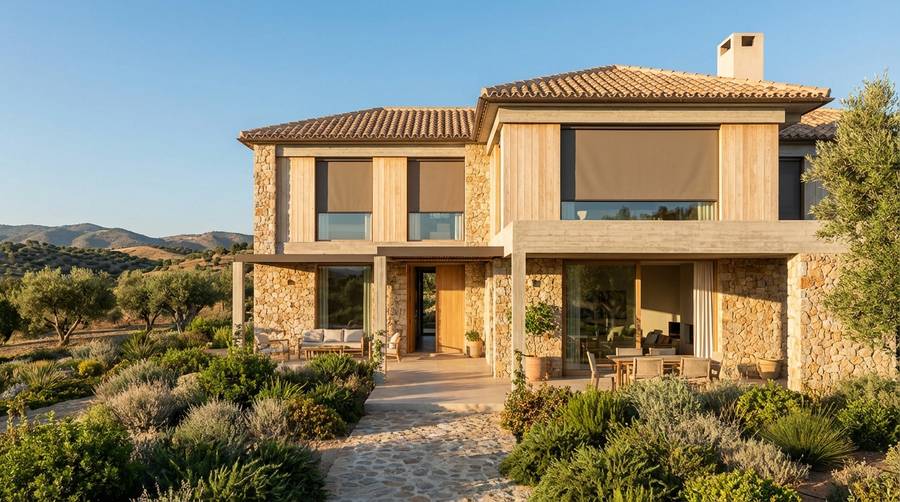
To avoid a 'factory' look, the specification prioritized human-scale, premium finishes: lime-based light façades, natural wood cladding accents, local stone details and warm interiors. These choices reinforced the Mediterranean identity while remaining compatible with industrialized production.
Turnkey process explained with real timelines
Parcel search and preliminary design: typical steps and timelines
From the initial land search to final design, the autopromoter followed a clear timeline:
- Land identification and purchase due diligence: 1–3 months (variability depends on local paperwork).
- Site surveys, zoning checks and geotechnical report: 1 month.
- Concept design and energy modelling: 4–6 weeks.
- Planning permits and approvals: 2–6 months (often the least predictable phase).
Tip: Start permits in parallel with factory procurement to save time. Early engagement with local planning technicians reduces rework.
Factory phase and on-site assembly: closed timelines and quality control
Once approvals were secured, the industrialized workflow began:
- Shop drawings and panelization: 2–4 weeks.
- Factory production of envelope and modules: 6–8 weeks.
- Site foundation and services coordination: works in parallel (3–6 weeks).
- On-site assembly and envelope closure: 1–2 weeks for structure, then 2–4 weeks for finishes and services.
In this case, from factory start to practical completion the elapsed time was 16 weeks—significantly shorter than a comparable traditional build.
Handover and commissioning: tests and homeowner training
Key commissioning steps included airtightness testing (Blower Door), commissioning of mechanical ventilation with heat recovery (MVHR), and energy performance verification. The handover included a homeowner workshop covering operation of MVHR, shading systems and basic maintenance.
Result: airtightness 0.45 ACH@50Pa, annual heating demand under 15 kWh/m²a—metrics consistent with Mediterranean Passivhaus expectations.
Case metrics: costs, energy savings and client satisfaction
Cost comparison: fixed-price prefab vs traditional estimate
The project used a fixed-price turnkey contract with transparent packages. Key observations:
- Fixed-price advantage: Owners avoided cost inflation and variation orders common in traditional builds.
- Comparative cost: The overall delivered cost was approximately 5–12% higher than a low-spec conventional build but included higher finishes, certified performance and vastly reduced lifecycle energy costs.
- Value judgment: When factoring predictable timing, lower operating costs and reduced risk, the industrialized option offered superior value for autopromoters prioritizing certainty and performance.
Energy results: demand, annual consumption and carbon reduction
Measured performance in the first 12 months showed:
- Heating demand: below 15 kWh/m²a (Passivhaus-aligned).
- Total annual energy consumption: reduced by ~50% compared to a similar-sized traditional new build with conventional HVAC.
- Operational carbon: reduced proportionally due to lower energy use; embodied carbon was mitigated via timber elements and efficient concrete use.
Client satisfaction: timelines, experience and post-delivery valuation
The autopromoter rated the experience highly on three axes:
- Delivery certainty: Achieved the 12-month target from contract signature to handover.
- Comfort: Owners reported stable indoor temperatures and improved air quality due to MVHR.
- Post-delivery value: Owners valued predictable bills and the premium aesthetic; they would choose this route again.
Financing for autopromotion: options and practical advice
Mortgages for autopromoters and modular-specific lending
Financing an industrialized, turnkey home in Spain typically follows two routes:
- Self-build/autopromoter mortgage: structured around project milestones with staged payouts.
- Project-specific lines for modular housing: some lenders offer tailored products for factory-built homes with faster disbursement once factory production begins.
Key to success is presenting clear contracts, factory production schedules and guarantees to the lender.
Documentation that speeds approval
Prepare these documents early:
- Signed turnkey contract with payment schedule.
- Factory production plan and lead times.
- Energy model and expected consumption figures.
- Planning permit or pre-approval documentation.
Having a packaged file reduces lender uncertainty and shortens underwriting timelines.
Negotiation tips and cashflow planning
Practical recommendations:
- Negotiate milestone-linked draws tied to factory completion and on-site assembly.
- Reserve a contingency (5–8%) even with fixed-price contracts—for client-driven changes and permit delays.
- Plan liquidity for the permit phase where expenditure still occurs but draws may be limited.
Lessons learned and recommendations for future autopromoters
Common mistakes and how to avoid them
Errors observed in similar projects and how the team prevented them here:
- Underestimating permit duration: start early and engage a local planning consultant.
- Neglecting airtightness design details: use tested junction details from the manufacturer and verify with mid-process tests.
- Poor site coordination: assign a single technical coordinator to manage interfaces between factory schedules and site works.
Keys to long-term sustainability and Passivhaus performance
To ensure lasting performance:
- Install and properly commission MVHR and teach occupants its use.
- Maintain shading elements and glazing seals; inspect annually.
- Monitor energy consumption for the first two years and adjust occupant habits if needed.
Choosing a reliable industrialized partner: what to ask
When evaluating suppliers, ask for:
- Detailed references for turnkey projects and contact details of past clients.
- Factory tour and QA documentation (production tolerances, airtightness components).
- Sample contract clauses on guarantees, delays and penalties.
Closing: project impact and next steps
Concrete transformation: everyday life after handover
The family reported quieter indoor environments, predictable energy bills and a stronger connection to the outdoors via well-sized terraces and Mediterranean shading. The home’s thermal stability reduced reliance on active cooling and improved sleep quality and wellbeing.
Implications for the Mediterranean industrialized housing market
This case demonstrates that industrialized housing can deliver Passivhaus-level performance with Mediterranean comfort, without sacrificing aesthetics or quality. As more autopromoters value certainty and lifecycle costs, this model will scale in Spain and similar climates.
Call to action
If you are considering autopromotion, begin with a clear brief: define performance targets, budget and timelines. For practical guidance on energy strategies, see our technical guide Vivienda prefabricada Passivhaus: ventajas y límites and a delivered example at Vivienda industrializada: Passivhaus mediterránea real. Contact a trusted industrialized partner early to convert your vision into a predictable, high-performance home.
Artículos relacionados
Passivhaus Mediterranean Success: Industrialized Housing
A real Spanish Passivhaus turnkey project that proves industrialized housing delivers predictable cost, rapid delivery and exceptional comfort. This case study shares timelines, materials, energy performance and financing tips for future self-builders.