Industrialized Housing: Common Mistakes and Fixes
Introduction — Hook: Stop Avoidable Failures Before You Build
If your industrialized housing project in Spain slips on cost, time or performance, the cause is rarely a single event. Most failures are predictable and detectable early. This guide focused on industrialized housing (modular, prefabricated, CAD‑to‑Fab production) explains the most common mistakes and gives practical fixes you can apply immediately — from design to handover.
80% of schedule and budget slippage in industrialized housing can be prevented by three actions: standardized design, early material selection for climate performance, and tight CAD‑to‑Fab coordination.
Why industrialized projects fail: early warning signs to catch now
Recognizing the red flags early saves weeks and tens of thousands of euros. Below are high‑impact indicators to monitor during preconstruction and design reviews.
Frequent planning errors and their cost and schedule impact
Symptoms to watch:
- Overly bespoke layouts that break modular grids.
- Unvalidated interfaces between building systems and finishes.
- Unrealistic lead times for specialty components (windows, HVAC).
These lead to duplicated engineering, on‑site corrections and inflated budgets. Fix: adopt modular modules and a measured tolerance matrix tied to production capabilities.
How to spot schedule deviations in a turnkey timeline
Compare three timelines weekly: design milestones, factory production slots and on‑site logistics. Early warning signs include delayed factory slot confirmation, unconsolidated transport bookings and mismatched assembly crew availability. When any of these slip beyond a one‑week buffer, trigger an escalation meeting.
Quick checklist to avoid surprises during CAD‑to‑Fab design
- Confirm grid and module dimensions with factory before final design.
- Lock critical details (window jambs, floor tolerances) in an interface sheet.
- Run a clash detection on shared BIM/CAD files and sign off with factory reps.
Error 1 — Design incompatible with industrialized manufacture
One of the most common and costly mistakes is treating industrialized housing as conventional custom design. That disconnect inflates time and cost.
Symptoms: overly customized plans that drive up production costs
Signs include irregular wall lengths, non‑modular window sizes and bespoke structural demands. These force the factory to exit standard workflows and increase per‑unit costs. Expect lead time increases and more quality checks.
Practical solutions: adapt modulation and CAD‑to‑Fab standards
- Adopt a modular grid: set a base module (600–1200 mm range) that all partitions and openings snap to.
- Standardize component sizes: windows, doors and panels sized to factory stock or repeatable batches.
- Create an interface spec: a 2–4 page document with tolerances, fastener types and finish sequencing for the factory.
Technical‑practical tip: early collaboration between designer and factory
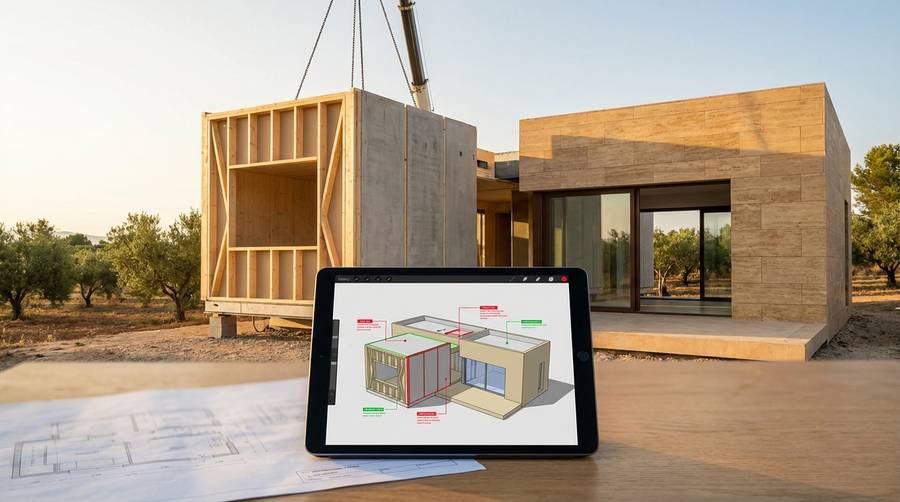
Initiate a three‑way workshop (client, architect, factory) before detailed design. Produce a signed modular brief and a first‑pass kit of parts. This reduces rework and shortens production validation from months to weeks.
Error 2 — Wrong material selection for climate and efficiency
Material choices are not aesthetic alone — they determine thermal performance, embodied carbon and running costs. The wrong choice undermines sustainability claims and Passivhaus goals.
Common problems: materials that penalize thermal efficiency
- High thermal bridging due to inappropriate structural connections.
- Insulation solutions that cannot be factory‑installed to required densities.
- Finishes that require on‑site curing or heavy wet trades, delaying closure.
Solutions: material alternatives with Passivhaus metrics
Consider these industrialized options and their typical benefits:
- Industrialized concrete panels: high thermal mass, precise factory quality and low maintenance. Use with thermal breaks to reduce bridging.
- Light timber frame (entramado ligero): excellent for airtightness when combined with factory‑applied continuous membranes and high‑performance insulation.
- Steel frame (steel frame): precise, fast, and compatible with modular façades; pair with thermal breaks and continuous insulation layers to meet Passivhaus targets.
Each option has trade‑offs. Use a simple life‑cycle matrix: embodied carbon, U‑values achievable, factory cycle time and cost per m². Select the system that meets your energy target without undue cost overruns.
Financial recommendation: how material choice affects total cost and carbon footprint
Upfront material costs often represent a small percentage of lifetime cost. A slightly higher initial investment in airtight details and high‑density insulation typically returns via reduced HVAC needs and higher resale value. When estimating, model costs over 30 years and include projected energy prices; this clarifies decisions like timber vs concrete for a Spanish Mediterranean climate.
Error 3 — Poor communication between project team and production
Miscommunication between designers, project managers and the factory leads to reinterpretations and rework. In industrialized housing, a lost detail in CAD can mean an entire panel re‑fabrication.
Risks: CAD reinterpretations that cause rework and delays
Common situations: missing layer standards, unshared metadata, and inconsistent file versions. These lead to on‑site adjustments and unexpected costs.
Organizational solutions: review protocols and shared BIM/CAD models
- Use a single source of truth: shared BIM model with version control.
- Define a mandatory review checklist before any fabrication order.
- Schedule formal factory design reviews at 30%, 60% and 100% design.
Best practices: synchronization meetings and firm documentation for turnkey delivery
Hold weekly 30‑minute standups with named decision‑makers. Record decisions and link them to the BIM model. For turnkey projects, require factory sign‑off on any change that impacts production schedule or cost.
Error 4 — Underestimating permits, parcel constraints and financing
Administrative delays and financing gaps are subtle but powerful schedule killers. They are easy to prevent with an integrated checklist.
Weak points: legal calendars and permits that extend delivery
Typical delays arise from unexpected parcel issues (slopes, connections, servitudes) and municipal permit backlogs. These can add months if not anticipated.
Solutions: parcel verification and advance financing planning
- Run a parcel due diligence checklist: geotechnical, utilities, easements and planning constraints.
- Secure pre‑approval for connection points and septic/sewer arrangements before committing to a production slot.
- Engage mortgage options early: autopromoter mortgages and construction‑to‑permanent financing require documentation and valuations in advance.
Practical tip: integrate parcel and financing management in your turnkey offer
A true turnkey proposal should include parcel verification and a financing roadmap. This reduces the chance that the home is ready before funds or permits are secured.
Turning failures into opportunities: an operational checklist for self‑builders
Below is an action‑oriented checklist you can apply from design freeze to factory load‑in.
Concrete steps from CAD to factory: validations and tolerances
- Design freeze: lock the modular grid and critical dimensions.
- Tolerance table: publish acceptable dimensional deviations for every element.
- Factory test piece: build a representative junction in the factory to validate assembly details.
Key indicators to measure: production times, cost per m² and client satisfaction
Track these KPIs weekly:
- Factory lead time vs planned (days).
- Cost variance per m² (fabrication + logistics + assembly).
- On‑site assembly hours per module.
Rapid mitigation template: what to do when you detect a deviation
- Stop new production orders for affected items.
- Hold an immediate 24‑hour cross‑team call (designer, factory QA, project manager).
- Decide: rework in factory, rework on site, or accept deviation with documented compensation.
- Log the root cause and update the modular brief and interface sheets to prevent recurrence.
Closing with guarantees: secure quality, time and budget in industrialized housing
Handover is not just keys and documentation — it is the moment the project proves its value. Without proper protocols, satisfaction and warranty exposure suffer.
Turnkey delivery protocols and final acceptance
- Prepare a handover pack: as‑built BIM files, warranties, operation manuals and maintenance schedule.
- Perform staged inspections: pre‑delivery factory QA, on‑site assembly QA, and final client walk‑through with punch list resolution deadlines.
- Use conditional acceptance: final payment held until punch list completion within an agreed window.
How to document results and prepare reproducible case studies
Collect quantitative data during the project: production days, transport incidents, on‑site assembly time and client satisfaction scores. Turn that into a short study with metrics and lessons learned. This approach elevates future bids and reduces perceived risk for financiers.
Final tips for choosing reliable partners and reducing project risk
- Check factory references and ask for production tour photos or a visit.
- Require a clear escalation matrix and SLA for defects.
- Insist on early cost and schedule contingencies tied to permit and transport risk.
For practical resources, check our related articles: Vivienda industrializada: errores comunes y soluciones and Errores en vivienda industrializada y cómo solucionarlos. These deepen the CAD‑to‑Fab checklist and document real case studies.
Conclusion — Secure your project before the first cut
Industrialized housing offers predictable schedules, fixed pricing and superior energy performance — but only if you prevent the common errors described above. Standardize design, choose climate‑appropriate materials, enforce CAD‑to‑Fab coordination and integrate parcel and financing checks into the turnkey scope.
If you’re preparing a self‑build or developer project in Spain and want a practical audit against these errors, contact an expert or request a modular design review. Small early fixes protect months and significant costs later.
Call to action: Reflect on your last milestone: do you have a signed modular brief and a factory‑validated tolerance table? If not, that’s the most impactful place to start.