Prefabricated House vs Traditional: Clear Advantages
Why choose an industrialized home in Spain today
Hook: If you want predictable costs, faster delivery and modern energy performance, a prefabricated house can outperform traditional build—often substantially.
Industrialized housing in Spain now combines architectural quality, certified energy performance and fixed-price offers. For many self-builders, it’s not just an alternative. It’s the efficient path to a high-quality home.
Quick summary: benefits vs traditional construction
- Predictable budgets: Factory-controlled workflows reduce surprises that inflate costs.
- Shorter enclosed-phase time: Weather-independent factory production and fast on-site assembly shrink the time to a weather-tight house.
- Consistent quality: Repeated processes, digital control and factory QA deliver repeatable results.
- Better energy performance: Modern panels and airtight assemblies simplify meeting low-energy standards like Passivhaus.
Ideal self-builder profile and common use cases
Prefabricated homes suit families and professionals who value time, budget control and energy efficiency. Typical use cases:
- First-time self-builders needing turnkey guidance.
- Owners with tight schedules or narrow on-site access.
- Clients targeting near-Passivhaus performance with lower complexity.
Real expectations: timelines, quality and budget control
Expect on-site assembly (envelope closed) in 2–8 weeks, depending on complexity. Total delivery from contract to keys typically ranges 6–12 months for a standard single-family home. Quality variability drops compared with on-site builds, but design changes late in the process remain costly.
In controlled production, variability is the enemy of predictability. Industrialized housing reduces variability—and financial risk—for self-builders.
Comparison: Panels & structural modules vs traditional builds
Execution times and control of the closed phase
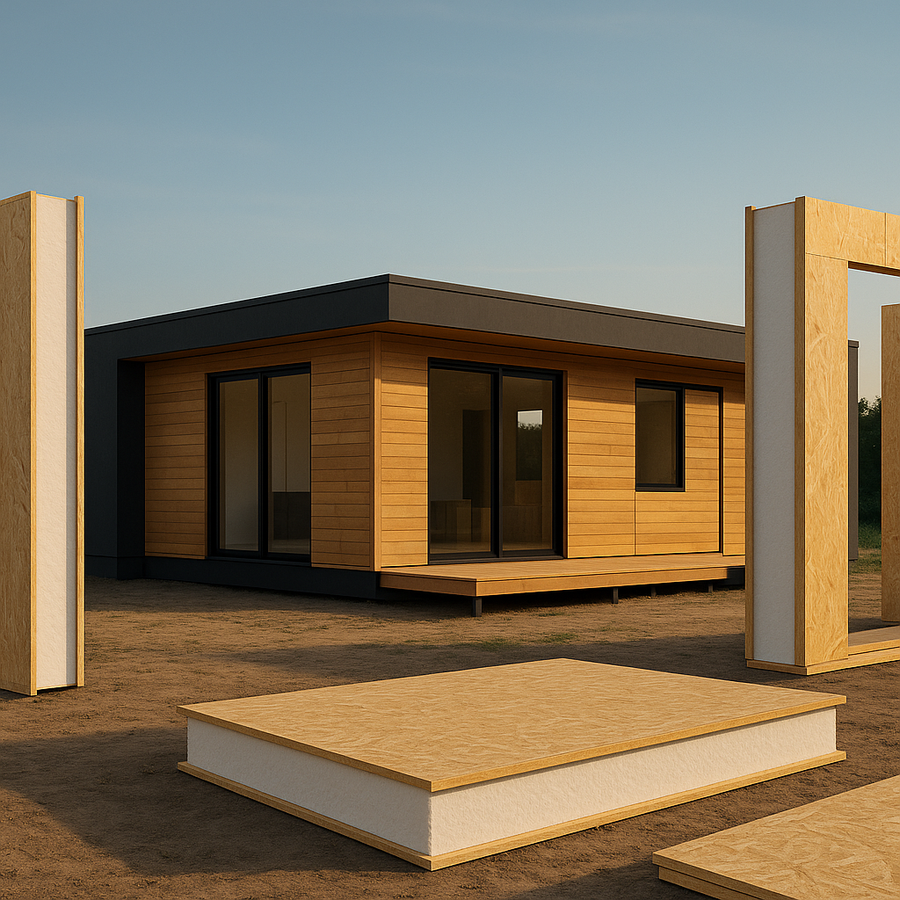
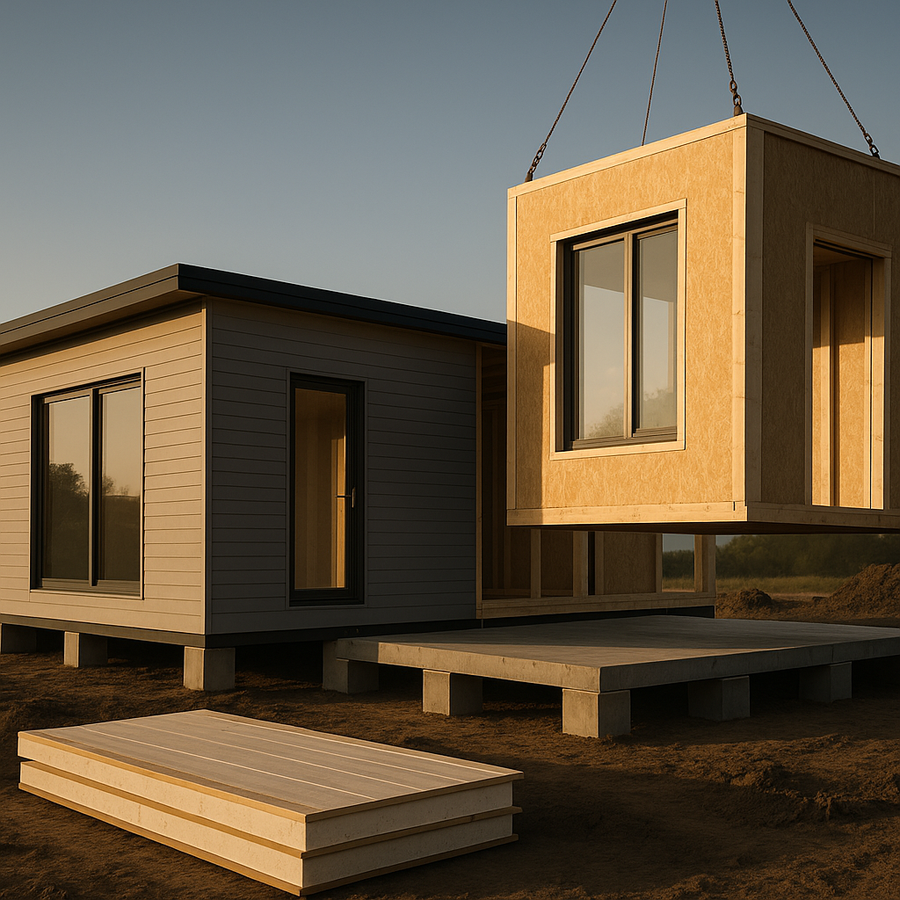
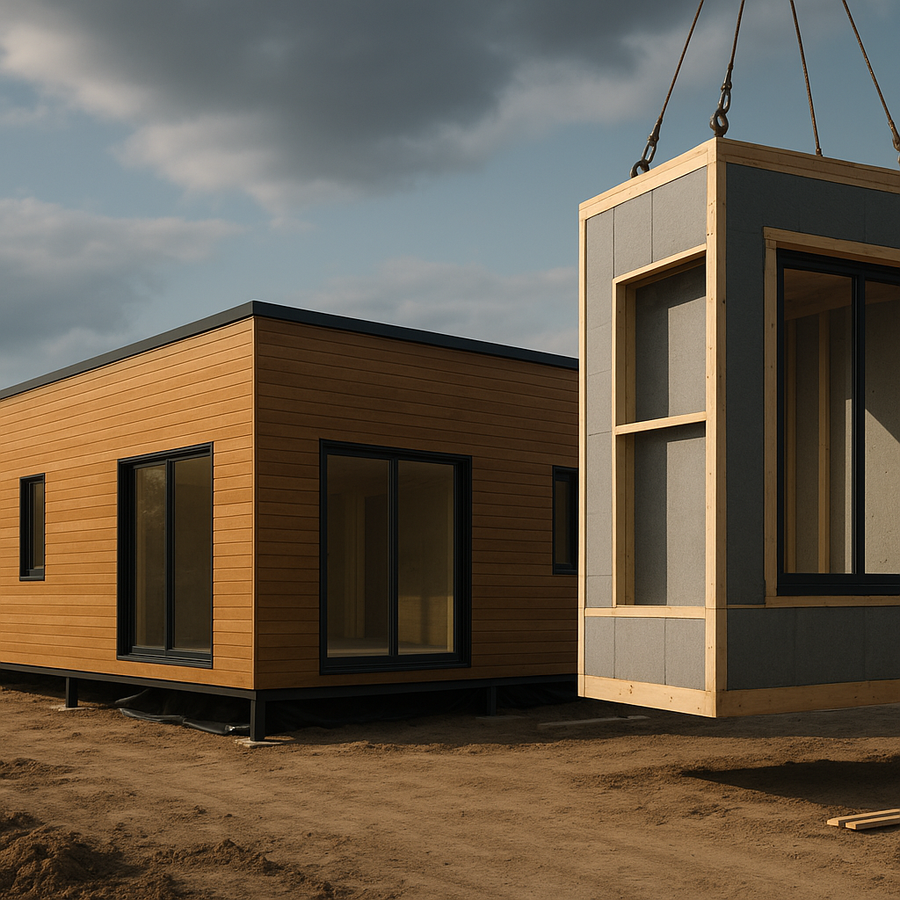
Panels and modules: Most structure and enclosure are produced off-site. On-site time to reach a closed, watertight envelope commonly takes 1–3 weeks for a standard house. This minimizes weather delays and improves subcontractor coordination.
Traditional builds: Foundation and masonry phases are sequential and heavily weather-dependent. The closed phase can extend several months. Delays often cascade into finishing works.
Total cost and risk of budget overruns
Industrialized options typically offer clearer fixed-price scopes for structure and envelope. That reduces the risk of supplier and material price swings during construction. However, costs still vary with finishes, site complexity and groundworks. A realistic budget should separate:
- Factory-fitted scope (structure, envelope, standard finishes).
- On-site scope (foundations, utilities, site access improvements).
Traditional builds often show higher variance. Contractor availability, wetter climates and supply bottlenecks can increase contingency needs.
Construction quality and medium/long-term guarantees
Factory QA and component testing provide better initial quality control. Many industrialized systems come with manufacturer warranties for structural panels, envelopes and key systems. For long-term performance, ensure clear warranty clauses and maintenance plans are in the contract.
Technical analysis of modern materials
Industrialized concrete: performance and durability
Applications: Load-bearing panels, insulated sandwich panels and structural plinths.
- Durability: High compressive strength and fire resistance.
- Thermal: When combined with continuous insulation, concrete panels can provide stable thermal mass.
- Limitations: Higher embodied carbon than timber options. Consider recycled content and low-CO2 mixes.
Light timber frames: efficiency, insulation and sustainability
- Thermal performance: Excellent when paired with high-performance insulation and airtight detailing.
- Speed and weight: Lightweight panels enable fast transport and minimal heavy machinery on site.
- Carbon footprint: Lower embodied carbon and potential for carbon sequestration in long-lived wood elements.
Steel frame: strength, design flexibility and construction details
- Strength-to-weight: High structural capacity with slender sections.
- Design freedom: Longer spans and open plans are easier to achieve.
- Thermal bridging: Requires careful detailing and thermal breaks to avoid energy loss.
Sustainability and energy efficiency in industrialized homes
How panels and modules reduce carbon footprint
Factory production reduces waste and optimises material use. Less on-site rework lowers transport and energy use. Choosing timber or low-carbon concrete further reduces embodied emissions.
Passivhaus strategies and real performance examples
Industrialized envelopes achieve airtightness and continuous insulation more reliably than traditional systems. In practice, panelized houses regularly hit 0.3–0.6 ach50 with good detailing and commissioning. When paired with heat-recovery ventilation and correct solar design, yearly heating demand can drop below 15 kWh/m²a.
For practical guidance, review our technical article on Paneles y módulos estructurales en interiores for interior approaches that help meet these targets.
Costs vs savings: return on energy and comfort
Higher initial costs for advanced envelopes often pay back through lower energy bills and higher comfort. A simplified payback example:
- Extra envelope investment: €8,000–€18,000
- Annual heating savings: €400–€1,200
- Simple payback: 7–20 years (variable by energy prices and usage)
The turnkey process explained for self-builders
From land search to technical project: steps and timelines
- Pre-assessment: site constraints, orientation and access (2–4 weeks).
- Concept and budget: schematic design and fixed-price proposal (4–8 weeks).
- Technical project and permits: full documentation for license (8–16 weeks).
- Factory production and site works run in parallel: foundations then module delivery (8–20 weeks).
- Final fit-out, testing and handover (2–8 weeks).
Coordinating manufacturing, transport and assembly
Successful projects separate responsibilities clearly in the contract. Typical coordination points to check:
- Transport windows and site access constraints.
- Foundation tolerances and interface details.
- On-site sequencing for utilities and finishes.
Handover, certifications and aftercare
Ensure the turnkey contract includes:
- Completion certificates and energy performance reports.
- Warranty periods for structure and systems.
- Defined aftercare and snagging processes.
Financing and permits: mortgages for self-promotion and options
Financing models for modular housing
Banks offer both specific self-build mortgages and standard home loans adapted to staged deliveries. Common approaches:
- Stage-based disbursements keyed to completion milestones.
- Contractor-backed fixed-price financing that reduces lender risk.
- Combination of short-term construction credit and standard mortgage at completion.
Documentation and bank requirements for self-builders
Typical bank requirements include:
- Detailed turnkey contract with fixed scope.
- Technical project, cost breakdown and schedule.
- Site ownership or purchase contract and planning permit (or pre-application).
How to evaluate offers and realistic cost calculation
Compare offers by total cost to completion, not only headline interest. Factor in:
- Contingency for site works and unforeseen ground conditions.
- Costs outside the factory scope (landscaping, connection works).
- Lifecycle savings from lower energy consumption.
How to decide: advantages and limitations for your project
Practical checklist to choose a structural system and supplier
- Define your priorities: cost, speed, energy, aesthetic.
- Request performance data: airtightness, U-values, embodied carbon.
- Ask for a sample contract with warranties and penalties for delays.
- Verify local references and completed projects.
Case studies with metrics: times, costs and satisfaction
Representative examples from recent Spanish projects:
- Timber-frame 140 m² family home: closed envelope in 10 days; total delivery 7 months; 12% energy bill reduction vs typical new-build baseline.
- Concrete sandwich 200 m² house: factory panels reduced site time by 50%; client reported high acoustic comfort and stable indoor temperatures.
- Steel-frame custom home: rapid large-span living area; tighter schedule enabled family move-in before winter.
Client satisfaction correlates strongly with clear upfront scope and communication during production. For practical interior systems, see Casa modular: ventajas, materiales y proceso llave en mano and our broader guide Vivienda industrializada: guía práctica para tu casa modular.
Key questions to negotiate a turnkey contract
- What is included in the turnkey price and what is excluded?
- Which party handles groundworks and utility connections?
- What penalties apply for delivery delays?
- How are variations and additional works priced?
Conclusion
Bottom line: A prefabricated house often offers clearer costs, faster weatherproofing and superior control of energy performance. It is not a universal solution, but it is increasingly the best option for self-builders in Spain who want speed, predictability and sustainability.
If you are comparing routes, start with a clear brief, a realistic site assessment and at least two fixed-scope turnkey proposals. That approach reveals which system best matches your budget and performance goals.
Next step: If you want tailored advice for a specific plot or budget, contact a modular specialist early. A short feasibility assessment saves time and reduces risk.
Interested in technical interior systems or panel options? Read Casa prefabricada: guía completa de paneles y módulos or Vivienda modular: paneles y módulos estructurales for deeper detail.