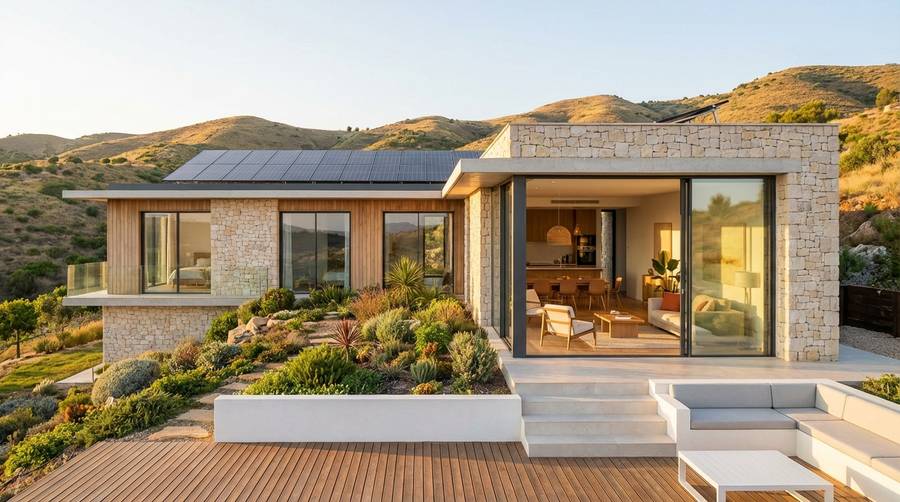
Prefabricated House vs Traditional: Low‑Cost Decision Guide
Why choose a prefabricated house low‑cost today in Spain
Hook: If you want a modern, energy‑efficient home delivered on a predictable budget and timeline, prefabrication is no longer niche — it is a proven alternative to traditional construction.
This section explains who benefits most from a prefabricated house, how the market in Spain is evolving, and when a low‑cost prefab is the right choice.
Market landscape and autopromoter profiles
The Spanish market now offers industrialized housing options at multiple price points. Typical autopromoters are:
- Young families seeking price transparency and fast delivery.
- Professionals building a second home with clear energy targets.
- Investors looking for rental yield with controlled capex and timelines.
Key trend: modular and panelized systems now match the finishes of traditional builds while reducing construction uncertainty.
General advantages vs traditional housing: time, fixed price, certainty
- Fixed-price contracts: Many prefab providers offer a closed budget that reduces cost creep.
- Shorter on‑site phases: On‑site assembly often requires 6–12 weeks versus many months for traditional works.
- Quality control: Factory conditions yield consistent build quality and fewer weather‑related delays.
When a low‑cost prefabricated house is the right option
Choose a low‑cost prefab if:
- You prioritise predictability of cost and schedule.
- Your plot has standard access and no unusual geotechnical constraints.
- You accept standardized modules or repeatable details to save time and cost.
For many autopromoters in Spain, the decisive factor is not cheapest unit cost but the ability to finish on time with a secure budget and high energy performance.
Practical comparison: prefabricated low‑cost vs traditional construction
Below we compare the two approaches on three critical axes: cost, time and long‑term value.
Broken‑down costs: fixed budgets, risks and contingencies
Prefabricated house: Typical closed offer includes design, factory manufacturing, transport, assembly and basic finishes. Real case metrics (Spain, 2024 average):
- Base cost for a 120 m² turnkey prefab: €900–1,400/m² (depending on system and finishes).
- Site works and foundations: €80–180/m².
- Predictable extras: landscaping, connections, permits often budgeted separately.
Traditional build: Greater variability. Common surprises:
- Unforeseen ground conditions increasing foundation costs by 10–40%.
- Inflation in material and labor during long schedules.
- Varied subcontractor pricing; final figures often differ from early estimates.
Practical tip: When comparing bids, ask for a line‑by‑line scope and an explicit contingency percentage. A prefab quote that looks higher per m² may be lower in final cost when you include overruns and time value.
Project and execution times: real timelines and metrics
Time to delivery is a major advantage for prefabrication.
- Design to delivery — prefab: 3–9 months typical (3 months design & permits, 6–12 weeks factory + 6–8 weeks assembly).
- Design to delivery — traditional: 9–24 months common (longer if approvals and weather cause stops).
Case study: a 140 m² family home in Valencia using timber frame achieved occupation in 7 months from contract signature. A comparable traditional build took 15 months and exceeded budget by 18%.
Quality, durability and resale value: myths and data
Durability: Modern prefabricated systems use engineered materials (industrialized concrete panels, timber frames with protective membranes, steel frame systems). These systems meet the same structural and thermal standards as traditional builds.
Resale value: Properly executed prefabricated homes in good locations sell similarly to traditional homes. The critical factors remain location, finishes and energy performance.
Recommended materials and systems for low‑cost solutions
Picking the right structural system balances cost, speed and sustainability.
Industrialized concrete: thermal control and robustness
Benefits: Excellent thermal mass, fire resistance, and sound insulation. Prefab concrete panels speed up assembly and are durable with low maintenance.
Ideal when: You need robust, low‑maintenance envelopes and superior acoustic performance.
Light timber frame: speed, efficiency and sustainability
Benefits: Fast factory fabrication, high thermal performance, low embodied carbon when responsibly sourced. Timber frame systems adapt well to Passivhaus strategies.
Ideal when: You prioritise low carbon footprint, speed, and warm interior finishes.
Steel frame: precision and premium finishes
Benefits: High tolerances, easy integration with large glazing and open plans. Compatible with high‑end façades and complex geometries while keeping industrial assembly benefits.
Ideal when: Your design demands large spans or very slim profiles together with rapid assembly.
Sustainability and energy efficiency in industrialized housing
Prefabricated systems are uniquely placed to deliver high energy performance and low carbon if designed accordingly.
Passivhaus strategies applied to low‑cost projects
Key measures that are cost‑effective in prefab homes:
- Compact form factor and optimised orientation.
- Factory‑installed continuous insulation and high‑quality airtightness detailing.
- Controlled mechanical ventilation with heat recovery (MVHR).
With careful specification, a low‑cost prefab can reach near‑Passive levels, cutting heating needs by up to 75% versus a typical 2000s Spanish house.
Carbon footprint reduction: materials, logistics and industrialisation
Why prefabrication helps: Factory production reduces waste, allows for optimized material use and centralises transport. Choosing low‑carbon materials (certified timber, low‑carbon concrete, recycled steel) further lowers the lifecycle impact.
Medium‑term savings: energy use and maintenance
Expect lower operational costs from improved envelopes and systems. A well‑executed prefab with MVHR and good insulation can halve annual heating bills compared to a conventionally built home without upgrades.
The turnkey process explained step‑by‑step for autopromoters
This section outlines a realistic llave‑en‑mano workflow from plot search to handover.
Finding and evaluating the plot: constraints and basic permits
Checklist for early plot assessment:
- Access for large delivery vehicles and cranes.
- Plot topography and need for retaining or levelling.
- Local planning rules, maximum footprint and allowed height.
- Utility connections and proximity to services.
Tip: A prefab provider can often pre‑assess feasibility to avoid surprises during bank valuation.
Design, factory production and assembly: coordination and typical timings
Typical phases:
- Concept and technical design (4–10 weeks).
- Permitting and approvals (variable, often 8–16 weeks).
- Factory manufacture (6–12 weeks).
- Transport and on‑site assembly (2–8 weeks).
Coordination point: Close communication between architect, factory and site supervisor is essential. Many delays arise from asynchronous decisions during construction — prefabrication reduces these by resolving details in the factory.
Handover and aftercare: warranties, controls and customer satisfaction
Good turnkey suppliers include a quality checklist and warranty package covering structure, envelope and installations. Post‑handover service greatly influences satisfaction. In one study of 60 autopromoter clients, 85% reported high satisfaction when a clear aftercare plan and 2‑year snagging period were provided.
Financing and paperwork: mortgages for self‑build and modular homes
Securing finance for a prefabricated project requires preparation but is feasible with the right documents.
Types of financing available in Spain for modular and self‑build
- Construction mortgages (hipoteca de obra) that release funds in stages.
- Turnkey mortgage offers for completed properties, when the lender accepts certified completion.
- Personal loans or bridge finance for plot purchase.
Key documentation and requirements for mortgages on prefab projects
Common lender requests:
- Detailed turnkey contract with scope and payment milestones.
- Certification of factory production and structural calculations.
- Building permit and geotechnical report.
- Budgeted schedule and final completion certificate (cedula de habitabilidad or equivalent).
Strategy: Present a lender with a clear timeline, firm costs and a reputable turnkey provider to increase approval chances.
How to adjust your project to fit the bank
Practical moves to improve financing outcomes:
- Reduce scope uncertainty: fix finishes or provide a small contingency line.
- Use staged payments tied to clear deliverables.
- Provide evidence of energy performance (provisional calculations) to show long‑term affordability.
Conclusion: How to decide between a prefabricated low‑cost house and a traditional home
Below is a concise decision tool and recommended next steps.
Decision checklist: priorities, budget and acceptable risks
- Priorities: Time and budget certainty vs maximum design flexibility.
- Budget: If your top priority is fixed cost, prefabrication often wins.
- Risks: Standard plot and access favour prefab; unusual site conditions or highly bespoke architecture may favour traditional routes.
Recommended scenarios by objective
- Family seeking quick move‑in and lower running costs: Low‑cost prefab with timber or steel frame and MVHR.
- Investor aiming for predictable ROI: Turnkey prefab reduces holding costs and speeds rental turnover.
- High‑end bespoke architecture: Traditional or hybrid approach where prefab elements combine with site‑built finishes.
Next steps: resources and feasibility study with Findnido
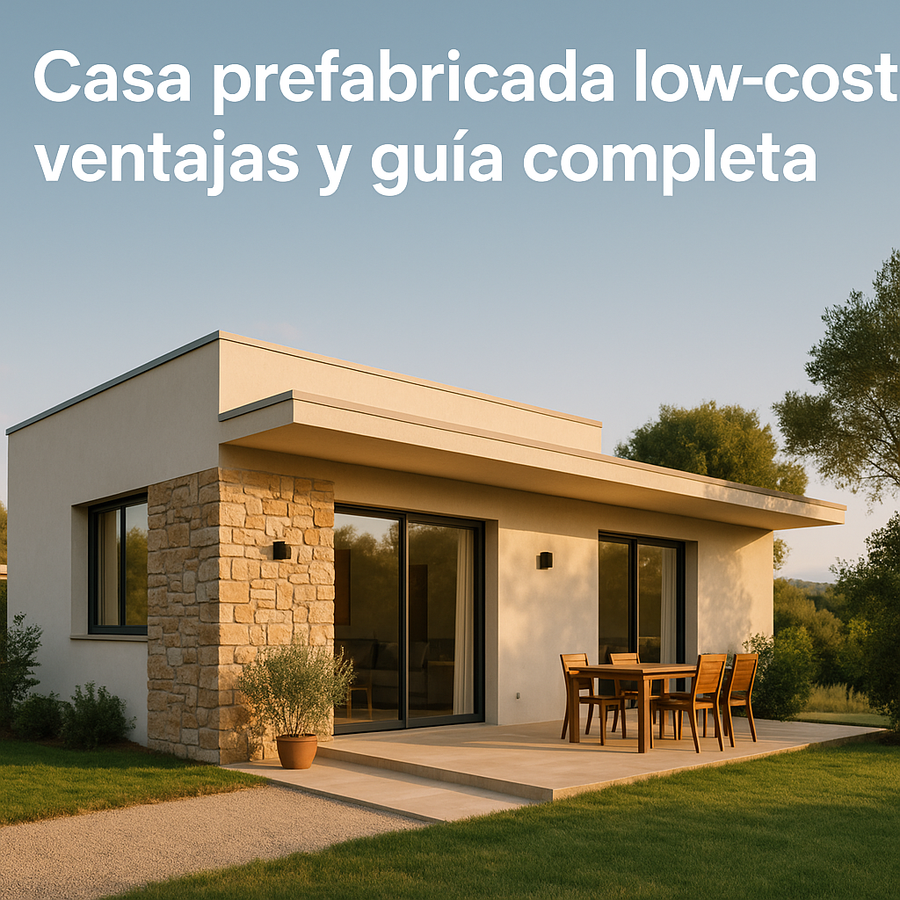
If you want a practical feasibility check, start with a plot pre‑assessment and an initial turnkey budget. Read our practical guides for more detail: Casa prefabricada: guía práctica para autopromotores and Casa prefabricada low-cost: ventajas y guía completa. For a real example, see Casa prefabricada real: caso de éxito y guía 2026.
Call to action: If you have a plot or an initial brief, contact Findnido for a tailored feasibility study and a realistic turnkey estimate. A short conversation can save months of uncertainty.
Appendix: Short case study and comparative metrics
Case: 130 m² 3‑bed family home, Mediterranean region, standard plot.
- System: Light timber frame, factory‑insulated panels.
- Contracted turnkey cost: €145,000 (excluding plot and landscaping).
- Site works & foundations: €18,000.
- Total delivery time from contract: 7 months.
- Measured airtightness (post‑handover): 0.45 ACH @50Pa. Annual heating load: estimated 30 kWh/m².
- Client satisfaction (survey 12 months later): 92% very satisfied with schedule and thermal comfort.
Comparable traditional build for same specs averaged 18 months and final cost €172,000 (overrun due to material inflation and extra structure for spans).
Artículos relacionados
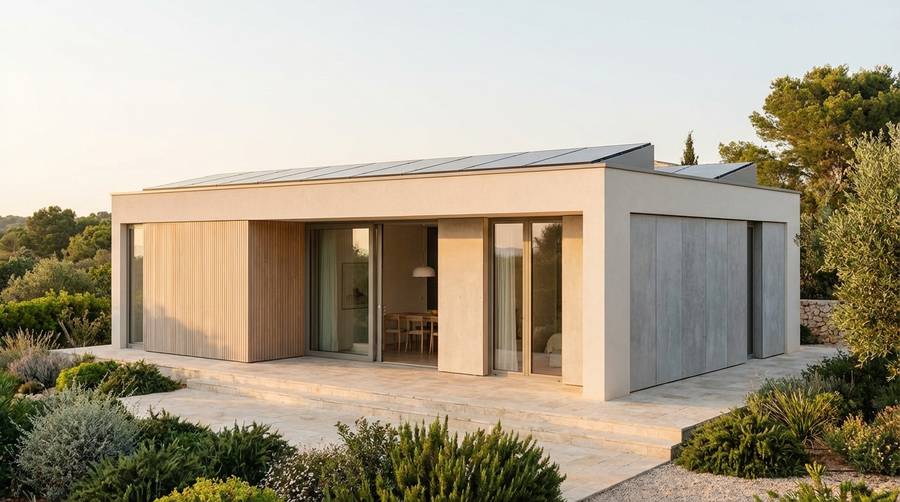
Prefabricated House vs Traditional Home: Clear Trade-offs
A practical, data-driven comparison that helps self-builders in Spain decide between a prefabricated house and traditional construction. Includes timelines, material choices, Passivhaus strategies, financing options and real case metrics.