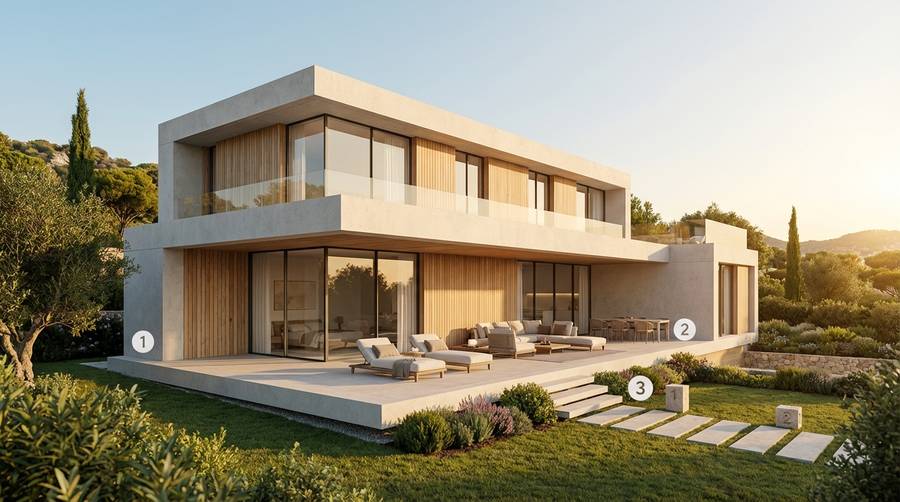
Industrialized Housing Guide: Modular Mass Delivery in Spain
When Maria decided to stop renting and build a family home, she had two non-negotiables: predictable cost and a fast, reliable delivery. Industrialized housing delivered both — in 14 weeks from factory to keys. This guide explains exactly how that outcome is achieved, what decisions matter, and how you can plan a modular, turnkey home in Spain with control and confidence.
Essential guide: Why choose modular mass delivery for your home in Spain?
Modular mass delivery (sometimes called entrega masiva modular) combines factory production, standardized modules and a turnkey process to deliver homes with predictable budgets and timelines. For autopromoters in Spain this model removes many uncertainties of traditional builds.
Advantages versus traditional construction: efficiency, fixed timelines and fixed price
- Predictable cost: standardized modules reduce variation and allow fixed-price contracts.
- Short, closed schedules: parallel site preparation and factory production shorten total time on site.
- Quality control: factory conditions enable higher consistency in finishes, QA and reduced weather delays.
- Lower disruption: less on-site labour and waste; faster occupation.
What 'mass modular delivery' means for industrialized housing
Mass modular delivery scales a modular approach with repeatable designs, batch production runs and logistics optimized for multiple plots or neighbourhoods. Key traits:
- Pre-approved module types and variant packs.
- Production scheduling tied to site readiness windows.
- Turnkey integration of structure, façades, MEPA (mechanical, electrical, plumbing) and finishes.
Self-builder profiles: when this is the best option
This approach suits:
- Families seeking cost certainty and short displacement.
- Developers building small clusters of homes with standardized layouts.
- People prioritizing energy efficiency and predictable quality.
How to design an industrialized house step by step (2026): plot to project
Design for modularity early. The sooner you lock module dimensions and constraints, the fewer costly revisions later. Below is a practical sequence you can follow.
Plot selection and urban planning constraints in Spain
- Check municipal zoning: occupancy ratio, height limits, setbacks and flood risk.
- Confirm access for large transport (module trucks) and crane placement.
- Request a geotechnical report to determine foundation strategy compatible with modular loads.
Architectural modular design: modules, areas and adaptable layouts
Design choices that reduce cost and speed production:
- Use a consistent grid (module width) across the project to maximize repeatability.
- Favor simple rooflines and façade modules that align vertically across floors.
- Plan technical shafts and bathrooms within module zones to simplify MEP runs.
Coordination with manufacturers and production drawings for series production
Clear responsibilities avoid delays:
- Agree interfaces: who supplies windows, finishes and built-ins?
- Lock the Bill of Materials early to fix costs.
- Require factory shop drawings and component-level QA checkpoints.
Materials and systems: choosing between concrete, timber framing and steel frame
Each system has strengths — choose based on climate, budget and performance targets.
Industrialized concrete: thermal, acoustic and durability benefits
- Excellent thermal mass, long-term durability and sound insulation.
- Best for coastal or high-humidity locations where robustness matters.
- Requires precision in junctions to avoid thermal bridges; factory detailing reduces risk.
Light timber framing: efficiency, biocompatibility and interior finish
- Lightweight modules, fast assembly and excellent embodied carbon potential when sourced responsibly.
- Natural finishes bring immediate occupant comfort without heavy secondary finishes.
- Suitable for Passivhaus ambitions with correct airtightness and continuous insulation.
Steel frame: speed, flexibility and structural advantage
- High load capacity with slimmer sections — useful for larger spans or multi-storey modules.
- Very consistent in factory conditions; connectors must be protected to avoid corrosion.
Sustainability and energy efficiency: making an industrialized home meet Passivhaus
Industrialized building is ideal for high-efficiency targets because of controlled assembly and repeatable insulation details.
Insulation, airtightness and passive design applied to modules
- Continuous external insulation and factory-tested airtight membranes reduce heat losses.
- Factory pressure tests identify leaks before delivery.
- Orient modules for solar gain and use shading for summer comfort.
Strategies to reduce carbon footprint and low-emission materials
- Prefer responsibly sourced timber and low-carbon concrete mixes.
- Minimize transport miles by clustering production runs and optimizing logistics.
Integrating renewables, ventilation and energy monitoring
- Heat-recovery ventilation (MVHR) is standard practice to achieve Passivhaus comfort.
- Design photovoltaic arrays and battery-ready electrical panels for future expansion.
- Install an energy monitoring system to track performance and validate savings.
Fact: A well-executed industrialized home can cut build time by 40–70% and reduce on-site CO2 emissions by up to 35% compared to a conventional build with equivalent specifications.
Turnkey process for mass modular delivery: timeline and responsibilities
Turnkey projects require clear milestones and a single point of responsibility to deliver the promise of a fixed price and date.
Key phases: survey, production, transport, assembly and handover
- Pre-contract: site surveys, permits and geotech.
- Design freeze: final drawings, BOM and approvals.
- Factory production: modules built, fitted and QA-tested.
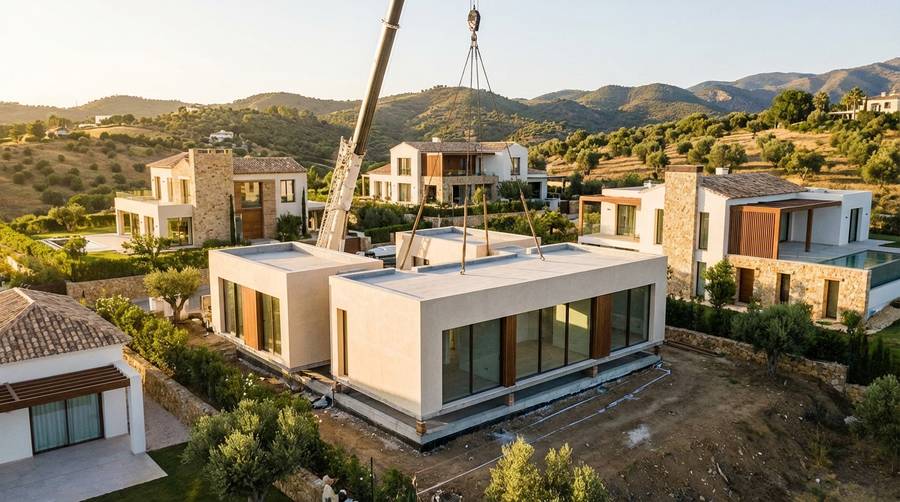
- Transport and on-site assembly: foundations, craning and connections.
- Commissioning and handover: systems checked, final snagging and documentation provided.
Real timelines and quality control in industrial plants
Typical schedules observed in recent projects:
- Design & permits: 8–16 weeks (parallel tasks shorten this).
- Factory build per module: 2–6 weeks depending on complexity.
- On-site assembly and finishes: 2–6 weeks after foundations are ready.
Warranties, documentation and final delivery to the owner
- Secure material warranties and a workmanship guaranty covering core systems.
- Request a handover pack: as-built drawings, operation manuals and energy certificate.
Financing and administrative steps for modular self-build: mortgages and grants in Spain
Financing modular delivery combines elements of self-build mortgages and traditional home loans. Banks increasingly recognize factory-based risk reductions.
Mortgage options for self-builders and bank requirements
- Ask lenders for mortgages that consider staged draws tied to production milestones.
- Provide fixed-price turnkey contract and factory production schedule to support lender risk assessment.
Grants and energy-efficiency programs applicable to industrialized homes
- Explore EU and regional grants for deep renovation and new low-carbon housing; many are compatible with Passivhaus-level new builds.
- Document expected energy savings to support grant applications.
Financial planning: closed budget and risk management
- Include contingency for site-specific works (foundations, access improvements).
- Fix as many supply items as early as possible: windows, kitchens and bathrooms drive cost variability.
Real cases and comparisons: metrics, costs and lessons learned
Below are condensed, anonymized case metrics drawn from recent Spanish projects to illustrate real outcomes.
Case study 1: 120 m² modular home delivered in 12 weeks
- System: light timber frame, MVHR, external insulation.
- Timeline: factory production 6 weeks, transport & assembly 2 weeks, commissioning 4 weeks.
- Cost: €1,450/m² turnkey (incl. foundations and local taxes).
- Client satisfaction: high — praise for predictable schedule and indoor comfort.
Technical comparison with conventional builds
- Energy performance: modular Passivhaus-style home achieved 70% lower heating energy vs a similar conventional build.
- Cost variation: initial outlay comparable or slightly lower; lower lifetime operational costs due to efficiency.
Common mistakes in mass projects and how to avoid them (checklist)
- Failing to verify transport and crane constraints early.
- Late decisions on finishes that force factory rework.
- Not securing a clear single-point contract for turnkey delivery.
Preparing your self-build for a successful mass modular delivery
Preparation accelerates delivery and reduces surprises. Below are the practical items to resolve before signing.
Documents and decisions that speed the process
- Final plot purchase and cadastral reference.
- Geotechnical report and basic foundation design.
- Approved municipal planning permission or pre-application feedback.
Communication with your supplier: milestones, reviews and acceptance
- Agree a milestone schedule with acceptance criteria for each stage.
- Request photographic and test evidence for air-tightness and factory checks.
Final checklist before handover to ensure quality and comfort
- Airtightness and ventilation commissioning document.
- As-built drawings and appliance manuals.
- Signed snag list with agreed remedy timeline.
Practical conclusion: making an informed choice for your industrialized home
Industrialized, mass modular delivery offers a compelling path to a predictable, energy-efficient and fast home in Spain. Success depends on early decisions about site logistics, material selection and a clear turnkey contract. For more context on the sector and strategic roadmap, see Vivienda industrializada: panorama y hoja de ruta 2026, and if financing is a priority, review Entrega masiva modular: guía para autopromotores 2026.
Next steps: compile your site documentation, prioritise the module grid with your architect and request fixed turnkey proposals from reputable manufacturers. If you want a tight checklist to start, gather plot deeds, geotech, a simple site plan and your target performance level (e.g., Passivhaus or local energy class).
Ready to move forward? Start by requesting factory portfolios and a two-stage quote (design-fee + turnkey) so you can compare real metrics: cost per m², factory lead time and in-field assembly duration. That comparison will reveal which provider truly delivers on the promises of industrialized housing.
Artículos relacionados