Modular housing success: a fast, high-quality turnkey case
Introduction — Hook: A family who reclaimed months of life with modular housing
What would you do with extra months during a build? For one family in Spain, faster delivery was not an abstract benefit: it meant avoiding rental costs, starting a new job, and moving their children into a stable home before the next school year. This case study tells the story of that family’s journey with industrialized housing — the choices, the numbers, and the practical takeaways for autopromoters who want speed without sacrificing quality.
Delivery shortened from 18 months (traditional) to 8 months (modular). Final cost ended up 6% below comparable traditional estimates; post-occupancy satisfaction at 92%.
Un arranque rápido: how we found the family who won time without losing quality
Project context: autopromoter profile and objectives
The clients were a couple in their early 40s planning to self-develop their primary residence near Valencia. Their priorities were clear: fixed budget, reliable schedule, high thermal comfort. They were open to modern materials and expected a turnkey delivery — from parcel selection to keys in hand.
Main goal: reduce delivery time with no cost overrun
The main objective was ambitious but measurable: halve the typical delivery calendar for a single-family home in the region while keeping predictable costs. Risk tolerance was medium: they wanted to avoid surprises but were willing to accept design constraints typical of industrialized systems.
Key outcome: narrative metrics summary
- Total delivery time: 8 months (from contract signature to handover).
- Cost vs traditional: -6% compared to a 120 m2 conventional build estimate (accounting for financing and time-related costs).
- Satisfaction: Independent survey 6 months post-occupancy scored 92% overall satisfaction; thermal comfort 95%.
The case in detail: real timeline and verifiable metrics
Phases and timings: parcel search to turnkey handover
The project followed an aggressive but realistic timeline:
- Parcel selection & prechecks: 3 weeks (land viability, cadastre, basic geotechnical check).
- Design & permits: 10 weeks (industrialized design streamline + local planning submission).
- Manufacturing of modules: 8 weeks (factory-controlled production).
- On-site assembly & finishes: 4 weeks (foundation, modular lift, connections, landscaping).
- Final commissioning & handover: 1 week.
From contract to keys: 8 months in total. By contrast, local comparable traditional projects averaged 14–20 months, depending on weather and subcontractor availability.
Costs and a comparative snapshot
The family tracked real invoices and compared them to a conservative traditional estimate prepared by an independent quantity surveyor. Highlights:
- Turnkey modular final cost: EUR 1,650 / m2 (including foundation, connections, VAT and landscaping).
- Estimated traditional cost: EUR 1,760 / m2 (same scope).
- Cost predictability: Modular contract included fixed-price manufacturing and a contingency clause; variation orders were limited and transparent.
When factoring time-related savings (shorter rental overlap, lower loan interest during construction), the effective financial advantage widened in favor of modular delivery.
Post-handover satisfaction and occupancy data
Six months after moving in, a structured questionnaire produced:
- Overall satisfaction: 92%
- Thermal comfort (winter/summer): 95%
- Acoustic comfort: 88%
- Perceived quality of finishes: 90%
Residents emphasized two qualitative wins: the predictability of the process and the immediate habitability on day one.
Why delivery speed made the difference: tangible advantages
Advantages versus traditional build: fixed timelines, fixed price, less uncertainty
Factory production and parallelized workflows reduced weather and coordination risk. The result: a clearly defined critical path and contractual protections that translated into real certainty for the family.
Impact on family planning and finances
Because the house was delivered within the agreed window, the family avoided nine months of rental payments and a planned bridging mortgage. They reported redeploying these savings into higher-grade windows and a small solar plus battery system.
Risks mitigated by swift delivery
Shorter projects reduce exposure to inflation in materials, labor shortages and permit delays. In this case the team avoided a forecasted 7% rise in key materials that affected local traditional sites that year.
Materials and systems that sped the build without lowering quality
Constructive choices: concrete industrialized, timber frame and steel frame
This project combined systems intelligently: a durable industrialized concrete plinth for moisture and structural stability; light timber framing for interior walls and thermal performance; and steel frame for larger spans and façade elements. That hybrid approach balanced speed, cost and longevity.
Efficiency gains: off-site prefabrication and on-site assembly
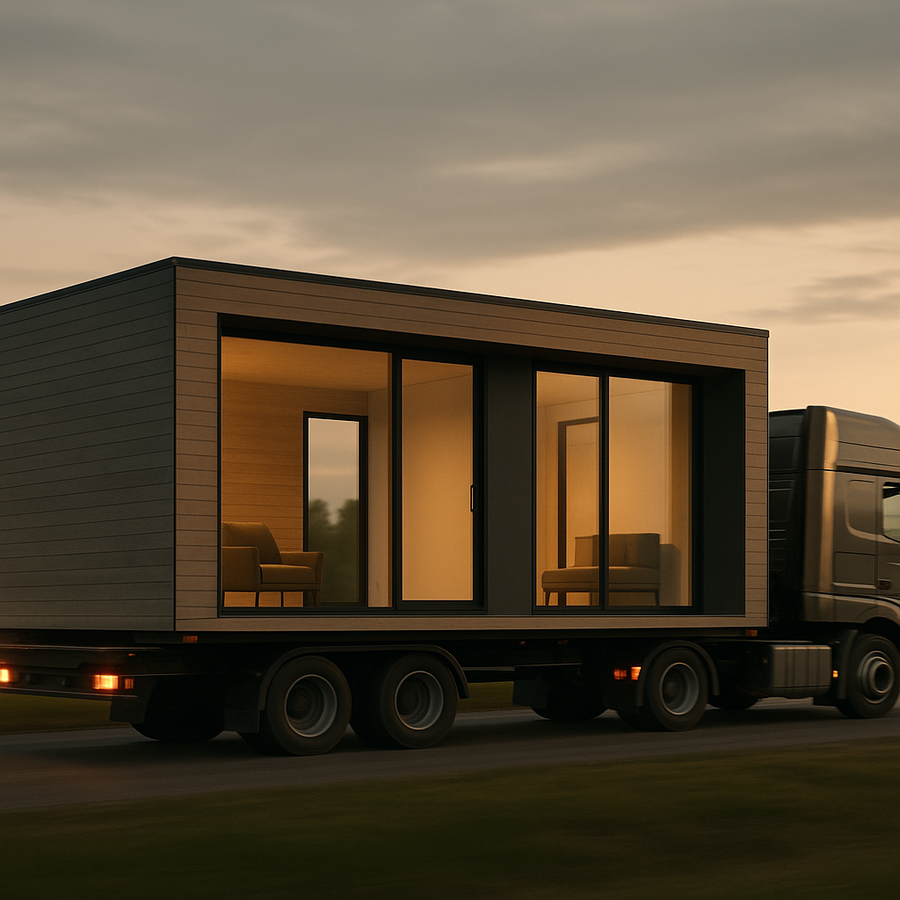
Prefabrication shifted repetitive tasks to controlled factory conditions, improving quality and reducing rework. On-site assembly was compressed into a brief, predictable phase: modules lifted, connected, sealed and commissioned within weeks.
Quality and comfort: insulation, airtightness and Passivhaus principles
The envelope met high-performance standards: continuous insulation, mechanical ventilation with heat recovery and meticulous airtightness detailing. The result was low heating demand consistent with Passivhaus principles and a noticeable reduction in energy bills.
Turnkey optimized process: clear steps for rapid modular delivery
From parcel to home: permits, design, industrialization, and assembly
- Initial viability: quick geotech and utilities check.
- Design for manufacture: compact, repeatable modules and simplified MEP routes.
- Permit-ready package: standardized drawings to accelerate approvals.
- Factory production: quality control & staging.
- Site works and assembly: foundations, craning modules, sealing, connections.
- Commissioning and handover: tests, certificates, walkthrough.
Coordination and communication: tools and practices that shorten schedules
Key operational choices:
- Weekly integrated meetings between design, factory and site teams.
- Shared digital documentation and version control for drawings.
- Milestone-based payments tied to deliverables — aligning incentives.
These practices reduced rework and made dependencies visible early.
Financing and formalities: mortgages for self-build and payment options
The family used a construction mortgage tailored to autopromoters, structured to match the faster timeline and avoid prolonged interest-only periods. Options considered:
- Progress payment schedule tied to factory milestones.
- Shorter drawdown periods to reduce cumulative interest.
Aligning finance with the modular calendar proved critical to cashflow and overall cost efficiency.
Technical and commercial comparison: results against alternatives
KPIs vs alternatives: delivery time, cost per m2, energy efficiency
| Metric | Turnkey Modular (case) | Traditional |
| Delivery time | 8 months | 14–20 months |
| Cost / m2 (turnkey) | EUR 1,650 | EUR 1,760 |
| Estimated energy demand (heating) | ~20–25 kWh/m2·yr | ~45–60 kWh/m2·yr |
Interpreting data without technical jargon
Faster delivery means lower carrying costs and less exposure to external price shocks. Better envelope performance reduces ongoing bills — real savings over the life of the home. When you add predictability, the value proposition is not only in the initial price but in total cost of ownership and peace of mind.
Lessons learned and practical recommendations for autopromoters
- Start parcel viability checks early — a three-week decision window is realistic.
- Design with manufacturing in mind to keep costs predictable.
- Use milestone-based financing aligned to the factory schedule.
- Insist on airtightness and MVHR to secure long-term comfort and savings.
- Choose a partner with turnkey delivery experience to reduce coordination risk.
Image prompt for Findnido AI generator (visual brief)
Main description
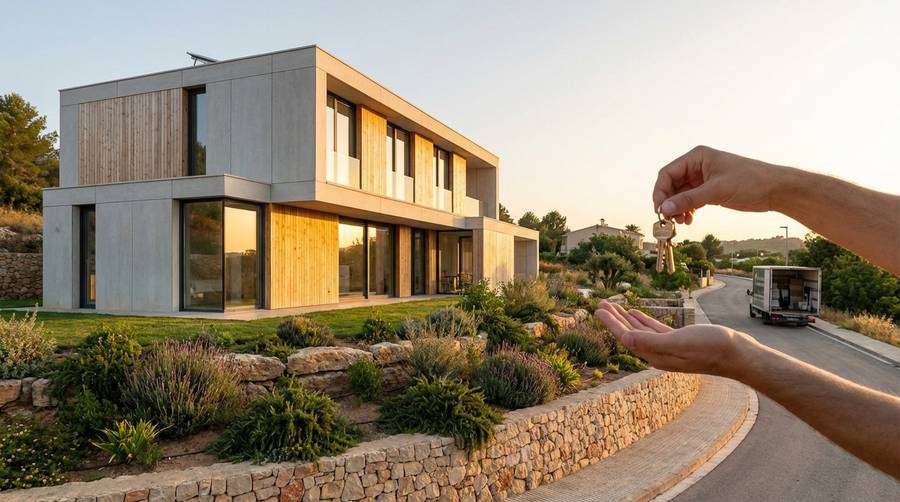
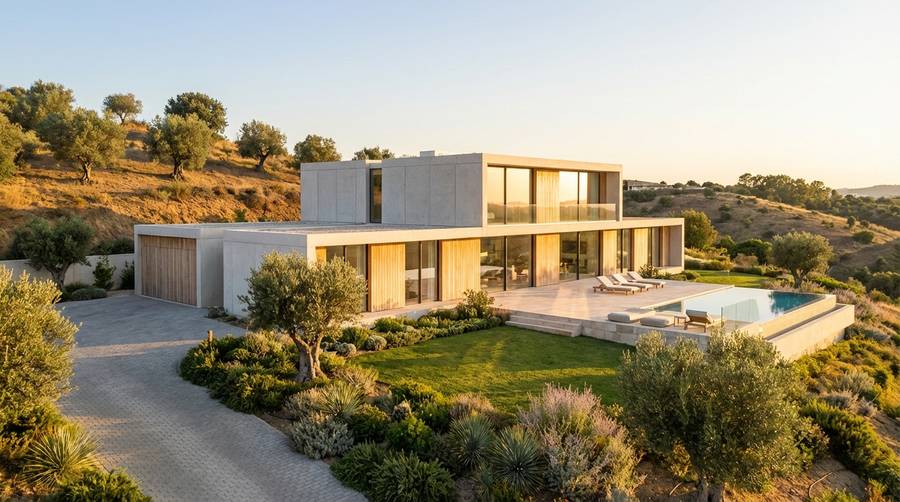
High-quality architectural photograph of a finished Mediterranean contemporary single-family home in Spain at golden hour. The house appears as a premium modular residence with light rendered façades, timber cladding accents and subtle stone details. Large windows reveal a warm, furnished interior and the exterior shows a small terrace with outdoor furniture and a planted garden. A small family (parents and one child) is casually enjoying the terrace, creating a lived-in, aspirational scene. Soft warm light, natural colors, and realistic textures convey comfort and sustainability.
Brand and style directives
Follow Findnido's visual identity: avoid container shapes and industrial aesthetics. No exposed construction or raw elements. Emphasize natural materials, balanced framing, golden-hour light, and a residential Mediterranean setting with vegetation. Photorealistic, magazine-quality composition that communicates trust, modern living and accessibility.
Closing inspiration: learnings and next steps for those who want to accelerate their project
Motivating summary: industrialization turns schedule into advantage
This case shows that industrialized housing can convert time into tangible benefits: reduced costs, lower risk and earlier occupancy. The advantage is not just speed — it is the combination of predictability, quality and energy performance.
Practical 90-day checklist for autopromoters who want speed and quality
- Days 0–30: Confirm parcel viability and utility access; request a design-for-manufacture brief.
- Days 30–60: Lock basic layout, secure financing terms aligned to modular milestones.
- Days 60–90: Submit planning documents and place production orders; set up weekly coordination routines.
Invitation — what to expect in the first three months
If you decide to pursue a turnkey modular route, expect fast, focused decisions in the first 90 days. You will trade some iterative design freedom for predictability and a quicker path to handover. To explore whether this fits your goals, consider an initial feasibility review with clear cost and schedule scenarios.
Ready to test your parcel and timeline? Contact a specialist to get a tailored feasibility study and a 90-day delivery plan. If you want further reading on timelines and error prevention, visit Vivienda modular: rapidez, eficiencia y llave en mano and Velocidad de entrega modular: evitar errores y asegurar plazos for practical guides.
Artículos relacionados