Industrialized Housing Guide: Build Your Modular Home
Why choose industrialized housing today: clear benefits and market outlook
Hook: If you want a high-quality home delivered on schedule, with predictable cost and better energy performance than typical new builds, industrialized housing (modular) is no longer experimental — it's a proven route for Spanish self-builders.
Industrialized housing combines factory-controlled production with on-site assembly. For an autopromotor, that translates into shorter on-site works, fixed-price contracts and measurably better quality control. In this section we summarize the core advantages and the ideal profile of households who benefit most.
Advantages vs traditional construction: time, cost and quality control
- Faster delivery: typical on-site assembly compressed to weeks; overall project time reduced by up to 30–50% compared with conventional builds.
- Cost predictability: many suppliers offer fixed-price turnkey solutions that limit surprises from weather delays or subcontractor price swings.
- Higher QA: factory conditions enable repeatable quality checks, consistent insulation installation, and fewer defects at handover.
- Sustainability benefits: efficient material use, less waste on site and easier integration of high-performance envelopes (e.g., Passivhaus-ready assemblies).
What ‘industrialized’ means in Spain: processes and guarantees
In the Spanish context, industrialized housing means circuiting most repetitive, weather-sensitive tasks into a controlled workshop: panel fabrication, quality testing, and partial finishing. On-site work focuses on foundations, joining modules or panels, and final fitted finishes.
Key guarantees to expect:
- Factory production reports and traceability of materials.
- Performance testing (air-tightness, thermal transmittance) before or immediately after on-site assembly.
- Clear warranty terms covering structure, envelope and installations.
Self-builder profile: when industrialized housing is the best option
Industrialized housing suits autopromotores who want:
- A fixed budget and a reliable delivery date.
- High energy performance without specialist site supervision.
- The possibility to choose premium finishes while avoiding long on-site projects.
Industrialized delivery reduces on-site time and defects while enabling energy standards — a strategic advantage for Spanish self-builders aiming for quality and predictability.
Modern materials and systems: choosing the right solution for your project
Choosing materials should align with your design goals, budget and long-term performance expectations. Below are the most relevant systems for Mediterranean homes.
Precast concrete: performance, durability and best uses
Precast concrete panels and elements deliver exceptional thermal mass and acoustic performance. Best used for ground floors, retaining walls and situations where robustness and fire performance trump lightness.
- Advantages: durable, low maintenance, excellent acoustic insulation.
- Considerations: heavier transport logistics and the need for a designed foundation that handles point loads.
Light timber frame and steel frame: efficiency, design flexibility and compatibilities
Timber frame (light wood) is lightweight, fast to assemble, and thermally efficient when combined with factory-installed insulation. It suits warm-climate Mediterranean renditions with timber finishes and large glazing.
Steel frame (steel frame) offers slimmer sections and greater open-plan spans. It pairs well with high-performance panels and is particularly efficient for Passivhaus-level envelopes.
- Timber: warmer tactile finish, rapid on-site assembly, excellent embodied carbon balance if sourced responsibly.
- Steel: precision, long spans, compatibility with high-performance rainscreens and ventilated facades.
Practical technical comparison: insulation, structure and finishes
When comparing systems, focus on three practical metrics:
- Thermal continuity: choose systems that minimize thermal bridges—prefabricated insulated panels or continuous external insulation are preferable.
- Moisture management: ensure vapour control strategies are adapted to Mediterranean conditions (ventilated façades, capillary-break details).
- Finish flexibility: confirm that the supplier can deliver the external and internal finishes you want without added site rework.
Design and energy efficiency step by step: toward a realistic Passivhaus
Designing for low energy requires early decisions. Here is a step-by-step approach that keeps aspirations realistic for Spanish climates.
Key efficiency principles: orientation, envelope and ventilation
- Orientation and solar gains: maximize winter solar gain on main living spaces; protect from summer overheating with shading and overhangs.
- Envelope performance: target continuous insulation, high-performance windows (low-e, warm-edge spacers) and airtight assemblies tested to 0.6–1.0 ACH for high-efficiency homes.
- Ventilation: mechanical ventilation with heat recovery (MVHR) sized correctly for the home ensures comfort and low energy use.
Strategies to reduce carbon footprint and real consumption
Reduce embodied and operational carbon by combining material choices with operational strategies:
- Prefer timber or hybrid systems where structural life-cycle carbon matters.
- Install solar PV sized to match annual consumption; pair with efficient heat pumps for domestic hot water and heating.
- Document expected consumption in kWh/m² annually and monitor post-occupancy to validate performance claims.
Certifications and measurements: what to expect and how to read results
Common references:
- Passivhaus: rigorous but achievable with industrialized systems—look for certified components and measured air-tightness.
- Energy Performance Certificate (EPC): an official metric for selling or renting, but use Passivhaus or monitored consumption for realistic performance expectations.
- Post-occupancy monitoring: insist on at least one year of consumption data for comparable projects to validate claims.
Turnkey process for self-builders in Spain: from plot search to handover
Turnkey means one accountable partner managing design, permits, manufacture, assembly and final handover. Below is a practical roadmap with typical timelines and checkpoints.
Parcel search and initial feasibility: practical criteria and early paperwork
Before purchase, evaluate:
- Local zoning and buildability: parcel ratio, permitted height, setback and occupancy (use site-specific municipal norms).
- Access logistics: crane access, truck turning radii and the feasibility of bringing prefabricated elements to site.
- Topography and soils: a geotechnical report can save months of rework.
Project phases: design, factory production, assembly and finishes
Typical sequencing:
- Concept and detailed design (8–12 weeks): planning drawings, structural design adapted to selected system.
- Permitting (variable): parallelize paperwork with detailed design where possible.
- Factory production (6–12 weeks): panels/modules built and tested.
- On-site assembly and connections (2–6 weeks): crane assembly, services connection, watertightness.
- Finishes and handover (4–8 weeks): final MEP commissioning, snagging and documentation.
Realistic schedule and quality-control milestones
- Contract: tie payments to verifiable milestones (design approval, factory completion, site assembly, handover).
- Quality control: require production photos, factory QA reports and on-site third-party air-tightness tests.
- Snagging: schedule a documented snag list with deadlines and retest targets before final payment.
Financing and permits: mortgages for self-build and modular solutions
Financing an industrialized home follows similar rules to self-build loans but lenders increasingly recognise turnkey modular delivery due to shorter risk exposure.
Financing options specific to modularized housing
- Self-build mortgage: staged draws linked to milestones; fewer months on site reduce lender risk.
- Construction-to-permanent loans: single contract converting into a mortgage at handover — useful for keeping paperwork simple.
- Supplier financing: some manufacturers offer financing packages or agreements with preferred banks to simplify approvals.
Documentation and bank requirements: what to prepare
- Detailed budget and milestone schedule from the manufacturer or turnkey provider.
- Signed turnkey contract with warranty and completion guarantees.
- Project permits, geotechnical reports, and proof of plot ownership.
Negotiation tips for milestone-linked payments
- Link payments to independent verification (e.g., factory QA, air-tightness test) rather than supplier statements alone.
- Retain a small final retention until defects are resolved and performance tests passed.
Case studies and practical comparisons: metrics that matter
Below are representative anonymized case studies drawn from real projects to give you measurable expectations.
Case 1: Family home in Andalusia — timelines, final cost and satisfaction
Summary: 150 m² single-family home, timber frame panels, turnkey.
- Parcel to handover: 9 months (2 months design and permits in parallel, 8 weeks factory, 4 weeks on-site assembly, 6 weeks finishes).
- Final cost: €1,450/m² delivered (including plot works and soft landscaping).
- Client outcome: high satisfaction with indoor comfort and minimal disruption during construction.
Case 2: Passivhaus with steel frame — real consumption and performance
Summary: 120 m² two-storey home, steel frame, MVHR and 6 kW PV.
- Measured annual heating demand: 10 kWh/m²·year.
- Annual electricity net consumption after PV: 2,000 kWh (household of 3).
- Lessons: early integration of MVHR and airtightness testing during factory stage ensured predictable results.
Practical comparison: total costs and schedules vs traditional build
On average, industrialized turnkey projects in these examples offered:
- Time savings: 30–45% shorter delivery schedule.
- Cost: similar or slightly lower final cost per m² once account taken for lower provisional sums and fewer overruns.
- Quality: fewer defects at handover and faster resolution times for snags.
Deciding and starting your modular project with confidence
To move forward without risk, follow a practical checklist and avoid common mistakes listed below.
Pre-contract checklist: questions and documents to request
- Detailed turnkey proposal with full schedule and itemised costs.
- Factory QA documentation and previous project references with measured outcomes.
- Sample contracts including warranty terms, completion criteria and retention clauses.
Common mistakes and how to avoid them: lessons from real projects
- Avoid vague scope definitions: be specific about finishes, window specs and external treatments to prevent later changes.
- Don’t under-budget utilities and connections — include service trenching, meter installations and local taxes.
- Insist on performance testing (airtightness, commissioning) before final payment.
Next steps: contact professionals, request quotes and set an initial calendar
Start by preparing:
- A short brief describing your plot, desired square metres and energy targets.
- Ask for two or three turnkey proposals and compare timelines, warranty terms and QA evidence.
- Link your research to useful technical resources such as Vivienda industrializada: guía práctica para autopromotores for real metrics and timelines.
Call to action: If you’re ready to explore a turnkey industrialized home, prepare your brief and request verifiable factory reports and a milestone-based contract. Contacting experienced providers early saves time and secures realistic budgets.
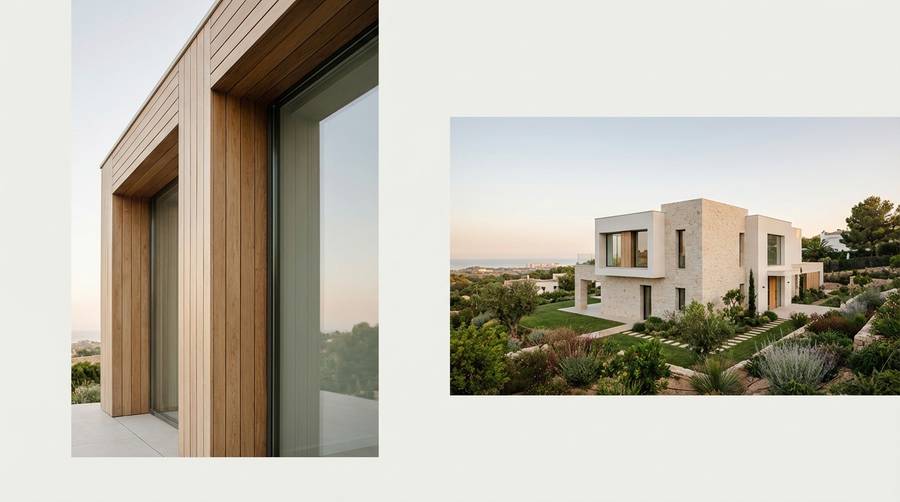
AI image generation brief (Findnido style)
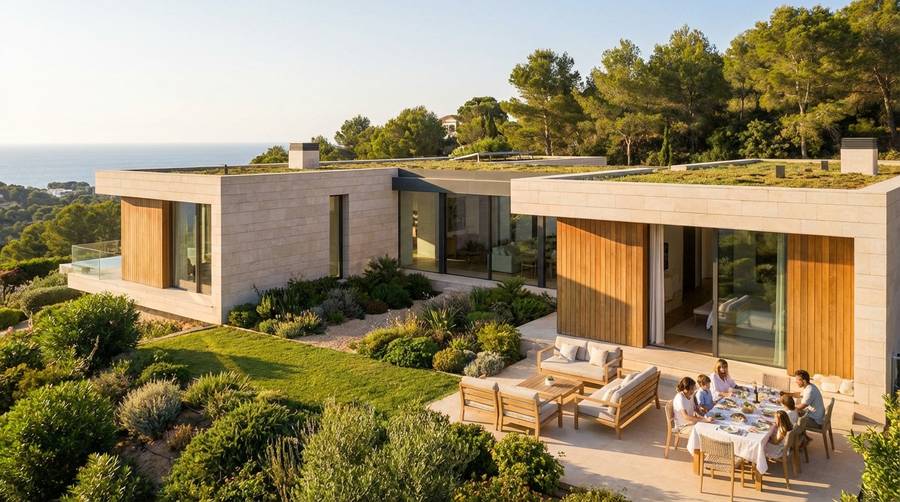
Photographic depiction of a finished Mediterranean-contemporary industrialized home in Spain: light façade with stone and timber accents, large windows and a furnished terrace in warm golden-hour light. Include subtle human presence (family or couple on the porch) to convey livability. Surroundings: garden with Mediterranean plants, real residential context. Style: high-quality real estate photography, natural colors, aspirational but achievable. Do not show any construction, modular containers, or industrial settings. Emphasize premium, sustainable atmosphere.