Modular Housing Success: A Spanish Family’s Real Case
How a Spanish family beat the housing crisis with industrialized housing
They finished their house in under eight months and saved 18% versus a comparable traditional build. That number opened doors: financial stability, comfort, and long-term energy savings. This article tells their story, with concrete metrics, decisions and a replicable roadmap for other autopromoters in Spain.
“We wanted certainty — a fixed price, a predictable calendar and a healthy home. Modular housing gave us all three.” — project lead
Context: access to housing and the family’s needs
The family was a young couple with a child. They were priced out of the city market and wanted permanence, quality and low running costs. Time was critical: they couldn’t wait years for a traditional build. They needed a home that matched Mediterranean aesthetics, Passivhaus-level efficiency, and a clear financial plan.
Why the family chose industrialized housing over traditional construction
The decisive factors were: fixed price guarantees, closed schedules for each phase, and the ability to control design and materials at factory level. The modular housing approach allowed parallel workstreams: while the foundation and permits progressed on site, the modules were fabricated in the factory.
Initial expected outcomes
- Completion within 9 months from permit approval.
- Price certainty with a limited contingency.
- Energy consumption under 40 kWh/m²·year through improved envelope and systems.
- High occupant satisfaction and low maintenance in the first two years.
Design and material choices: modernity and efficiency
Comparing structural systems: precast concrete, light timber frame and steel frame
The team evaluated three main systems. Each has pros and cons for cost, thermal inertia, acoustic performance and environmental footprint.
- Precast concrete: superior thermal mass and acoustic comfort. Slightly higher embodied carbon but excellent durability.
- Light timber frame: low embodied carbon, fast fabrication and good thermal performance. Ideal where sustainability and speed are priorities.
- Steel frame: precise tolerances and large spans. Requires careful thermal bridging treatment.
The family selected a mixed approach: load-bearing industrialized concrete elements for the base and a light timber frame for upper modules. This balanced comfort, speed and sustainability.
Design decisions aligned with Passivhaus and energy efficiency
Key measures implemented:
- High-performance insulation with continuous thermal envelope.
- Triple-glazed windows with low-e coating and thermal breaks.
- Mechanical ventilation with heat recovery (MVHR).
- Airtightness targets below 0.6 ACH@50Pa to approach passive standards.
These choices reduced heating demand and enabled a compact, comfortable layout suited to Mediterranean life: shaded terraces, large openings oriented to favorable solar gains, and cross-ventilation for summer comfort.
Selection of Mediterranean finishes and interior comfort
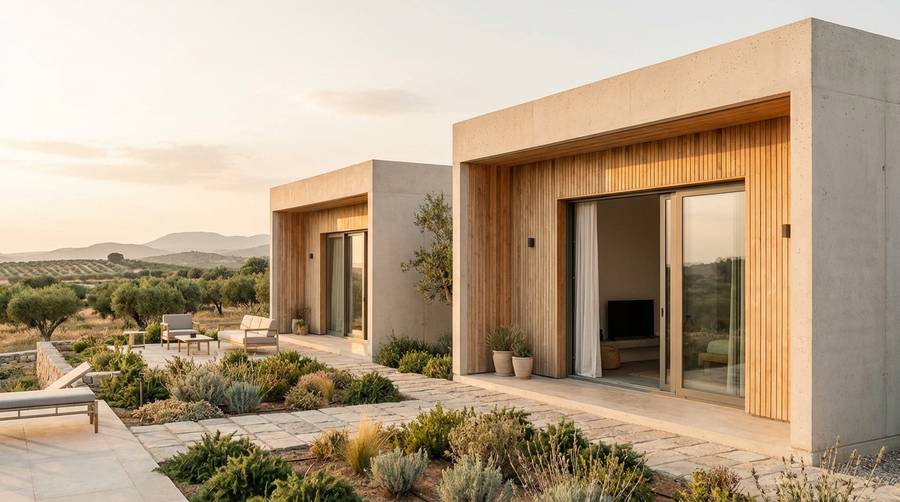
The finishes balanced modern aesthetics with durable, local materials: light lime-based renders, timber cladding accents, porcelain floors with thermal comfort, and stone elements at the entrance. Internally, the brief prioritized daylight, natural materials and low-VOC products to ensure indoor air quality.
The turnkey process step-by-step: from plot to handover
Finding and evaluating the plot; permits and local procedures
The project started with a 600 m² plot in a peri-urban area. Key checks included orientation, access, municipal zoning, and utilities. A local architect and a technical team assessed feasibility and secured required licenses. Timeline for permits averaged 10 weeks due to a straightforward local procedure.
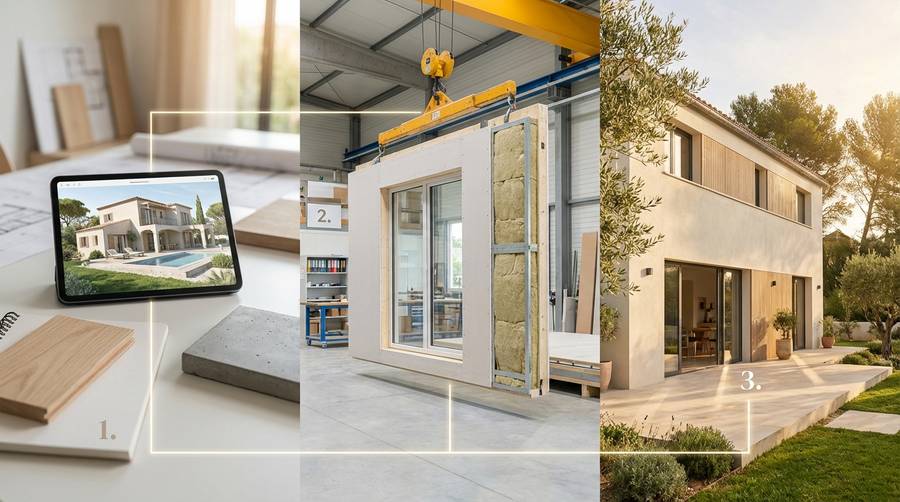
Factory phases and on-site assembly with guaranteed fixed times
Production and site work ran in parallel:
- Weeks 1–8: detailed design freeze and factory preparation.
- Weeks 9–20: module fabrication in climate-controlled conditions.
- Weeks 12–22: site foundations and groundwork.
- Week 23: module delivery and assembly over five days.
- Weeks 24–32: on-site finishes, connections, testing and commissioning.
Because manufacturing controls quality in the factory, on-site weather delays were minimal. The overall calendar from permit approval to handover was 32 weeks — under the initial nine-month expectation.
Quality control, deliverables and client training at handover
Quality checks included:
- Factory QA reports and thermal-Bridging details.
- Airtightness and pressure tests performed on site.
- System commissioning certificates for PV, heating and MVHR.
At delivery, the client received an operation manual, warranties and a short training session on system use and maintenance. This improved long-term performance and occupant confidence.
Practical financing for autopromoters: mortgages and options
How self-build mortgages work in Spain (key points for 2026)
Self-build mortgages in Spain typically disburse funds in tranches tied to certified milestones. Lenders now offer more modular housing–friendly products with the following characteristics:
- Higher loan-to-cost limits when working with certified industrialized builders.
- Disbursements linked to manufacturing milestones and site assembly completion.
- Interest rates competitive with conventional mortgages, conditioned to proper documentation.
Documentation must include final factory production schedules, fixed-price contract clauses and proof of land ownership. These elements reduce perceived risk for banks.
Mixed financing strategies: savings, bridge loans and milestone lending
The family used a hybrid approach:
- Personal savings: 20% of total project cost as equity.
- Bridge loan: to acquire the plot and cover initial permit costs.
- Self-build mortgage: staged payments aligned with factory milestones and assembly.
This lowered financing costs and avoided unnecessary early interest charges. It also matched cash flow to real progress.
How to present your project to the bank and secure better terms
Practical tips:
- Prepare a clear timeline and milestone schedule from the industrialized builder.
- Include factory QA documentation and fixed-price guarantee clauses.
- Showcase energy efficiency gains and lifecycle cost savings to justify collateral value.
- Work with banks familiar with modular housing or with specialist mortgage brokers.
Real metrics from the case: timelines, costs and satisfaction
Planned vs actual timelines: modular housing vs traditional build
Comparison based on the project:
- Permit to handover (modular): 32 weeks.
- Equivalent traditional build estimate: 60–80 weeks depending on local labor and weather.
Time certainty was the family’s primary non-financial gain. The modular approach halved typical project timelines.
Cost breakdown and fixed-price assurance
Project financials (rounded):
- Total turnkey cost: €220,000 (including land preparation).
- Factory fabrication and modules: €125,000.
- Foundations, connections, finishes and landscaping: €65,000.
- Contingency and fees: €30,000.
The contract included a fixed-price clause with defined change-order rules. Final outturn came in at 98% of budget, providing real cost certainty versus traditional projects that often exceed budgets by 15–30%.
Client satisfaction and measured energy performance
At 12 months post-occupancy:
- Occupant satisfaction: 9.3/10 (surveyed on comfort, noise, and indoor air quality).
- Measured heating consumption: 35 kWh/m²·year. Cooling peaks reduced via shading and ventilation strategies.
- Maintenance incidents in first year: 2 minor items resolved under warranty.
These figures show that industrialized housing can deliver on comfort and efficiency promises when design and execution align.
Lessons learned and recommendations for future autopromoters
Common mistakes and how to avoid them
- Underestimating permit times: engage a local architect early.
- Changing scope after factory fabrication begins: freeze design before production starts.
- Ignoring airtightness and commissioning: plan testing into the schedule and budget.
Best practices to maximize sustainability and operational savings
- Prioritize the thermal envelope and MVHR to reduce operational energy.
- Consider hybrid structural systems to balance durability and embodied carbon.
- Install monitoring tools to track performance and adapt use patterns.
How to replicate the model: a practical checklist to start
- Secure a plot and verify zoning constraints.
- Select a certified industrialized builder with clear QA processes.
- Create a fixed-price contract with defined milestones.
- Plan financing early: bridge loan, savings and staged mortgage.
- Define energy targets and include commissioning tests in the contract.
Useful further reading: For a practical primer and questions before contracting, see Vivienda industrializada: guía práctica para autopromotores. For economic context and trends, explore Vivienda industrializada: el futuro viable en España and strategic trends at Vivienda modular: estrategia contra la crisis de vivienda.
Final thought: The modular housing route converted uncertainty into control. Predictable timelines, price certainty and energy efficiency made this project successful and repeatable. If you’re considering self-building in Spain, industrialized housing is a pragmatic and modern path forward.
Ready to explore whether modular housing fits your plot and budget? Talk to a specialist who can run a feasibility check and a financing plan tailored to your situation.
Artículos relacionados