Industrialized Housing: Spain's Residential Future
Why industrialized housing is the axis of Spain's new residential stock
Hook: In 2026, Spain faces a unique window to renew its housing stock quickly, affordably and sustainably — and industrialized housing is positioned to lead that transformation.
Market snapshot 2026: data and growth projections
Recent sector analyses show modular and industrialized approaches growing at double-digit rates across Europe. In Spain, pilot programmes, developer interest and regulatory nudges are creating a projected annual growth of 12–18% in delivered dwellings through 2030. Industrialized delivery reduces on-site time by 40–60% compared to traditional builds and concentrates risk in controlled factory environments.
Key advantages versus traditional construction: speed, cost certainty and quality control
Speed: Factory fabrication synchronised with site works shortens delivery windows. Typical closed-envelope timelines drop from 18–24 months (traditional) to 6–12 months (industrialized) for similar-size single-family homes.
Cost certainty: Fixed-price packages are more achievable when the majority of scope is produced in plant. This reduces scope creep and on-site contingencies.
Quality control: Factory settings enable repeatable processes, traceable material batches and integrated QA testing before site assembly.
What this means for autopromoters: measurable opportunities and risks
Opportunities include predictable schedules for financing, better energy performance, and lower on-site disruption. Risks center on early-stage decisions: poor parcel fit, suboptimal design-for-manufacture choices, and underestimating logistics (transport and crane time). Effective mitigation requires clear up-front studies and contractual clarity.
Industrialized housing shifts uncertainty earlier in the project lifecycle. Invest in planning and you convert that uncertainty into measurable, controllable variables.
Technological and construction trends that will shape the next decade
Evolution of systems: industrialized concrete, light timber frame and steel frame
Three systems dominate current industrialized practice in Spain:
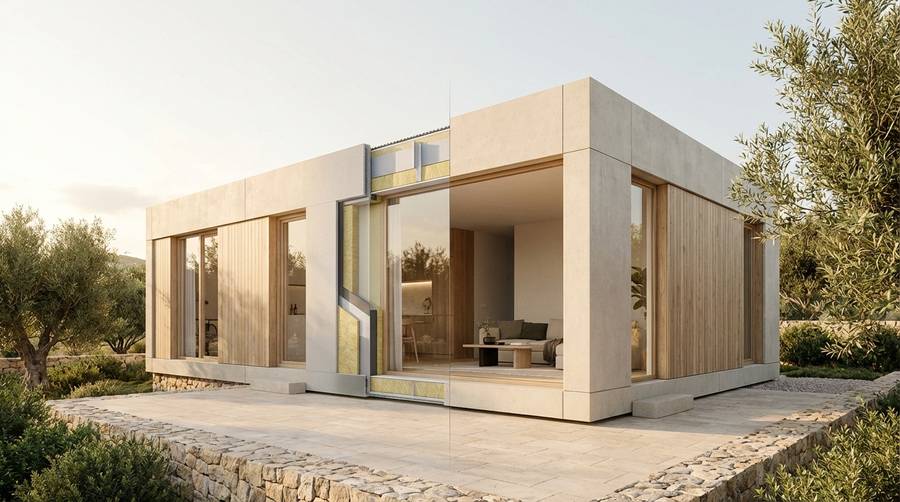
- Industrialized concrete: Volumetric elements and precast façades provide high durability and thermal mass. Best for urban lots where acoustic performance and fire resistance are priorities.
- Light timber frame: Rapid, lightweight, and low embodied carbon when sourced responsibly. Excellent for low-to-mid rise housing and compatible with high levels of prefabrication.
- Steel frame: High versatility and long spans. Ideal for hybrid solutions and designs needing open plans or modular adaptability.
Digital integration: parametric design, QA and plant manufacturing
Parametric design enables component optimisation for material use, thermal performance and transport dimensions. Combined with a BIM-driven workflow, factories can link design variants directly to CNC and cutting machinery, reducing errors and short-circuiting costly rework.
Performance indicators: reduced timelines, cost variance and quality uplift
Key performance indicators to track:
- On-site days per dwelling
- Percentage deviation from fixed price at contract close
- Thermal performance measured vs design (U-values, air changes)
Modern materials: technical comparison to guide system selection
Industrialized concrete: durability, thermal efficiency and unit costs
Concrete offers durability and fire resistance. When produced as insulated precast panels, it combines thermal mass with factory-installed insulation. Unit costs tend to be higher than lightweight systems but lifecycle maintenance is lower. Suitable where longevity and acoustic separation are required.
Light timber frame: weight, carbon storage and speed of assembly
Timber frames are light and fast to assemble. They store biogenic carbon, reducing lifecycle emissions. Key considerations: moisture management, durability detailing and supply chain certification (FSC/PEFC). For many single-family autopromoters, timber balances speed, sustainability and comfort.
Steel frame: structural versatility and use in Mediterranean climates
Steel provides long spans and precise tolerances. In the Mediterranean context, thermal breaks and integrated insulation are essential to avoid thermal bridging. Steel works well in mixed systems where larger openings or future adaptability are priorities.
Sustainability and energy efficiency: how industrialization reduces footprint
Applying Passivhaus strategies to industrialized homes in Spain
Industrialized construction simplifies achieving Passivhaus-level performance because factory-controlled assembly reduces air leakage. Key measures:
- Tight envelope with factory-sealed joints
- High-performance glazing tailored to orientation
- Mechanical ventilation with heat recovery sized to actual dwelling loads
These measures reduce energy demand and enable smaller renewable systems.
Calculating emissions: lifecycle, materials and transport
Perform a life cycle assessment (LCA) tailored to the chosen material system. Timber often scores best on embodied carbon; industrialized concrete can be competitive over long service lives if low-carbon mixes and recycled aggregates are used. Transport emissions must be modelled by distance from plant to site and truck loading efficiency.
Practical measures to improve efficiency: envelope, ventilation and renewables
Actionable steps for autopromoters:
- Specify continuous insulation and thermal bridging details at the design stage.
- Integrate MVHR (mechanical ventilation with heat recovery) in the turnkey scope.
- Size PV and battery systems using modeled demand rather than rule-of-thumb.
Turnkey guide for autopromoters: from plot search to handover
Plot search and assessment: regulations, soil and cost drivers
Early due diligence saves time and money. Key checks:
- Zoning and permitted uses
- Terrain constraints: slope, retaining requirements, access for heavy goods vehicles
- Utility connections and urbanisation costs
Obtain a preliminary site survey and a geotechnical report before committing to design contracts.
Project phases: design, factory manufacture, assembly and finish
A standard turnkey flow:
- Concept and feasibility (4–8 weeks)
- Design for manufacture (6–12 weeks) — this is when most cost control happens
- Factory manufacturing (8–14 weeks)
- On-site assembly and finishes (4–12 weeks)
Clear milestones and hold-points for inspections are essential when managing quality and financing draws.
Timeline and metrics: typical 2026 schedule with checkpoints
Useful checkpoints:
- Parcel close + site survey complete
- Design freeze and manufacturing release
- Delivery to site — logistics confirmed 2 weeks prior
- Envelope closed and systems commissioned
- Final QA and client handover
Financing and viability: autopromotion mortgages and financial models
Financing options in Spain for modular housing and autopromotion
Autopromotion mortgages continue to evolve. Lenders typically offer staged disbursements tied to construction milestones. Industrialized projects have an advantage: shorter on-site phases reduce lender exposure and can improve loan-to-cost ratios when the factory partner provides fixed-price guarantees.
Cost-benefit analysis: scenarios with and without financing
Model two scenarios when evaluating viability:
- Upfront equity finance with lower total finance cost but higher capital requirement.
- Staged mortgage finance that leverages lower on-site risk to reduce margins but extends financing duration.
Compare net present value (NPV) across both, including opportunity costs and tax implications.
Practical documentation to access autopromotion mortgages
Typical lender requirements:
- Detailed project budget and timeline
- Fixed-price contract or factory purchase order
- Architect/engineer credentials and warranties
- Parcel deeds and planning permissions (or proof of application)
Real cases and conclusions: lessons to scale industrialized projects
Case study 1: Timelines, costs and client satisfaction (real metrics)
Project A: 120 m2 single-family home using light timber frame.
- Design to handover: 9 months
- Total delivered cost: €1,650/m2 (turnkey)
- Client satisfaction: 9/10 (post-handover survey at 6 months)
- Energy performance: measured primary consumption 40% below regulated baseline
Key drivers: early site coordination, factory QA and an integrated supply chain.
Case study 2: Process optimization and lessons learned
Project B: 180 m2 house with hybrid steel frame and precast concrete elements.
- Design delays at 2nd stage added 6 weeks to the program.
- Crane logistics cost exceeded estimates by 12% due to access constraints.
- Post-project adjustments: improved transport planning and pre-contract simulation of on-site lifts.
Lesson: logistics modelling and early abstraction of site constraints reduce unforeseen costs.
Strategic recommendations for companies and autopromoters in 2026
For autopromoters:
- Validate parcel feasibility before design spends
- Choose a material system aligned with site and lifecycle goals
- Require factory QA records as part of contract
For companies scaling industrialized housing:
- Invest in digital twins and parametric libraries to reduce variant costs
- Standardise logistics and lifting protocols across regions
- Publish measured performance data to build market trust
For further technical reading on the fundamentals of industrialized delivery, see Vivienda industrializada: guía para autopromotores and for a focused comparison with traditional approaches, consult Casa prefabricada: ventajas para tu vivienda modular. If you are exploring scale-up strategies, Escalado industrializado de vivienda: guía práctica provides practical frameworks, and a documented delivery in 12 months can be found at Vivienda industrializada: caso real en 12 meses.
Conclusion
Industrialized housing offers a measurable path to faster delivery, better energy performance and greater cost certainty for autopromoters in Spain. The advantages are real, but they require discipline: front-loaded planning, logistics simulation and transparent contracts.
If you are planning a project in 2026, prioritise system selection, insist on factory QA data, and model financing scenarios early. These actions convert industrialization's promise into predictable results.
Call to action: If you'd like a tailored feasibility checklist for a specific parcel or a benchmarked cost model for your project, contact our team and we will prepare a concise, data-driven brief.
Artículos relacionados