Industrialized Housing: Prefab vs Traditional — Pros & Cons
Why consider industrialized housing today
Hook: If you want a predictable budget, faster delivery and a high-performance home in Spain, industrialized housing deserves a serious look. This article cuts through myths and gives practical criteria to decide between a prefabricated system and a conventional build.
Current context in Spain: demand, regulation and opportunities for self-builders
Spain is seeing rapid interest in industrialized housing driven by tighter energy codes, a shortage of skilled on-site labor and homeowners seeking lower execution risk. New regional regulations and incentives for energy-efficient buildings favor off-site manufacturing where thermal performance is controlled and repeatable.
What we mean by industrialized housing: myths and realities
Reality: Industrialized housing includes multiple systems — panelized concrete, light timber-frame and steel-frame modules — produced in controlled environments and assembled on site. This is not synonymous with low-quality mobile homes. Modern industrialized homes can meet or exceed traditional build performance, especially for airtightness and energy efficiency.
General advantages: cost predictability, faster timelines and quality control
- Fixed-price contracting: Many industrialized suppliers offer a clear turnkey price, reducing variation risk for self-builders.
- Shorter wet works exposure: Reduced on-site time minimizes weather-related delays and construction-phase damage.
- Industrial QA: Factory conditions enable repeatable quality, documented testing and better warranty traceability.
Data point: Modular assembly can reduce on-site time by 40–60% compared with a similar-size traditional build — a decisive advantage when seasonal weather or market timing matters.
Direct comparison: prefabricated vs traditional construction
Costs: fixed-price advantages, hidden variables to watch
Prefabricated house: Typically offered with a fixed turnkey price that covers design, manufacture, transport, assembly and basic services. This reduces the risk of cost overruns common in traditional projects. However, watch for exclusions: plot preparation, connections to utilities, civil works, and local taxes can be billed separately.
Traditional construction: Often starts with a provisional budget and may evolve with unforeseen site conditions, subcontractor claims and material price volatility. For autopromoters this can mean a need for larger contingency and more hands-on management.
Actionable checklist:
- Request a full price breakdown: manufacturing, transport, foundation, on-site assembly, finishes, and commissioning.
- Clarify scope of civil works and any geotechnical contingencies in the contract.
- Verify warranty terms and which party is responsible for defects detected after handover.
Build timelines: factory production + assembly vs on-site sequencing
Prefabricated: Most time savings occur because many tasks run in parallel — foundations and permitting can proceed while modules or panels are produced. Typical delivery windows (Spain, recent cases):
- Design and approvals: 2–4 months
- Factory production: 6–12 weeks
- On-site assembly and finish: 4–8 weeks
Traditional build: For a similar-sized home, the timeline frequently ranges from 9–18 months depending on weather, crew availability and complexity. Delays in any trade can cascade.
Quality and durability: industrial control, finishes and warranties
Industrialized methods allow tighter tolerances, more consistent insulation installation and verified airtightness testing. Traditional construction can achieve equivalent durability, but outcomes depend heavily on contractor skill and site supervision.
Practical evaluation tips:
- Request thermal bridge analysis and blower-door test results for the system.
- Ask to inspect completed projects or third-party test certificates.
- Compare the lifecycle warranties and spare-parts availability.
Advantages and disadvantages by materials and systems
Industrialized concrete: performance, insulation and life-cycle
Advantages: High mass contributes to acoustic comfort and thermal inertia. Factory-cast concrete elements can integrate high-quality finishes and embedded services.
Limitations: Concrete elements can be heavier to transport and may require more substantial foundations. Achieving high insulation levels typically requires combined strategies (exterior insulation, thermal breaks).
When to choose: For multi-storey residential projects or coastal sites where robustness and fire performance are priorities.
Light timber frame: speed, sustainability and constraints
Advantages: Excellent embodied carbon performance when sourced responsibly, very fast production and high thermal performance when combined with dense insulation. Timber systems are flexible for changes during design development.
Limitations: Moisture management and detailing at junctions are critical. In some climates, acoustic performance requires specific solutions.
When to choose: Detached houses where speed, sustainability and comfort are priorities — often a good match for Passivhaus targets.
Steel frame: strength, design freedom and thermal considerations
Advantages: Long spans and structural flexibility enable open-plan layouts and large glazing. Steel is durable and predictable under factory fabrication.
Limitations: Steel conducts heat; thermal breaks and careful insulation are required to meet high-efficiency standards. Corrosion protection must be specified for coastal climates.
When to choose: Complex geometries, large cantilevers or where quick erection and slim profiles are desired.
Sustainability and energy efficiency: real impact and certifications
Thermal performance and Passivhaus in industrialized homes
Industrialized systems excel at consistent insulation installation and airtightness — two critical Passivhaus pillars. Off-site assembly reduces workmanship variability, making the certification pathway more predictable.
Practical tip: Prioritize systems with documented blower-door results and a clear plan for thermal bridge mitigation. Request an energy model (PHPP or equivalent) early in design.
Carbon footprint reduction: controlled manufacturing and efficient logistics
Factory production concentrates waste streams and allows for material recycling. Logistics can be optimized to reduce truck trips and site waste. However, embodied carbon varies by material — timber frames tend to have lower upfront emissions than concrete or steel.
Operational costs and comfort: measured savings
Real-world monitoring of industrialized homes often shows utility savings of 30–60% compared with similar non-insulated builds, assuming high-efficiency systems. These savings improve payback on slightly higher upfront investments when quality HVAC and solar strategies are included.
Turnkey process and practical steps for self-builders
Phases: plot study, design, manufacture, assembly and delivery
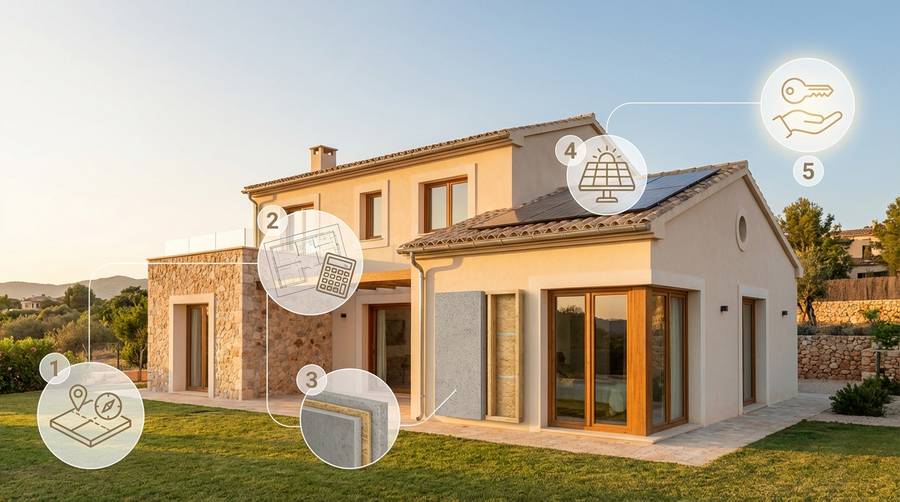
Typical turnkey workflow:
- Plot study: geotechnical report, easements, access and utility availability.
- Design and approvals: adapted schematic design, permit submissions and municipal coordination.
- Manufacture: component fabrication, QA checks and pre-assembly testing.
- Site works and foundations: performed while components are manufactured.
- Assembly and commissioning: module or panel erection, systems connection, finishes and final testing.
- Handover: final inspection, commissioning reports and warranty documentation.
Documentation, permits and site coordination
Actionable steps for autopromoters:
- Secure the geotechnical study before design freezes; foundation type may change cost and schedule.
- Integrate utility connection timelines early — delays in water or grid connection can stall commissioning.
- Confirm municipal inspection points and who will present documents on site: the turnkey provider or the promoter.
Warranties, after-sales and contractual timelines
Look for clear SLAs on delivery dates, defect rectification windows and responsibility matrices. A robust turnkey contract will include penalties for missed milestones and defined acceptance criteria at handover.
Financing and mortgages for modular self-builds
Credit options: self-build mortgages vs construction loans
Banks in Spain increasingly recognise industrialized projects. Options include:
- Self-build (autopromoción) mortgage: phased payments linked to milestones — land purchase, foundation, chassis delivery, final delivery.
- Construction loan: short-term credit released against invoices during the build, then converted to a mortgage.
- Green mortgages: emerging products offering better terms for high-efficiency builds (Passivhaus or near-zero-energy).
How to negotiate financing for industrialized projects
Practical negotiation tips:
- Present a turnkey contract with clear milestones and delivery penalties to the lender.
- Provide evidence of supplier reliability: previous projects, completion certificates and financial standing.
- Request a payment schedule aligned with off-site manufacture and on-site assembly to reduce interest exposure.
Payment schedule and its effect on project budget
Factory-led projects often front-load costs in the production phase but shorten interest-bearing on-site periods. Compare total financing costs under different release schedules and ask for amortization projections from the bank.
Practical cases and a final decision checklist
Case studies 2023–2026: timelines, costs and client satisfaction
Summary of anonymised benchmarks from recent projects in Spain (aggregated):
- Single-family timber-frame home, 140 m²: Total turnkey cost €210k–€240k; lead time 6 months from contract to handover; measured heating demand under 15 kWh/m²·yr; client satisfaction index 9/10.
- Concrete-panel semi-detached, 200 m²: Total cost €330k–€370k; lead time 8 months; robust acoustic performance; warranty issues resolved within 30 days; client satisfaction 8/10.
- Steel-frame bespoke home with large spans, 180 m²: Total cost €290k–€320k; lead time 7 months; higher initial insulation costs but superior architectural flexibility; client satisfaction 8.5/10.
These cases show typical trade-offs: timber for speed and low embodied carbon, concrete for mass and robustness, steel for design freedom.
Checklist to decide: plot, budget, schedule and sustainability
- Plot suitability: access, crane workspace, foundation type and local constraints.
- Budget clarity: inclusive turnkey quote with civil works and taxes.
- Schedule realism: alignment between permits, factory lead times and seasonal site access.
- Sustainability targets: insulation, airtightness, HVAC efficiency and renewables integration.
- Financing plan: lender acceptance of industrialized delivery and phased payments.
- After-sales: documented warranties, spare parts and service network.
Final recommendations for self-builders: questions to ask suppliers
Ask every prospective provider these core questions:
- Can you provide completed project references with measured energy performance?
- What is the precise scope of the turnkey price and what is excluded?
- Do you supply blower-door and thermal-bridge analysis as standard?
- How do you handle site irregularities and unforeseen ground conditions?
- What penalties or remedies are in the contract for missed delivery dates?
For more on the fundamentals of industrialized housing and financing, see our primer Vivienda industrializada: ventajas, materiales y financiación and design-oriented guidance in Bienestar residencial industrializado: diseño sostenible y humano.
Conclusion
Bottom line: Industrialized housing in Spain is a mature, practical path for autopromoters who prioritize cost predictability, faster delivery and high energy performance. The best choice depends on plot constraints, design aspirations and the promoter’s appetite for involvement. If you value speed, documented performance and a controlled budget, modern prefabricated systems — timber, steel or concrete — are compelling.
If you are planning a project, use the checklist above and request measured performance data and clear turnkey terms. For further reading on common pitfalls and solutions, consult Vivienda industrializada: errores comunes y soluciones and explore design variations in Espacios modulares de bienestar para tu hogar.
Call to action: If you want help applying this checklist to your plot and finances, contact a specialist — early feasibility analysis saves months and reduces cost risk.
Image description for Findnido (AI generator prompt)
Category: Bienestar residencial industrializado
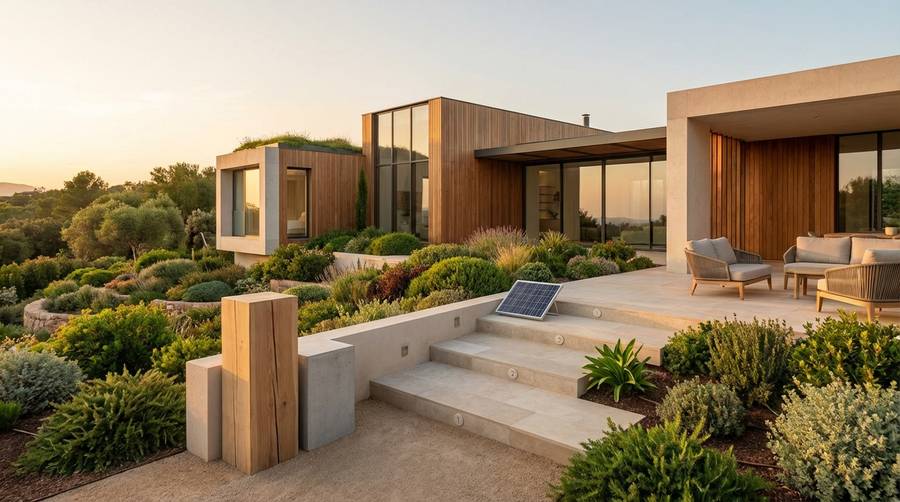
Prompt: High-quality real-estate photograph in the Findnido brand style showing a finished Mediterranean-contemporary home in Spain representing industrialized housing done well. The house features light façades with natural stone and timber accents, large windows and a sunlit terrace opening to a small garden with potted plants. Golden-hour or soft daylight illumination, warm natural colors, and a subtle human presence (a family casually on the terrace, not the focus). The scene feels lived-in, premium and aspirational but achievable. Residential setting with trees and neat landscaping; no construction, exposed systems, containers or tiny-house aesthetics. Photographic, magazine-quality composition emphasizing trust, comfort and sustainability.
Artículos relacionados