Steel Frame Mistakes to Avoid in Industrialized Housing
Why choose steel frame for your industrialized home (practical advantages)
Hook: If you plan to self-build a modern, energy-efficient home in Spain, choosing steel frame can shorten delivery time, stabilise costs and help you reach ambitious energy targets — but only if you avoid the usual pitfalls.
Below I list the main advantages you should expect from a well-executed steel frame industrialized project — and what to verify early to ensure those advantages become real.
Efficiency and fixed timelines: what to expect for schedules and delivery
What it delivers: predictable manufacturing cycles in the factory, reduced on-site wet work and faster enclosure times (closed envelope) compared to traditional methods.
- Target delivery: panelised steel frame modules typically reduce on-site assembly to weeks rather than months.
- Key verification: ask for a documented manufacturing and installation timetable with tolerances for each milestone.
Fixed cost and budget control: how to avoid surprises
Why it helps: factory production lets you lock material and labour costs early. But cost certainty only holds when scope and interfaces are well defined.
- Ensure contracts include detailed scope and change-order pricing.
- Reserve a contingency (typically 5–8%) for client-driven scope changes.
Energy efficiency and sustainability: Passivhaus and carbon reduction
Real potential: steel frame assemblies with correct insulation and airtightness can achieve high-performing thermal envelopes compatible with Passivhaus principles.
Verify: U-values, continuous thermal breaks and a plan for airtightness testing (blower door) before and after finishing.
When executed properly, industrialized steel frame homes can cut onsite time by up to 50% and halve unexpected budget overruns — the caveat is coordination and quality control.
Error 1 — Design not adapted to climate and plot
Why this is a problem: a technically excellent steel structure cannot compensate for poor orientation, wrong window sizing or lack of shading. The result is higher consumption and uncomfortable spaces.
Consequences: energy losses and reduced comfort
Misplaced glazing or unprotected south façades create overheating in summer and heat losses in winter. This undermines any Passivhaus-like gains and increases HVAC needs.
Practical solution: orientation, shading and window criteria
- Orientation: prioritise living spaces to the south/ southeast where passive solar gains help winter comfort.
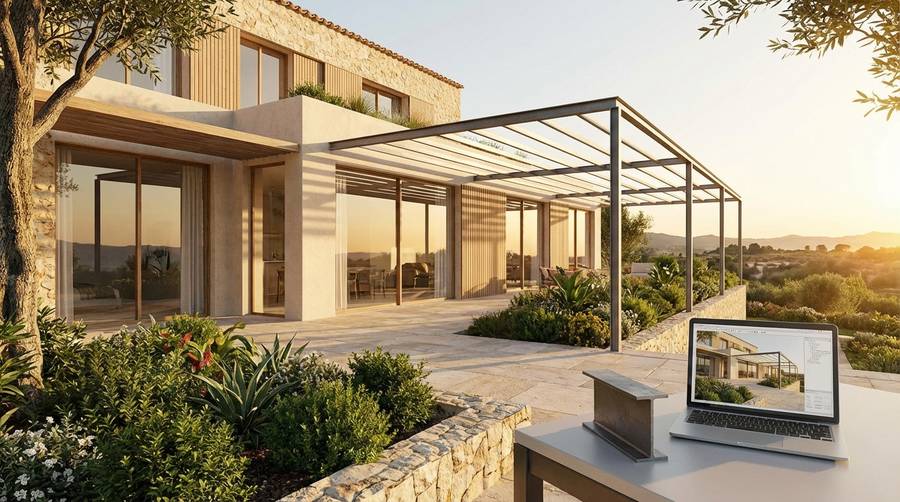
- Shading: fixed or adjustable external shading (brise-soleil, pergolas) for southern façades.
- Glazing selection: use low-e coatings and correctly sized overhangs; avoid floor-to-ceiling glass without thermal planning.
Accessible technical checklist for designer and client
- Solar path study for the parcel (seasonal sun angles).
- Window-to-wall ratio per façade: keep extremes under control (recommendation: 20–35% depending on orientation).
- Passive cooling strategies (cross ventilation paths, night purge).
Error 2 — Inadequate selection of materials and enclosure systems
Warning: choosing materials that don't work together is a common source of thermal bridges, moisture issues and acoustic complaints.
Red flags: thermal bridges, humidity and noise
Signs you may have a problem: condensation stains near connections, cold spots, visible thermal bridging at slab-to-wall joints and unsatisfactory sound insulation.
Recommended alternatives: layers, insulation and finishes compatible with steel frame
- Continuous insulation: exterior insulated sheathing or thick cavity insulation to avoid thermal breaks.
- Vapour control: an assembled vapour control layer placed correctly relative to the insulation to prevent condensation.
- Acoustic layers: resilient layers and decoupling at internal partitions for effective sound control.
How to verify quality: technical documentation and on-site tests
- Request product datasheets, thermal bridging details (Psi-values) and manufacturer installation guides.
- Plan a site-specific test regime: blower-door test, thermographic inspection and acoustic tests before handover.
Error 3 — Poor coordination between design, factory and on-site assembly
Common failure mode: mismatched details between factory-produced panels and on-site elements lead to rework, delays and extra costs.
Typical risks: delays, incompatible pieces and extra costs
Errors range from mis-drilled connection plates to panels arriving without embedded conduits in the correct positions — each requires on-site fixes.
Solutions: coordination protocols, simple BIM and a single accountable lead
- Early alignment: establish interface drawings between factory and on-site trades during design phase.
- Model-centric approach: use a simple 3D model or shared drawing set to sign off connections before production.
- Single responsible contact: appoint a project coordinator who signs off factory drawings and on-site tolerances.
For further technical detail on steel frame specifics consult Steel Frame: guía para construir tu casa prefabricada, which explains common detailing practices and tolerances.
Communication tips: milestones, reviews and factory acceptance
- Define clear milestones: design freeze, factory production start, factory acceptance test (FAT), transport and site assembly.
- Schedule factory visits during FAT and require photographic reports.
- Agree acceptance criteria for panels and connections before they leave the factory.
Error 4 — Underestimating foundations and connections
Why foundations matter: steel frame buildings rely on precise foundations and anchored connections to perform. Poorly designed or executed foundations nullify the benefits of industrial precision.
Impact: distortions, leaks and structural problems
Inadequate foundations cause settlement, misalignment of panels and problems with waterproofing — all of which are costly to fix once the envelope is closed.
Preventive measures: geotechnical studies and correct anchor design
- Geotechnical report: commission a site-specific study to define bearing capacity, water table and soil variability.
- Anchor design: specify anchor plates, tolerance grids and anti-corrosion protection suitable for the location (coastal exposure requires special coatings).
Best practices in execution: tolerances and inspections
- Inspect and sign off foundation levelness and anchor positions before panel delivery.
- Maintain interface control records and measure as-built positions against factory coordinates.
Final checklist — Turnkey steps to prevent mistakes and guarantee delivery
Use this checklist as your minimum standard before committing to production:
Required documentation before start: drawings, timelines and warranties
- Signed and finalised construction drawings and schedule (GANTT) with milestone tolerances.
- Product datasheets, thermal and acoustic calculations and installation procedures from suppliers.
- Warranties: factory, structural and envelope guarantees detailed in contract.
Acceptance criteria and final tests (airtightness, thermal, acoustic)
- Define pass thresholds for blower-door (airtightness), thermography and acoustic tests before handover.
- Plan a staged testing approach: pre-finish tests in factory, post-installation tests on site and final commissioning.
Financing options and negotiating autopromoter mortgages
Practical steps: autopromoter (self-build) mortgages in Spain usually disburse in tranches tied to verified milestones. Use demonstrable factory schedules and fixed-price contracts to strengthen your financing application.
- Present a clear Gantt, signed construction contract and factory acceptance documentation to lenders.
- Ask lenders for example disbursement plans and align your milestones with their requirements to avoid cash-flow delays.
- Consider fixed-price turnkey offers to minimise lender concerns about cost overruns.
If you want a deeper look into steel frame residential strategies and project examples, see our case portfolio including Viviendas unifamiliares industrializadas in Bierces and the technical deep dives in Estructura de acero ligero residencial: guía completa.
Conclusion
Bottom line: steel frame industrialized housing delivers speed, cost predictability and strong energy performance — but only when design, materials, factory production and on-site execution are coordinated from day one.
Follow the checklists above: adapt design to climate, choose compatible materials, enforce rigorous coordination with the factory and verify foundations before panels arrive. Insist on objective testing (airtightness, thermography, acoustic) and align financing milestones with documented production schedules.
Next step (CTA): If you are planning an industrialized self-build in Spain, contact a specialised coordinator early — even at concept stage — to convert these recommendations into an actionable project plan tailored to your parcel and budget.
Artículos relacionados