Industrialized Housing: Common Errors and Practical Fixes
1. Why industrialized enclosure systems make a measurable difference
Hook: If your objective is a predictable schedule, controlled costs and a high-performance home, the enclosure system is where projects win or fail.
Industrialized enclosure systems (prefabricated wall, roof and floor assemblies) shift risk from the site to a controlled factory environment. That change affects three measurable variables: time to close the building envelope, cost certainty and energy performance. For self-builders in Spain these are not abstract benefits — they directly cut financing costs, reduce on-site disruption and make meeting Passivhaus-level targets realistic.
Advantages vs traditional enclosure: efficiency, faster closed envelope and cost control
- Reduced on-site time: Panels or modules arrive ready to assemble. On average, industrialized enclosures reduce on-site envelope installation time by 40–60% compared to masonry and traditional wet trades.
- Cost predictability: Factory processes lower variability in labour hours and material waste. That translates into narrower contingency requirements when budgeting.
- Integrated performance: Systems are designed with thermal continuity and HVAC integration in mind, improving first-cost vs lifecycle cost ratios.
Impact on energy efficiency and Passivhaus compliance
Controlled manufacturing makes it easier to meet airtightness and thermal bridge targets required for low-energy certifications. In practice, using insulated panels or high-performance timber/steel frames with factory-installed membranes increases the likelihood of passing blower door and thermal imaging checks on the first attempt.
Link: for system-level options and sustainable façades see Cerramientos industrializados para diseño sostenible.
How enclosure systems affect the turnkey process and the self-builder experience
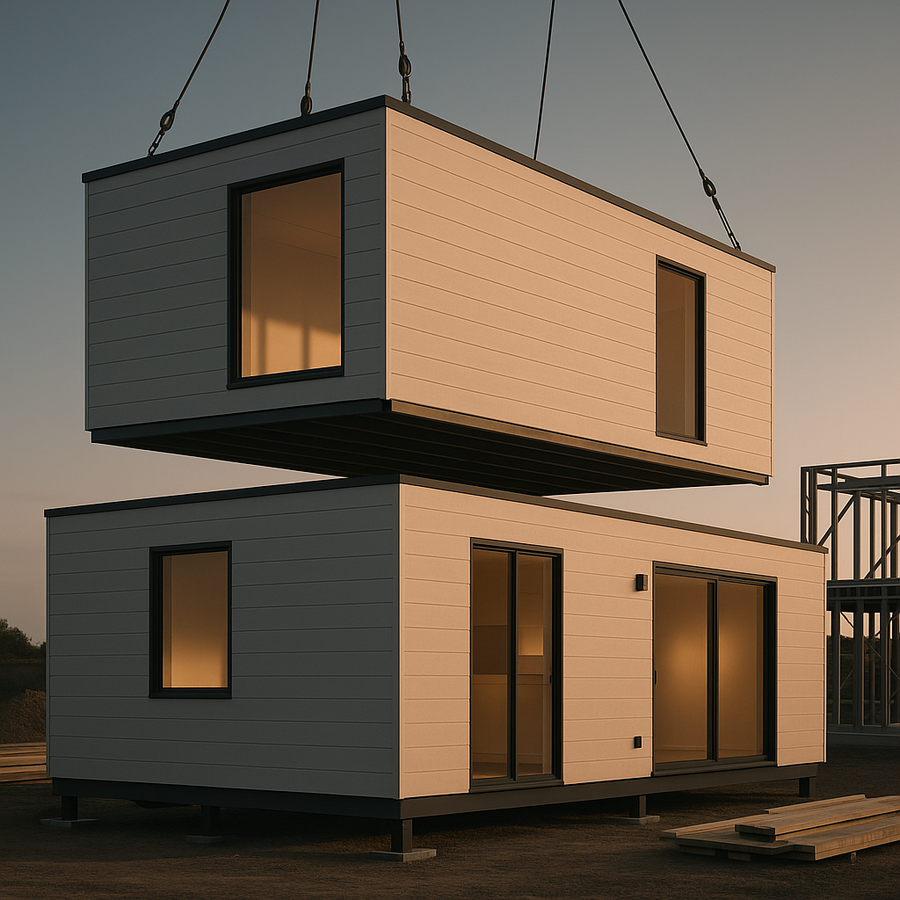
When the enclosure is industrialized, the turnkey workflow becomes more linear: site works and foundations happen while the factory builds enclosure units. This parallelization shortens total project duration and reduces on-site coordination complexity — a major advantage for autopromotores (self-developers) balancing multiple suppliers.
2. Common error: Choosing the wrong enclosure material
Symptom: aesthetic or performance failures only appear after occupation — warped façades, thermal bridges, or premature finish degradation.
Symptoms to watch: deformation, thermal bridges and poor durability
- Visible cracks or misaligned panels within 1–3 years indicate material or connection errors.
- Cold spots on walls or ceilings on thermal imaging usually point to thermal bridges or missing insulation continuity.
- Rapid moisture staining or rot in timber elements signals inadequate detailing or protective layers.
Practical solution: selection criteria for concrete, light timber frame and steel frame
Choose based on performance needs, site constraints and maintenance expectations. Use the following criteria to compare options:
- Concrete industrialized panels: excellent thermal mass and durability; best if your design benefits from monolithic façades and you need robustness in coastal or urban sites. Consider factory-applied insulation and breathable membranes to avoid condensation issues.
- Light timber frame (entracado ligero): fast, lightweight and highly thermally efficient when detailed correctly; ideal for tight sites and projects aiming for low embodied energy. Prioritize treated interfaces and ventilated cladding to prevent moisture accumulation.
- Steel frame (steel frame): high strength-to-weight ratio and dimensional precision. Good for larger spans or open plans. Protect steel against thermal bridging with thermal breaks and ensure corrosion protection in saline environments.
Rule of thumb: request U-values, hygrothermal simulations and detail drawings for connections before committing. If the manufacturer cannot provide these, escalate or seek alternatives.
Advice: ask for technical comparisons and real case studies with metrics
- Request at least two completed project case studies per material, with recorded times to envelope completion, measured airtightness (n50) and actual thermal imaging reports.
- Prefer suppliers who provide on-site test results rather than only lab values. Measured performance beats theoretical performance.
3. Common error: Failures in airtightness and thermal insulation
Air leakage and insulation discontinuities cause the most persistent comfort and energy complaints. They also generate the largest discrepancies between calculated and actual energy use.
How it shows: condensation, discomfort and high bills
- Persistent condensation on windows or inside cupboards.
- Rooms that never reach setpoint temperatures or feel drafty.
- Heating bills significantly above projections despite efficient systems.
Technical and operational solutions: detailing and construction controls
Key fixes that work in practice:
- Continuity of the airtight layer: decide and document the primary airtight plane (interior membrane, exterior panel or hybrid) and detail every penetration in drawings with approved sealing products.
- Thermal bridge mapping: identify junctions (foundations, corners, balconies) and adopt tested solutions such as thermal break connectors or insulated brackets.
- Factory prefitted interfaces: order panels with pre-applied gaskets and seals to reduce on-site variability.
Best practices for quality control and in-situ tests (blower door, thermography)
- Run a blower door test after enclosure completion but before finishes; target thresholds should be agreed contractually (e.g., n50 ≤ 1.5 h−1 for high-performance homes).
- Use infrared thermography under appropriate conditions to detect cold bridges and missing insulation layers.
- Include a QA checklist in the contract requiring rework if tests fail. Do not accept 'best effort' clauses for airtightness.
Measured airtightness and thermal continuity are the single most reliable predictors of long-term occupant comfort and energy cost alignment with projections.
4. Common error: Ignoring regulatory and planning requirements
Many self-builders assume factory-built equals automatic compliance. That is false and dangerous: lack of regulatory foresight causes stoppages, costly redesigns and permit denials.
Common risks: stoppages, fines and expensive redesigns
- Non-compliant façades or materials rejected by the local technical building office (OT).
- Urbanistic constraints (setbacks, heights) ignored in modular layouts leading to redesigns.
- Incorrect or missing documentation for energy certificates and warranties.
Solution: regulatory checklist for Spanish self-builders (licenses, CTE, energy)
Compile and verify the following early in the project:
- Urban planning requirements from the municipal plan: setbacks, max height, permitted materials.
- Building permit dossier aligned with CTE: thermal transmittances, acoustic performance and basic structural compliance.
- Energy compliance: include the necessary energy model outputs (CE3X/HE) and, if aiming for Passivhaus, the PHPP summary and airtightness targets.
Practical tip: bring regulatory advice early and share examples of resolved files
Hire or consult a technical architect early and request precedent permit dossiers from your supplier that were accepted by local authorities. Seeing a closed permit file removes doubt and shortens the approval loop.
5. Common error: Poor logistics planning and schedule control
Even the best factory-made panels fail to deliver if transportation, site access and on-site sequencing are not planned.
Impact: cost overruns, delayed turnkey delivery and coordination problems
- Missed crane windows or unsuitable access lead to storage costs and increased site days.
- Delayed envelope assembly pushes interior trades into winter months, inflating heating and site protection costs.
- Lack of a critical path plan causes subcontractor idle time and claims.
Solutions: critical calendar, prefabrication coordination and assembly logistics
Practical steps that reduce schedule risk:
- Create a critical path schedule that includes factory lead times, transport permits and crane availability. Lock these dates contractually.
- Perform a site access study: turning radii, load-bearing for crane pads, storage footprint and neighbor constraints.
- Schedule envelope erection during predictable weather windows. If impossible, arrange temporary covers and quick-erect shelters in the contract.
Case study: timeline metrics and savings vs traditional builds
Example (realistic composite): a 140 m² single-family home using industrialized timber panels:
- Traditional build: foundations to roof watertight ~ 18–22 weeks on site.
- Industrialized envelope: foundations and services 4–6 weeks parallel; panel manufacture 6–8 weeks; on-site envelope assembly 2–4 weeks. Total time to watertight ~ 10–12 weeks.
- Net saving: ~40–45% on envelope schedule; soft cost savings (site supervision, protection, temporary services) typically 10–15%.
These numbers are conservative. Ask suppliers for actual build logs and time-stamped photos to verify claims.
6. Practical conclusion: quick checklist and next steps to avoid these errors
Summary of prioritized solutions for each common error
- Material selection: compare U-values, embodied carbon, moisture resilience and supply-chain lead times.
- Airtightness and insulation: define the primary airtight plane, require factory-fitted seals and contract in-situ testing.
- Regulations: obtain municipal constraints early and supply precedent permit dossiers.
- Logistics: produce a critical path schedule that includes transport and crane dates; verify site access.
Downloadable checklist for supplier and technical meetings
Bring this checklist to your next meeting:
- Manufacturer portfolio: case studies with measured n50 and thermal imaging (ask for files).
- Detail drawings: junctions, foundation-to-wall, roof-to-wall, balcony interfaces.
- Contract terms: defined airtightness targets, lead times, penalties for missed crane windows.
- Regulatory pack: pre-approval examples, CTE compliance excerpts, energy model outputs.
- Logistics plan: transport route, crane specs, site storage layout and protective measures.
Next steps: evaluate offers, request studies and prepare your plot
When assessing proposals:
- Insist on measured results, not just declared performance.
- Ask for a project-specific timeline that shows parallel factory and site activities.
- Prepare the plot with all utilities and foundation tolerances verified by the supplier before panel delivery.
For system-level façades and sustainable detailing, explore Sistemas de cerramiento industrializado: guía completa and the practical assembly options in Sistemas de cerramiento industrializado: guía clave. If you want a clear walkthrough of the turnkey process, see Casa prefabricada: ventajas y proceso llave en mano.
Final takeaway: Industrialized housing delivers predictable schedules and energy performance — but only when material selection, airtightness detailing, regulatory planning and logistics are managed proactively. Use data, insist on tests and lock dates in contracts.
Ready to move from concept to a verified plan? Contact a technical advisor early, request measured case studies and start the regulatory checklist this week. If you need a structured checklist or supplier vetting template, we can help — reach out to start a project review.