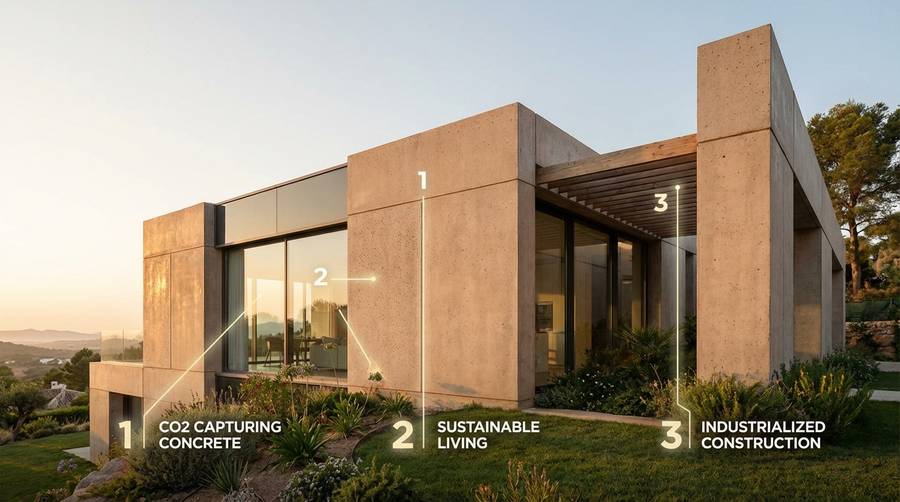
Carbon-Capturing Concrete for Modular Housing
Carbon-Capturing Concrete for Modular Housing
Hook: If your goal is a modern, Mediterranean-style home with measurable carbon reductions and predictable delivery times, carbon-capturing concrete can be the single most impactful material choice for a turnkey modular project.
Why carbon-capturing concrete matters for industrialized housing
What is carbon-capturing concrete and how it works in practice
Carbon-capturing concrete (also called carbon-sequestering or CO2-capturing concrete) uses processes that either absorb CO2 during curing or substitute high-emission clinker with alternatives and mineralizing agents. In practice, producers achieve this via:
- Mineral additives (e.g., calcined clays, supplementary cementitious materials) that reduce clinker content.
- CO2 injection during curing to mineralize and lock CO2 into the concrete matrix.
- Optimized mix designs that keep strength while lowering embodied carbon.
For modular housing, these methods are applied in factory conditions where mix repeatability, controlled curing, and quality testing are consistent—making the measured carbon reductions reliable.
Impact on carbon footprint: modular homes vs conventional concrete
Measured examples from recent projects show embodied carbon reductions of 20–60% for elements using carbon-capturing mixes versus conventional concrete. Key drivers:
- Factory control: less waste, optimized dosage, and fewer curing losses.
- Transport consolidation: modules delivered in fewer trips.
- Material substitution: lower clinker factor in mixes reduces CO2/kg of concrete.
These reductions are complementary to operational energy savings achieved with good enclosure and Passivhaus-aligned detailing.
Benefits for developers and self-builders: quality, durability and sustainability
Adopting carbon-capturing concrete in an industrialized process delivers tangible benefits:
- Predictable performance: factory-made elements meet tolerances and structural specifications.
- Longevity: reduced permeability and enhanced durability in many formulations.
- Market value: clearer sustainability credentials improve resale and financing outlooks.
How to integrate carbon-capturing concrete into a modular home design
Choosing compatible structural systems
Carbon-capturing concrete integrates well with several systems common in Spain’s industrialized housing market:
- Industrialized concrete panels for load-bearing walls and slabs—ideal when you want thermal mass and long spans.
- Steel frame (steel frame) with concrete infill for hybrid solutions that reduce concrete volume while keeping fire resistance.
- Light timber frame where concrete is used selectively for foundations, stair cores and terraces.
Selection should be based on structural needs, architectural intent (Mediterranean aesthetics), and thermal strategy.
Façade, finishes and Mediterranean aesthetics
To retain a Mediterranean contemporary look while using industrialized concrete:
- Use light, textured external renders or thin stone cladding over low-carbon concrete panels.
- Integrate natural wood details at terraces and shading devices to soften facades.
- Spec large windows with high-performance glazing to balance daylight and thermal control.
Tip: Coordinate the mix design with finish requirements—some low-clinker mixes have different surface colors or curing marks that should be addressed at design stage.
Thermal and energy criteria: coordinating with Passivhaus approach
Carbon-capturing concrete can be an asset in a Passivhaus-aligned design if you:
- Use concrete where thermal mass is beneficial (south-facing living rooms) and pair with high insulation on the envelope.
- Ensure airtightness strategies are independent of panel joints—use factory-installed gaskets and onsite sealing checks.
- Model hygrothermal behaviour early to avoid condensation issues in Mediterranean climates.
Manufacturing and quality control: from plant to turnkey delivery
Production: mix, curing and testing in an industrial environment
In factory production you can standardize CO2-capturing processes. Controls to require:
- Documented mix design with measured clinker substitution and declared CO2 reduction per m3.
- Curing protocols when CO2-injection is used (time, pressure, safety).
- Routine mechanical testing (compressive strength) and durability tests (chloride ingress, freeze–thaw where relevant).
Logistics, assembly and closed-site times for modular homes
One of modular construction’s main advantages is reduced on-site time. Real metrics from recent turnkey projects:
- Factory production cycles for panels or modules: 4–8 weeks depending on complexity.
- Transport and on-site assembly: typically 1–3 weeks for a single-family home shell.
- Finishes and commissioning on site to achieve fully delivered turnkey: 4–12 weeks depending on services and custom finishes.
These times contrast with conventional builds where on-site structural work alone can take many months.
Certifications, testing and traceability to guarantee CO2 reductions
Ask suppliers for:
- Declared embedded carbon (EPD or internal verified reports).
- Batch traceability and production records showing kiln/clinker ratios and CO2 injection logs where used.
- Third-party durability tests or lab reports for critical elements.
Costs, financing and economic advantages for the self-builder
Cost breakdown: materials, prefabrication, transport and assembly (practical metrics)
Below is a representative cost split for a 120–150 m2 turnkey modular house in Spain (figures indicative, 2024–2026 market reference):
- Materials & factory components: 35–45% of total cost (including carbon-capturing concrete premium of ~3–8% on concrete elements).
- Manufacturing & quality control: 20–25%.
- Transport & assembly: 8–12%.
- On-site finishes, services & landscaping: 20–30%.
Using carbon-capturing concrete often increases the concrete line-item modestly but is offset by savings from reduced remedial works, improved durability and streamlined factory processes.
Financing options and mortgages for self-build modular housing in Spain
Self-builders (autopromotores) have several routes:
- Traditional construction mortgages with staged drawdowns for turnkey modular projects—banks may favor factory processes for predictable budgets.
- Specific green mortgages and preferential loans for low-carbon homes—eligibility often requires EPDs or energy-certification (A rating/Passivhaus proof).
- Bridge loans combined with final mortgage once completed—common when buying parcel then building turnkey.
Practical advice: Prepare a clear turnkey contract, a production schedule and the supplier’s EPD to speed bank underwriting.
Medium and long-term savings: maintenance, energy and resale value
Key economic advantages:
- Lower maintenance needs where concrete mixes improve durability.
- Energy savings when paired with robust insulation and passivhaus design—lower operational costs.
- Increased market appeal and potential price premium for verified low-carbon homes.
Case studies and technical comparisons: real-world outcomes
Practical case: a turnkey home with carbon-capturing concrete (2024–2026 data)
Project snapshot (anonymized, aggregated data):
- Size: 135 m2 single-family, Mediterranean contemporary design.
- Structure: industrialized concrete panels with timber accents.
- Factory lead time: 6 weeks. On-site assembly: 10 days. Turnkey delivery: 9 weeks post-assembly.
- Embodied carbon reduction: measured 38% lower CO2eq in structural elements vs conventional concrete.
- Client satisfaction: 92% rated overall process positively for predictability and final quality.
Lessons: early coordination between architect, concrete supplier and factory yields the best cost and carbon outcomes.
Technical comparison vs conventional concrete and alternative materials
Comparison highlights:
- Carbon-capturing concrete vs conventional concrete: lower embodied carbon, similar strength when specified correctly.
- Concrete vs timber frame: timber often wins on embodied carbon per m3 but may need hybrid solutions for fire, acoustics and thermal mass.
- Steel frame: great for long spans and repeatability but steel’s embodied carbon can be higher unless recycled content is high.
Recommendations derived from case experience
Do this: specify EPDs, plan integration with Passive strategies, and allocate budget for independent testing. Avoid: late changes to panel layouts that increase waste or require rework in the factory.
Step-by-step guide to implement carbon-capturing concrete in a turnkey project
Key phases: parcel search, design, cost control, permits and industrialized production
Phase checklist:
- Parcel selection: check accessibility for module transport and orientation for solar gains.
- Concept design: choose structural system early and request supplier feasibility studies.
- Budget & contract: fixed-price turnkey with clear change control and production milestones.
- Permitting: submit factory production drawings and installation sequence to local authorities where required.
- Production & QA: factory testing, EPD documentation and pre-delivery inspections.
- Delivery & commissioning: site assembly, seals, services connection and final airtightness and commissioning tests.
Technical and document checklist before ordering in the factory
Must-have documents:
- Approved structural drawings with mix specifications.
- Declared EPD or equivalent carbon statements for concrete elements.
- Assembly sequence and transport plan.
- Factory quality control plan and acceptance criteria.
- Third-party test plan for onsite inspections.
Delivery, commissioning and performance metrics to measure
Measure and record:
- Embodied carbon per m2 for structural elements (from EPDs).
- On-site airtightness (Blower door results).
- Operational energy use (first-year monitoring recommended).
- Client satisfaction survey at handover and at 12 months.
Closing and next steps for self-builders seeking sustainable homes
Summary of benefits and how to choose a supplier
Carbon-capturing concrete used in an industrialized, turnkey workflow combines reduced embodied carbon, factory-quality control and predictable schedules. When choosing a supplier, prioritize:
- Transparent documentation (EPDs, batch traceability).
- Experience with modular assembly and Mediterranean details.
- Clear warranty and post-delivery support.
Frequently asked questions to resolve before signing a turnkey contract
Essential questions:
- What documented CO2 reductions does the supplier provide?
- How will on-site airtightness and thermal bridge details be guaranteed?
- What is included in the turnkey scope and what counts as a change order?
- Which banks or financing options have previously underwritten similar projects?
Recommended resources: regulations, grants and further reading in Spain
Check regional subsidies for energy-efficient construction, national green mortgage offerings, and official technical regulations (CTE) for structural and thermal compliance. Keep documentary proof of carbon claims to access incentives.
Choosing carbon-capturing concrete within an industrialized, turnkey workflow reduces both embodied carbon and delivery risk—while maintaining Mediterranean design and long-term value.
Call to Action: If you are planning a self-build or developer project, compile your parcel details and concept brief and request manufacturer EPDs and a preliminary production schedule. Contact a trusted turnkey provider to get a realistic quote and first feasibility review.