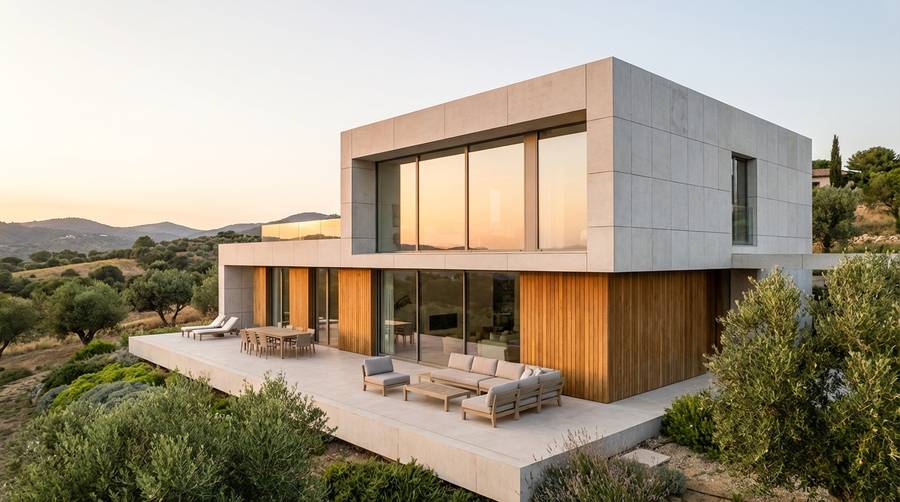
Avoiding Common Mistakes in Industrialized Housing
Avoiding Common Mistakes in Industrialized Housing
Hook: If you're planning an industrialized or modular home in Spain, one misstep early on can double costs or add months to your schedule. This guide cuts straight to the most common errors and gives clear, actionable fixes so your project stays on time, on budget and energy-efficient.
How to avoid the most frequent mistakes in alternative building systems
Industrialized housing is not a single product — it is a process that combines design, off-site manufacturing and on-site assembly. Many autopromoters confuse systems, overlook local rules or buy solutions that don't suit their plot. Below we explain core concepts, real advantages versus traditional builds and the initial checklist every promoter must run through.
What to understand before you start: key concepts (prefabricated, industrialized, modular)
Define the terms early. In practice: prefabricated often refers to components made off-site; industrialized refers to factories producing repeatable, quality-controlled assemblies; modular refers to volumetric units assembled into a final building. Confusing these leads to wrong expectations on costs, schedule and on-site disruption.
Real advantages versus traditional construction and why they matter
- Predictable costs: fixed manufacturing budgets reduce variability from subcontractor claims.
- Shorter on-site time: closed envelope achieved faster, lowering weather risks and site overheads.
- Quality control: factory environment reduces rework and improves repeatability.
- Energy performance: modern systems can meet or exceed Passivhaus principles with less variability.
Initial checklist for self-builders: plot, regulations, budget and timelines
- Confirm urban planning and building regulations for your municipality.
- Order a basic geotechnical report and check access for large deliveries.
- Set a realistic budget that separates manufacture, transport, foundations and finishes.
- Agree on a target timeline with milestones tied to factory runs and on-site works.
Small investments up front — geotechnical, energy simulations and a detailed contract — prevent far larger surprises later.
1. Choosing a system without matching it to climate and site
Picking a construction system as if one size fits all is the single most common cause of failures. Thermally light systems perform differently in coastal Valencia than in the continental interior of Spain. Soil, wind exposure and orientation also change the plan.
Error: selecting a generic system without site or thermal envelope study
Promoters often choose a system based on price or marketing images rather than a site-specific study. The result: overheating, condensation problems or excessive heating demand that undercut the promise of savings.
Solution: adapt materials and systems (industrialized concrete, light timber frame, steel frame) to climate and local rules
Match material to context:
- Industrialized concrete: excellent for thermal mass in continental climates, good acoustic performance and compliance with strict wind or seismic requirements.
- Light timber frame (entramado ligero): high speed, low embodied energy, ideal in mild climates with careful moisture detailing.
- Steel frame: high precision and slender sections, good for tight structural requirements or large spans but requires thermal bridge control.
Practical tip: request energy simulations and a parcel viability report
Before choosing a system, require:
- An energy model with heating/cooling estimates for the proposed envelope.
- A site viability report covering access, crane location and required foundation type.
- Comparative lifecycle carbon estimates for at least two systems to evaluate sustainability trade-offs.
- Action: include these studies as pre-contract deliverables and link payment milestones to their completion.
2. Underestimating energy efficiency and certification (long-term cost risk)
Many self-builders accept a marginal envelope to reduce up-front cost, but that creates persistent energy bills and lowers resale value. In Spain, variable climate zones make robust envelopes more valuable.
Error: focusing only on initial savings rather than Passivhaus-grade or efficient envelopes
A cheap envelope can increase lifetime energy costs. Additionally, poor airtightness drives condensation, compromising finishes and warranties.
Solution: design with detailed thermal bridge treatment, airtightness and ventilation with heat recovery
Key technical priorities:
- Detailed junction design where floors, walls and roofs meet to avoid thermal bridges.
- High-performance windows and installation details proven in testing.
- Mechanical ventilation with heat recovery sized and commissioned for actual airflows.
- Factory QA for insulation placement and airtightness panels to reduce on-site variability.
Practical tip: require an energy study and estimated consumption before signing
Ask for a clear estimate of annual heating and cooling demand (kWh/m²·year) under a chosen standard (e.g., Passive House Planning Package or Spanish CTE methodology). Use that figure when weighing bids.
3. Contracting without understanding the scope of a 'turnkey' service
'Llave en mano' promises comfort, but its definitions vary widely. The gap between expectation and contract scope is a frequent source of disputes.
Error: assuming every permit, foundation and connection is included
Promoters sometimes believe the turnkey provider handles the plot access, foundations, utilities or finishing scopes. Later, they discover exclusions and pay extra.
Solution: insist on a detailed contract with milestones, responsibilities and penalties for deviation
A robust contract should state:
- Exactly which works are included (foundations, connections, permits, site preparation, landscaping).
- Clear milestones with dates and retention clauses.
- Liquidated damages for delayed delivery and defined remedies for defects.
- Third-party warranties and factory QA certificates for components.
Practical tip: ask for a closed schedule and examples of similar projects with metrics
Demand examples showing manufacturing lead time, on-site assembly duration and final delivery dates. Look for projects with similar ground conditions and size, and compare promised vs actual timelines.
4. Not planning specific financing for self-build modular projects
Standard mortgage products for finished homes do not match the cashflow profile of manufacturing milestones and staged payments. Misaligned finance creates delays or forces scope cuts.
Error: seeking a standard mortgage when the project needs staged payments tied to fabrication
Banks may refuse disbursement before permanent connection or occupancy, but factories need payment earlier. This funding mismatch interrupts production runs and causes penalties.
Solution: explore self-build mortgages and financing lines adapted to industrialized housing
Options to explore:
- Self-build mortgages that disburse by construction milestone.
- Factory financing or supplier credit linked to production schedules.
- Bridge loans to cover initial site works and foundations until larger disbursements occur.
Practical tip: prepare technical documents and an itemised budget to negotiate terms
Banks will want a professional set of documents: a detailed schedule of works, technical specs of the modular system, factory timetable and a cost breakdown. Presenting these up-front shortens negotiations and improves offers.
Summary: keys for a turnkey modular project without surprises
Turning common failure points into contractual requirements and early investments is the most reliable path to a successful industrialized housing project.
Primary warning signs and how to turn them into contract requirements
- Vague scope: require an appendix with inclusions and exclusions.
- No site report: make geotechnical and access studies a condition precedent.
- No energy estimate: tie payment approval to an energy model and airtightness target.
Small early investments that prevent overruns
- Geotechnical study and survey.
- Preliminary energy simulation and window/insulation specifications.
- Detailed turnkey contract with penalties and QA obligations.
Final delivery checklist: quality, documentation, warranties and client satisfaction
- As-built documentation and O&M manuals for mechanical systems.
- Factory QA records and airtightness/blower-door test results.
- Warranty certificates and clearly defined defect rectification periods.
- Client walkthrough and punch-list with agreed rectification deadlines.
Case study snapshots and comparative data (realistic benchmarks)
Below are concise, anonymised benchmarks drawn from recent industrialized housing projects in Spain. Use them as comparative data, not guarantees.
Case A — 150 m² timber-frame suburban home
- Factory time: 6 weeks
- On-site assembly: 2 weeks
- Total from groundworks start to delivery: 16 weeks
- Budget variance: +3% (mainly due to extra site drainage works)
- Energy: projected heating demand 18 kWh/m²·year (ventilation with heat recovery)
Case B — 200 m² steel-frame coastal home
- Factory time: 10 weeks
- On-site assembly: 4 weeks
- Total delivery: 20 weeks
- Budget variance: -1% (savings on finishes)
- Energy: projected heating demand 25 kWh/m²·year with targeted shading strategy
Comparative notes
Interpretation: timber-frame can be the fastest for envelopes, but requires rigorous moisture control in exposed sites. Steel frames give precision for complex layouts but must be detailed to avoid thermal bridges. Concrete systems add mass valuable in continental climates.
Practical final checklist before signing any turnkey contract
- Confirm geotechnical and access report is included or completed.
- Obtain an energy simulation with expected consumption figures.
- Ensure the contract lists responsibilities for permits, foundations and connections.
- Require a closed schedule with liquidated damages for delays.
- Secure financing that matches milestone payments.
- Ask for at least two completed reference projects with similar context.
Conclusion
Takeaway: Avoiding common mistakes in industrialized housing comes down to three practical habits: demand site-specific studies, make performance targets contractual, and align financing with manufacturing. These steps convert perceived risks into measurable deliverables.
If you want a tailored checklist for your plot or help reviewing a turnkey contract, contact a technical advisor before signing — a short review now can save months and tens of thousands later.
Call to action: Reflect on your next step: order a geotechnical study, request an energy simulation or ask for a turnkey breakdown — and if you prefer, reach out to experts to validate your plan.