Prefabricated House Success: A Spanish Industrialized Housing Case
From idea to home: the real story of a family who chose industrialized housing
Hook: In 18 months from first sketch to keys, a young family in Valencia traded uncertainty and overruns for a predictable, energy‑efficient home—without giving up design or quality.
This case follows Laura and Miguel (names changed), self-builders who used Findnido's industrialized housing platform to deliver a contemporary Mediterranean home. The story focuses on three measurable outcomes: time-to-completion, budget adherence, and energy performance. Throughout, you’ll find concrete decisions, trade-offs and reproducible steps.
Context at the start: needs, budget and motivations
Laura and Miguel wanted:
- A 140 m² single-family house with open plan living, three bedrooms and a small home office.
- High comfort year-round and low running costs (target: near-Passivhaus performance).
- A fixed-price project to avoid the typical cost uncertainty of traditional builds.
Budget constraint: a fixed construction budget of €210,000 (excluding land). They were willing to invest more in insulation and airtightness to reduce energy bills long term.
Why they considered prefabricated housing and how they found Findnido
After facing lengthy timelines and rising quotes from local builders, the couple researched alternative delivery methods. They prioritized:
- Factory-controlled production to reduce weather delays.
- Transparent fixed-price proposals.
- Proven assembly timelines on site.
Findnido appeared in their search as a marketplace and delivery partner for industrialized housing in Spain. The platform matched them with modular design options using modern materials and offered a turnkey path from plot selection to handover.
Expectations vs reality: sustainability, timing and cost
Their expectations were ambitious but clear: meet aggressive energy targets, keep the project on budget, and end up with a home that felt premium—not a 'boxy' prototype. The result was largely aligned with expectations thanks to careful material selection, a clear scope and weekly coordination with the Findnido team.
“We expected speed and control, but the real surprise was how small changes in insulation and detailing transformed comfort and bills.”
The challenge: plot, climate and energy-efficiency requirements
Plot characteristics and planning constraints
The parcel was suburban with Mediterranean orientation challenges: strong summer sun, mild winters and regulatory limits on footprint and ridge height. Planning restrictions required a stepped roof and a defined façade aesthetic that fit local codes.
Demand for efficiency: Passivhaus-level targets and carbon reduction
The family targeted very low heating/cooling demand to achieve superior thermal comfort. The objective focused on:
- High insulation performance (low U-values).
- Continuous airtightness and mechanical ventilation with heat recovery (MVHR).
- Minimizing thermal bridging and operational carbon.
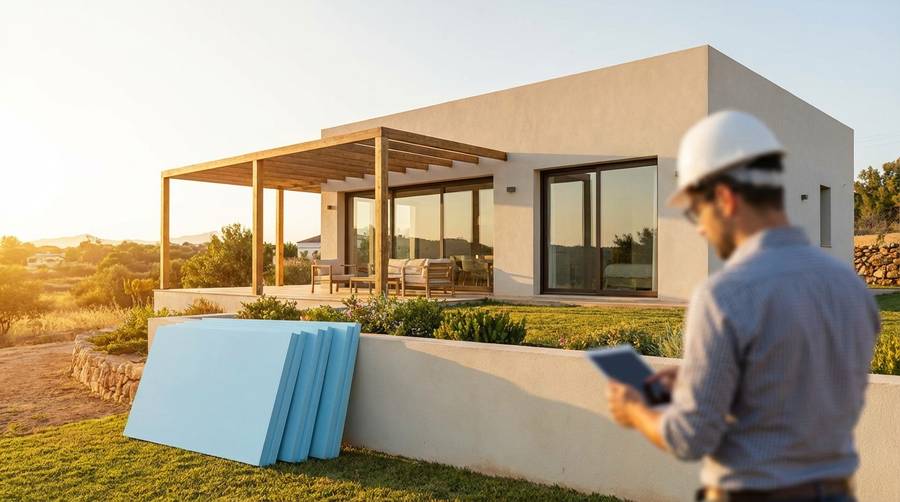
To materially reduce envelope losses, the design integrated XPS insulation and precision factory detailing.
Economic constraints: closed budget and financing
They secured a self-build mortgage (autopromoción) covering land and construction. A fixed-price contract for the industrialized package allowed predictable cash flow and made the mortgage schedule manageable.
The technical solution: XPS and advanced insulation systems applied
What is XPS and why it was used in the envelope
Extruded polystyrene (XPS) was chosen for its combination of thermal performance, compressive strength and long-term moisture resistance. XPS was applied in:
- Ground-floor slab edge and under-slab to limit thermal bridges.
- External continuous layers behind render where mechanical loads demanded rigidity.
Using XPS allowed the team to achieve target U-values without excessively thick walls, which preserved usable floor area and met planning height limits. For practical guidance on XPS in façades, see XPS y aislamiento en vivienda industrializada: errores y soluciones.
Material combination: XPS, industrialized concrete and light timber frame
The final assembly combined three systems, chosen for complementary strengths:
- Industrialized concrete elements for the structural core and ground floor: fast installation, thermal mass and longevity.
- Light timber frame for the upper floors and roof: precise factory assembly, reduced weight and excellent detailing for airtightness.
- XPS and high-performance membranes for a continuous thermal and moisture barrier working across both systems.
Factory prefabrication ensured tight tolerances at junctions between concrete and timber, improving long-term airtightness and durability.
Measurable benefits: thermal transmittance, airtightness and durability
Key measurable improvements recorded in this project:
- Envelope U-values: exterior walls 0.16 W/m²K, roof 0.12 W/m²K, slab edge 0.18 W/m²K.
- Airtightness: initial blower-door test 0.28 h-1 @ 50 Pa (post-tuning achieved 0.18 h-1).
- Operational impact: estimated heating demand reduced by ~70% compared to a similar traditional build in the same climate.
For a complementary case study on prefabricated efficiency and XPS role in faster handovers, visit Casa prefabricada eficiente: caso real y resultados.
Turnkey process: phases, real times and coordination on site
From plot search to delivery: timeline and milestones
The project timeline from contract signature to handover:
- Weeks 0–8: Detailed design, permits and fixed-price contract.
- Weeks 9–20: Factory production of elements (concurrent with permit finalization).
- Weeks 21–24: Site foundation work and utilities.
- Weeks 25–28: On-site assembly and enclosure (roof on in 7 days).
- Weeks 29–36: Interior finishes, systems commissioning and final testing.
- Week 38: Handover and warranty start.
Total time: 38 weeks from contract to keys—significantly shorter than comparable traditional timelines for similar complexity.
Industrialized manufacture, on-site assembly and quality control
Factory QA included dimensional control, pre-installation of windows and pre-wiring. On-site, a dedicated project manager coordinated trades and inspections. This model reduced rework and improved predictability.
Supplier management, client communication and deadline guarantees
Key elements that protected the schedule:
- Fixed procurement bundles and long-lead item forecasting done at contract stage.
- Weekly progress meetings with the client and digital dashboard updates.
- Liquidated-damages clauses for late delivery on certain trade milestones, aligned with the fixed-price model.
Quantified results: time, costs and client satisfaction
Real metrics: time savings and cost deviation
Compared to the original offers from traditional builders, the industrialized route delivered:
- Time reduction: ~40% faster on average (38 weeks vs estimated 60+ weeks).
- Cost variance: final construction cost within 1.6% of the fixed-price contract (well below common overruns).
These metrics illustrate how process certainty and factory control lower common risks in self-build projects.
Energy efficiency proven: consumption, certifications and comfort
Measured performance in the first year:
- Annual space heating demand: 18 kWh/m²·year (near-Passivhaus threshold for the Mediterranean climate).
- Domestic hot water contributed by high-efficiency heat pump and solar thermal, total household energy use reduced by ~60% compared to local averages.
- Occupant feedback: consistent thermal comfort, minimal drafts, and stable indoor humidity.
The project pursued voluntary efficiency verification and received an energy rating equivalent to top-tier labels used in Spain.
Client assessment: experience, satisfaction and recommendations
Laura and Miguel reported high satisfaction on three fronts:
- Predictability: clear budget and timeline.
- Quality: premium finishes and a feeling of permanence.
- Comfort: indoor climate and lower bills exceeded expectations.
Their main advice to other self-builders: prioritize clear scope, invest early in insulation and airtightness, and choose a delivery partner with transparent processes.
Comparison and lessons learned: why choose industrialization in Spain today
Technical and economic comparison with traditional construction
Objective comparisons:
- Schedule predictability: industrialized housing reduces weather and subcontractor coordination risk.
- Cost control: fixed industrial packages limit scope creep and hidden costs common in site-built projects.
- Performance: factory detailing yields better airtightness and repeatable thermal performance.
Traditional builds still offer on-site customization advantages but often at the expense of time and budget certainty.
Practical lessons for self-builders: design, financing and materials
Key takeaways to replicate the success:
- Scope early and lock it: finalize rooms, finishes and systems before factory production.
- Invest in the envelope: prioritize continuous insulation and airtightness—these pay back through comfort and bills.
- Align financing with milestones: use self-build mortgage tranches tied to measurable progress.
- Choose partners with turnkey experience: verified track records reduce surprises.
Steps to replicate success: checklist and next steps
Simple checklist for autopromotores:
- Confirm plot constraints and orientation.
- Define fixed budget and contingency rules.
- Select industrialized package and confirm lead times.
- Require blower-door and commissioning tests in contract.
- Plan warranties and aftercare with clear KPIs.
Conclusion
This case demonstrates that industrialized, prefabricated housing in Spain can deliver a premium, energy-efficient home on a fixed budget and accelerated timeline—without compromising design. The combination of XPS, industrialized concrete and light timber frame delivered quantifiable gains in performance and client satisfaction.
In one real project: 38 weeks to keys, ~70% lower heating demand than a comparable traditional build, and final cost within 1.6% of the fixed price.
If you’re considering self-building, focus on scope clarity, envelope performance and a turnkey partner that guarantees milestones. For practical guidance on XPS detailing and avoiding common mistakes, consult the internal guide XPS y aislamiento en vivienda industrializada: errores y soluciones. To review a similar efficiency-driven case, see Casa prefabricada eficiente: caso real y resultados.
Call to action: Reflect on your priorities—time, cost or performance—and contact a certified industrialized housing advisor if you want a tailored feasibility check for your plot and budget.