


Industrialized Housing Success: Spanish Case Study
How we started: a family's dream of industrialized housing
Hook: In 18 months from concept to keys, a young family in Valencia swapped uncertainty for a fixed-price, energy-efficient home. This case study shows exactly how.
Initial situation and owner objectives (budget, timelines, sustainability criteria)
The owners were a family of three with two clear constraints: a strict budget and a desire for low operational costs. Their objectives were specific and measurable:
- Budget cap: €220,000 including land and VAT.
- Timeline: ready to move in within 20 months.
- Sustainability targets: high insulation, mechanical ventilation with heat recovery (MVHR) and reduced embodied carbon.
They chose industrialized housing because it offered a predictable timeline, fixed-cost packages and modern material options like industrialized concrete, wood frame and steel frame systems.
Why they selected industrialized materials: industrialized concrete, wood frame and steel frame
The design team proposed a hybrid approach: a reinforced industrialized concrete foundation and ground floor slab for durability, a light wood frame (wood frame) for upper floors to achieve quick assembly and low thermal bridging, and steel frame elements where larger spans were needed.
Benefits observed:
- Faster onsite assembly — key elements arrived pre-cut and ready to assemble.
- Higher quality control — components manufactured in controlled conditions.
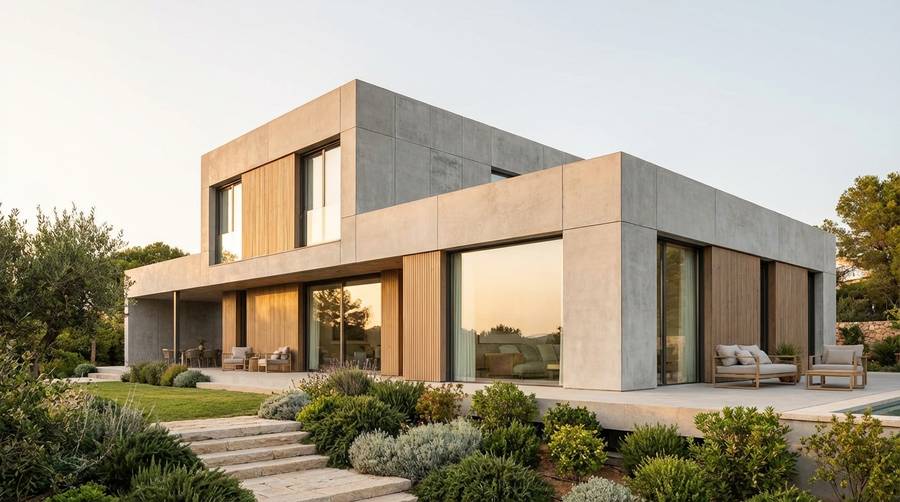
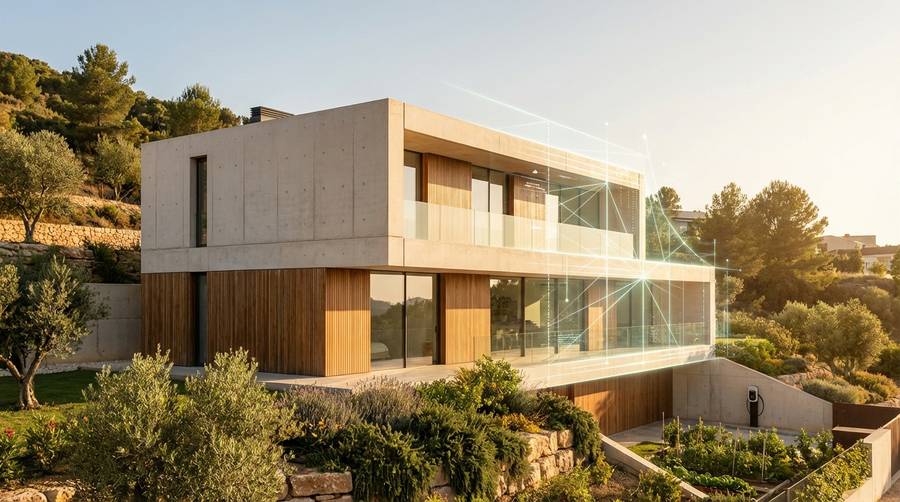
- Flexibility in finishes — Mediterranean aesthetic preserved with natural materials.
First steps with the platform: plot search and turnkey advisory
The family engaged Findnido's turnkey advisory to locate a 450 m² plot near a commuter town. Findnido coordinated site surveys, a soil report and initial planning advice, which prevented costly surprises during permitting.
From day one the approach was pragmatic: define non-negotiables, run cost checks against three construction systems, and reserve contingency — all documented in a simple spreadsheet updated weekly.
Design and planning: turning an idea into a buildable project
Collaborative design process: functionality, energy efficiency and Mediterranean style
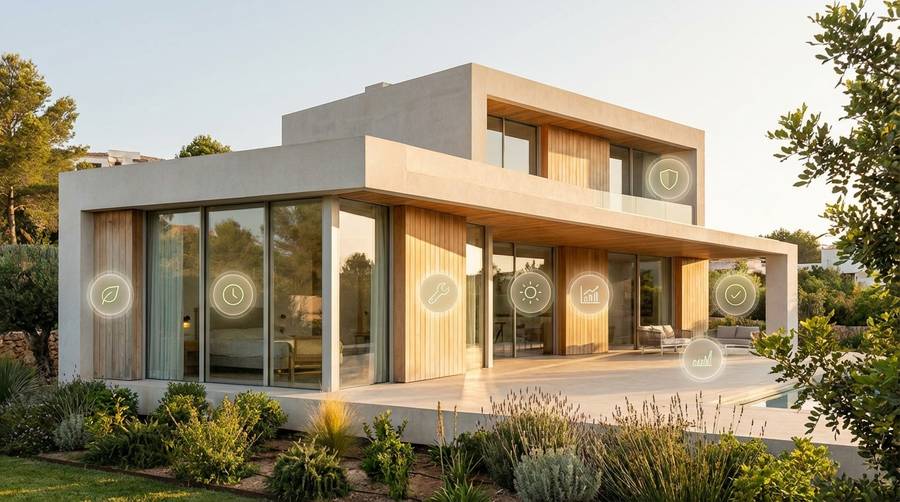
Design meetings balanced three priorities: functional family spaces, Passivhaus-inspired energy targets, and a Mediterranean look that fit the neighborhood. The result: a compact two-storey plan with large south-facing windows, a shaded terrace and a warm facade palette of light render, timber slats and local stone accents.
Actionable tip: Establish an energy target early (e.g., annual heating demand < 15 kWh/m²) and let it guide window sizing and insulation levels from the first sketch.
Choosing materials and the construction system by climate and budget
Selection criteria used by the team:
- Thermal performance: prioritize continuous insulation and airtightness.
- Speed to enclosure: choose systems that close the building quickly to avoid weather delays.
- Budget balance: use industrialized concrete for durability where needed and wood frame to reduce labor hours.
The finished specification included external PIR insulation, high-performance triple-glazed windows, and wood frame upper walls with mineral wool and a ventilated rainscreen to achieve durability and comfort.
Permits, timelines and coordination with the builder in a turnkey model
Under the turnkey model, Findnido coordinated the planning application, structural calculations and permit submission. Key process steps that saved time:
- Early geotechnical report to avoid foundation redesigns.
- Pre-application meeting with the town hall to clarify facade rules.
- A single point of contact for paperwork to streamline approvals.
Result: planning permission granted in 12 weeks — faster than the region average due to proactive documentation.
Industrialized construction: times, costs and quality control
Assembly phases vs traditional build: prefabrication, transport and on-site assembly
The construction was divided into clear, measurable phases:
- Factory production (10 weeks): panels, floor cassettes and window units manufactured and QA-tested.
- Transport (2 weeks): coordinated just-in-time to avoid onsite stacking.
- Onsite assembly (6 weeks): structure erected, roof on and building weather-tight.
- Fit-out (8–10 weeks): mechanical systems, finishes and external works.
Compared to a traditional build, the time from start of manufacturing to weather-tight was reduced by about 40%.
Real metrics from the case: closed timelines, cost deviations and quality checks
Project performance vs plan:
- Planned completion: 20 months. Actual: 18 months.
- Budget: planned €220,000. Final certified cost: €226,000 (+2.7% mainly due to optional landscaping).
- Airtightness (blower door): 0.55 ACH at 50 Pa — close to Passivhaus target and significantly better than typical new builds.
Quality control measures: factory QA records, site checklists, and third-party thermal imaging before handover ensured defects were identified early and corrected.
Managing contingencies and post-delivery warranties in a turnkey delivery
Turnkey contracts included a 2-year snags period and a 10-year structural warranty. When minor leaks appeared around a terrace junction, the manufacturer issued a focused remediation within two weeks — demonstrating how factory responsibility simplifies warranty actions.
Predictable manufacturing and clear warranties reduced the family's exposure to cost overruns and long onsite repairs.
Efficiency and sustainability: measurable outcomes
Energy performance and certifications (Passivhaus approach and carbon reduction)
The team targeted Passivhaus principles rather than formal certification to keep costs controlled. Measured results in the first winter:
- Annual heating need estimated at 12 kWh/m².
- Primary energy demand reduced by ~40% versus a comparable conventional new build in the area.
Where relevant, industrialized concrete elements were specified with low-clinker cement mixes to reduce embodied carbon, and the wood frame portion used certified timber.
Savings in consumption and emissions: before/after comparisons
Comparative data (first 12 months of occupancy vs regional average):
- Space heating energy: -65%.
- Domestic hot water energy: -30% (with solar thermal support).
- Estimated CO2 emissions related to operation: -55%.
These outcomes translated into lower bills and a more comfortable indoor climate year-round.
Passive solutions and material choices: insulation, windows and ventilation
Key passive choices that made a measurable difference:
- Continuous external insulation with high-performance render to avoid thermal bridges.
- Triple-glazed aluminum-wood composite windows with low-e coating.
- Balanced MVHR system sized for actual occupancy, ensuring fresh air with minimal heat loss.
Financing and access: how the house was paid for and options for autopromoters
Construction mortgages for self-build and modular housing products in Spain
Autopromoter mortgages in Spain typically offer staged payments tied to construction milestones. For modular projects, lenders are increasingly comfortable when a turnkey contractor provides fixed-price guarantees and factory QA documentation.
Financing structure used: a 70% land + construction mortgage with staged disbursements and a 30% owner equity contribution drawn from savings and a small regional sustainability grant.
Financial example from the case: investment breakdown, grants and payment schedule
High-level breakdown:
- Land: €70,000
- Construction turnkey contract: €130,000
- Professional fees, permits and IVA: €26,000
Payments matched factory and onsite milestones: 30% on contract, 40% on delivery of panels, 20% on assembly completion and 10% on final handover. A €6,000 regional grant for energy-efficient new builds partially offset costs.
Practical tips to negotiate financing and protect your budget
- Insist on a fixed-price turnkey contract with clearly defined scope.
- Ask the lender for staged disbursements that mirror manufacture and assembly milestones.
- Keep a 5–10% contingency fund for owner-driven upgrades, not for construction overruns.
Lessons and recommendations: inspiring future autopromoters
What worked best: main successes of the project and why
Key successes:
- Clear targets: an early energy and budget target focused decisions and avoided scope creep.
- Turnkey coordination: a single coordinator reduced permit delays and miscommunication.
- Hybrid materials approach: matched performance needs with cost-effective assemblies.
Avoidable mistakes and how to plan them out from day one
Common pitfalls identified and mitigations:
- Underestimating site logistics: pre-plan crane access and transport permits.
- Late finish choices: decide key finishes before factory production starts to avoid rework.
- Financing alignment: get lender buy-in on the turnkey schedule before signing the main contract.
Practical checklist for anyone planning an industrialized home in 2026
- Define budget, timeline and energy target.
- Choose a construction system early and test costs with two suppliers.
- Secure a plot with good access and utilities.
- Use a turnkey contract with clear milestones and warranties.
- Plan landscaping and external works as part of the budget, not an afterthought.
For further reading on material choices and comfort, see Massamagrell y la vivienda unifamiliar: vivir mejor and for a broader guide on turnkey benefits, see Vivienda industrializada: ventajas y guía llave en mano.
Handover day: living in the house and measuring satisfaction
Final reception, homeowner training and after-sales services
On delivery, the team provided a two-hour walkthrough covering MVHR operation, warranty registration and a maintenance schedule. A concise homeowner manual and digital dossier with factory QA reports were delivered.
Satisfaction indicators: comfort, timelines met and the sense of home
Measured satisfaction after six months:
- Comfort score (survey): 9/10
- Would recommend to friends: 85%
- Gap vs planned timeline: finished 2 months early
The family emphasized that predictability and low running costs made the industrialized route feel like a prudent, modern choice rather than a compromise.
How the experience informs future improvements in processes and materials
Lessons for the supply chain include tighter alignment on window lead times and earlier landscaping decisions. Material-wise, the project reinforced that a hybrid system can combine robustness with speed and low embodied carbon when specified with care.
Conclusion: practical inspiration for autopromoters
Summary: This case shows industrialized housing can deliver a Mediterranean-style home with predictable costs, short timelines and measurable energy benefits. The keys are early targets, a turnkey partner and a pragmatic material strategy.
If you're considering self-build in Spain, start with clear energy and budget targets, and test a turnkey offer against a traditional estimate. For a practical first step, request a feasibility review with documented milestones — it will reveal whether a turnkey industrialized approach fits your plot and goals.
Call to action: If you want help translating your brief into a realistic turnkey plan, contact an advisor to run feasibility checks and a preliminary budget — small upfront clarity prevents large downstream surprises.
Artículos relacionados
7 Reasons to Choose Industrialized Materials for Modular Homes
A concise, actionable guide explaining why industrialized materials (concrete, light timber frame, steel frame) deliver predictable costs, shorter schedules and better energy performance for modular homes in Spain — with checklists, a case study and next steps to finance your project.