Prefabricated House Success: A 9‑Month Turnkey Story
They moved in nine months later: how a prefabricated house changed one family's life
The day the family turned the key, they cried. After years of renting and frustration with renovation delays, they now had a bright, compact home that matched their budget and sustainability goals. This story is not an abstract promise — it is a practical blueprint for building a prefabricated house in Spain on a fixed budget and tight timeline.
"We wanted certainty: a fixed price, a finished schedule and a real finished house. Prefabrication gave us that without sacrificing design or energy performance."
A new life in 9 months: real context and initial goals
Family context, plot and objectives
The homeowners were a young family with a single plot in a suburban Mediterranean town. Their goals were clear: a healthy, low‑maintenance home sized for their family of three, certification-ready energy efficiency, and a maximum total budget. They prioritized:
- Cost certainty — a firm maximum construction cost.
- Speed — move in within a year from the decision.
- Sustainability — low energy bills and reduced carbon footprint.
Why they chose an industrialized solution instead of traditional build
After comparing options, the family selected a modular home delivered as a turnkey project. Key deciding factors were:
- Predictable pricing and a formal contract limiting cost overruns.
- Shorter on‑site assembly time, reducing disturbance and weather delays.
- Factory quality control for airtightness and finishes, aiding energy targets.
The challenge: cap costs and time without sacrificing quality
Plot conditions, target budget and administrative limits
The plot had a slight slope and local regulations limiting footprint and height. The target total investment — land excluded — was competitive against local traditional builds. The family required that final numbers include all trades, finishes and site connections.
Main client concerns: fixed price, closed timeline and energy efficiency
Their top three worries were familiar to autopromoters:
- Unexpected cost overruns in traditional construction.
- Long execution times and prolonged site disruption.
- Poor thermal performance despite modern aesthetics.
The turnkey solution: from design to handover
Material and structural choice: concrete, light timber frame and steel frame explained
The project used a hybrid approach: a industrialized concrete base for foundations and a garage slab, light timber framing for primary living modules, and selective steel frame elements to achieve longer spans in the living area. Why this mix?
- Concrete for durability, acoustic mass and thermal inertia in ground floors.
- Timber frame for fast assembly, excellent embodied carbon performance and ease of integrating insulation.
- Steel where structural spans required slender sections and open interiors.
This combination preserved factory control while delivering a modern Mediterranean aesthetic with warm materials.
Project stages: feasibility, design, prefabrication, assembly and turnkey delivery
The process followed a tight, coordinated chain:
- Feasibility (3 weeks): soil check, regulatory review and preliminary budget.
- Design and approvals (8 weeks): architectural package, energy model (Passivhaus‑oriented), and building permit submission.
- Prefabrication (12 weeks): factory manufacturing of panels, modules and bathroom pods while siteworks proceed.
- On‑site assembly (10 days): crane craned modules placed and connected; external finishes completed in two weeks.
- Commissioning and handover (2 weeks): systems balancing, airtightness test, client walkthrough and formal delivery.
Throughout, the project used a single turnkey contract covering all phases and trades. That contractual clarity protected the family from scope creep.
Real results and measurable metrics
Timeline comparison: planning versus execution (key dates)
From contract signing to move‑in: 9 months (≈270 days). Key milestones:
- Contract signed: March 1
- Permit granted: April 20
- Factory start: May 10
- Modules delivered & assembled: August 18–27
- Systems commissioning: September 5–15
- Move‑in: November 1
Compared to an estimated 14–18 months for a comparable traditional project, the modular route shaved roughly 5–9 months.
Costs breakdown and relative savings versus traditional build; client satisfaction
Actual numbers (rounded and illustrative):
- Total turnkey price (including finishes, landscaping and connections): €185,000.
- Average comparable traditional build quoted: €220,000–€250,000 for similar quality.
- Effective savings: ~15–26% when factoring time value and lower on‑site management costs.
Client satisfaction (post‑handover survey):
- Overall satisfaction: 9/10
- Perceived value vs price: 9/10
- Comfort and energy performance: 8.5/10
Key driver of satisfaction was the predictable final price and the short disturbance period on site.
Technical comparison: why industrialized housing wins
Energy efficiency and sustainability metrics
The house was delivered with high insulation levels, triple glazing and mechanical ventilation with heat recovery. The project targeted Passivhaus‑aligned performance — not necessarily certified — and achieved:
- Measured airtightness: 0.6 ACH@50Pa (near Passive House targets).
- Estimated heating demand: 18 kWh/m²/year.
- Lower embodied carbon through timber elements and optimized material use.
Factory fabrication enabled precise insulation installation and reduced thermal bridging, crucial to meeting these metrics.
Cost, quality control and time: risk reduction explained
Why did costs stay lower? Because prefabrication transfers much of the variability to an industrial process with:
- Controlled lead times for materials.
- Less on‑site labor sensitivity to weather.
- Standardized components reducing bespoke labor hours.
Quality issues are reduced through factory QA checks, which also facilitate consistent finish levels that avoid the 'cheap prefabricated' look.
Materials and finishes: avoiding low‑quality aesthetics
High‑end prefabricated homes rely on carefully selected finishes and detailing. This project used:
- Real stone cladding accents and natural oak for visible elements.
- Rendered light façades with hidden gutters and recessed windows.
- High‑quality interior finishes specified in the turnkey contract.
Design freedom remains high when the client prioritizes finishes during the brief phase.
Financing and permits for autopromoters in Spain
Mortgage options for self‑builders and modular projects
Autopromoter financing is evolving. Key options used in this case:
- Construction‑to‑mortgage loans: funds disbursed in stages aligned with factory production and assembly.
- Specialised modular home lenders: some banks recognise the lower execution risk of turnkey modular homes and offer competitive terms.
- Top‑up mortgage post‑delivery: converting a construction loan into a standard mortgage once the certificate of occupancy is issued.
Advice: secure a pre‑approval that contemplates the turnkey contract, and include contingency for minor client‑requested changes.
Practical tips to secure finance and clear administrative hurdles
- Present a single turnkey contract to lenders to reduce perceived risk.
- Confirm local planning constraints early; modular dimensions must match approvals.
- Use a project manager (or the turnkey provider's coordinator) to handle technical deliverables for the bank.
Lessons learned and concrete recommendations for future autopromoters
Practical checklist: decisions to make before signing
- Confirm plot regulations and utility connection costs.
- Decide the level of finish included in the turnkey price.
- Choose materials early to avoid expensive late changes.
- Demand airtightness and energy targets in the contract.
- Clarify warranty scope: structure, waterproofing, finishes and services.
How to ensure an inspiring, modern and affordable project
Three practical rules that guided this family to success:
- Define non‑negotiables: footprint, energy target and maximum budget.
- Use a hybrid material strategy: match concrete, timber and steel to their strengths.
- Insist on early procurement: locking finishes and windows early stabilises cost.
These steps preserve design quality while keeping prices predictable.
Image brief for the article (AI generation in Findnido style)
Visual description
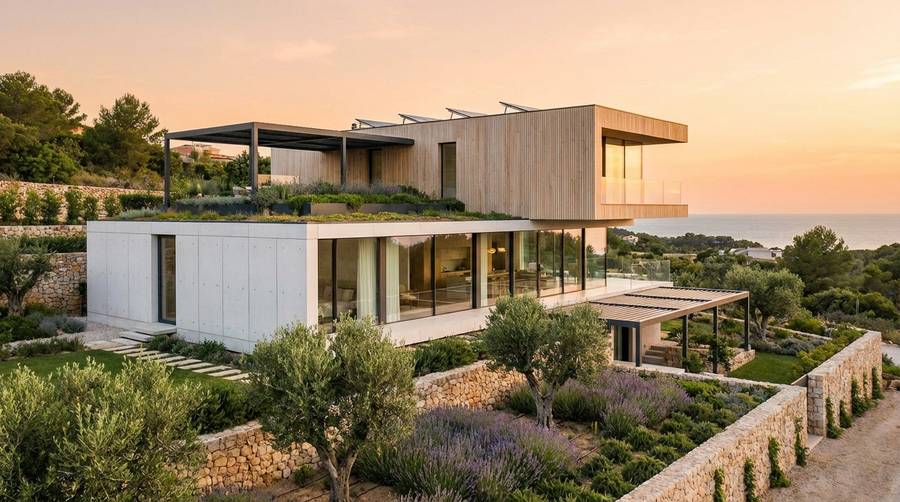
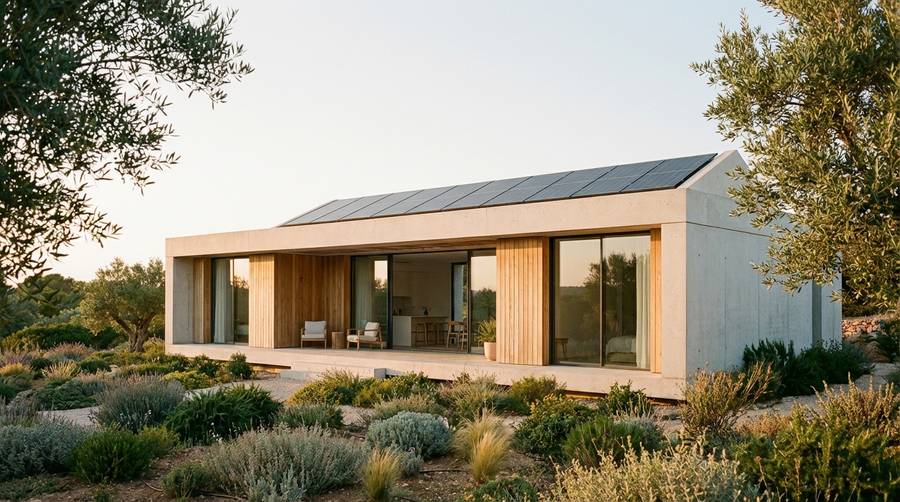
A high‑quality real estate photograph of a finished Mediterranean contemporary home in Spain at golden hour. The house should look premium and lived‑in: light rendered façade, natural stone and wood accents, large low‑emissivity windows with warm interior light. The framed scene includes a small terrace and a landscaped garden with drought‑tolerant Mediterranean plants (lavender, rosemary, ornamental grasses). A small family or couple sits casually on the terrace, suggesting comfort and everyday life. The architecture must be realistic, not modular boxes; avoid visible construction systems. The atmosphere should convey trust, sustainability and attainable modern living in Findnido's brand tone.
Final thoughts and an invitation
Building a prefabricated house does not mean giving up control — it can mean gaining it: fixed costs, accelerated timelines and measurable energy performance. This family's result shows that with clear priorities and a well‑scoped turnkey partner, you can have a modern, efficient home in less time and often at lower effective cost than traditional routes.
If you are considering an autopromotion project, start by clarifying your non‑negotiables and ask potential partners for a turnkey quote that includes airtightness and energy guarantees. A short conversation at the planning stage can prevent months of uncertainty later — and get you closer to turning the key in less than a year.
Ready to explore what a turnkey prefabricated house could look like on your plot? Reach out to a specialist and request a feasibility check to compare timelines and a tailored cost estimate.
Artículos relacionados