Prefabricated House vs Traditional Home: Pros & Cons
Why industrialized housing is gaining ground in Spain
Imagine signing a fixed-price contract and walking into your finished home months later—on an agreed date. That certainty is the main reason more Spanish families and self-builders are choosing industrialized housing over traditional construction.
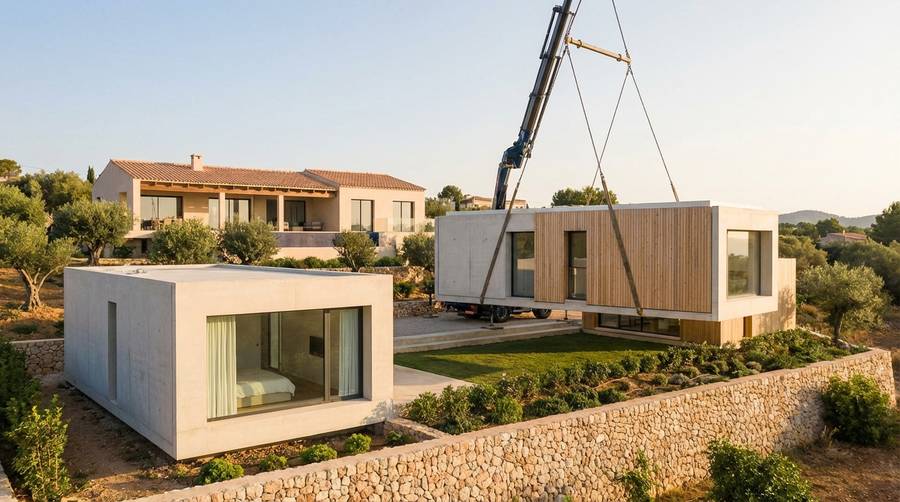
Industrialized housing (often called prefabricated or modular) combines factory-made elements with on-site assembly. In Spain this approach has shifted from niche to mainstream thanks to improved regulations, mature factories and rising demand for faster, more predictable projects.
Market context: growth, demand and the 2026 regulatory landscape
In 2026 the market shows steady growth driven by:
- Longer waiting lists and labor shortages in traditional trades.
- Policy incentives for energy-efficient homes and carbon reduction.
- More mortgage products for self-builders and modular projects.
Result: industrialized housing is no longer experimental—it's a viable route for families seeking control over cost and timing.
General benefits compared with traditional construction
- Shorter on-site duration: weather-independent factory work reduces delays.
- Higher quality control: repeatable processes and testing in controlled conditions.
- Predictable costs: fixed-price packages reduce financial risk.
Who benefits most: self-builders and family profiles
Industrialized housing suits:
- Autopromoters who want transparency and schedule certainty.
- Families prioritizing energy efficiency (Passivhaus-level performance).
- Buyers on constrained budgets seeking value without sacrificing quality.
Detailed comparison: prefabricated house vs traditional home
This section focuses on three concrete comparison axes: time, cost and constructive quality. Each axis includes practical examples and metrics.
Construction time and fixed schedules: practical data
Typical timelines (Spain, average projects):
- Prefabricated house (factory modules + on-site assembly): 4–8 months from groundworks to delivery.
- Traditional build (full on-site): 12–24 months depending on size and complexity.
Case example: a 150 m² three-bedroom home built modularly showed a total calendar time of 6 months: 10 weeks factory fabrication, 3 weeks foundations and connections, 2 weeks assembly and finishes. The traditional analogue required 16 months, with multiple weather-related pauses.
Total cost and financial risk: fixed price, deviations and guarantees
Cost components to compare:
- Design and permits
- Groundworks and utility connections
- Factory modules or on-site labor
- Finishes and landscaping
Prefabricated houses often offer a clearer fixed-price package that includes warranties for factory work. That reduces the risk of change orders and inflation-related overruns. However, groundworks, land purchase and local permit fees remain potential variability sources.
Constructive quality: factory control vs on-site variability
Factories enable repeatable processes: precise cuts, integrated service runs and pre-tested assemblies. This generally improves airtightness and thermal performance—critical for Passivhaus or low-energy targets.
Downside: Some bespoke architectural features are harder or more expensive to execute in highly standardized modular systems. Choose a supplier with a sufficiently flexible production line if design uniqueness matters.
Materials and construction systems: options and performance
Material choice shapes cost, durability, carbon footprint and thermal behavior. Below are the main systems used in Spain today.
Industrialized concrete: durability and thermal efficiency
Precast concrete panels or volumetric concrete modules deliver high thermal mass and long service life. Benefits include:
- Excellent durability and fire resistance.
- Good acoustic insulation and thermal inertia—advantageous in Mediterranean climates with large diurnal swings.
Use case: two-story homes and buildings where longevity and low maintenance are priorities.
Light wood framing: speed, low carbon and design warmth
Light timber frame systems are quick to produce and assemble. Key points:
- Low embodied carbon compared with concrete.
- High prefabrication accuracy, enabling tight envelopes for energy performance.
- Natural aesthetics and ease of interior customization.
Note: choose treated and certified timber for durability in humid zones.
Steel frame (steel stud): strength, flexibility and Passivhaus compatibility
Steel frame systems provide high structural capacity with slim wall profiles—useful when maximizing interior space. They integrate well with insulation systems needed for Passivhaus. Consider thermal breaks and careful detailing to avoid thermal bridging.
Sustainability and energy efficiency in industrialized housing
Sustainability is a core competitive advantage of modern industrialized homes when done intentionally.
Passivhaus strategies applied to modular homes
Passivhaus is achievable with prefabricated systems through:
- Continuous insulation layers delivered in factory conditions.
- High-performance windows and factory-controlled airtightness testing (blower door).
- Mechanical ventilation with heat recovery (MVHR) pre-installed and calibrated off-site.
These measures reduce heating and cooling loads substantially—often cutting operational energy by 70–90% relative to a conventional build.
Projects documented in Spain report modular Passivhaus homes with final airtightness n50 values well below 0.6 h‑1 and annual heating demand under 15 kWh/m²—comparable to the best traditional Passivhaus builds.
Life-cycle carbon reduction: comparative analysis
Embodied carbon depends on materials and transport. General observations:
- Timber-framed modular homes typically show the lowest embodied carbon when sourced responsibly.
- Concrete-based systems can offset higher embodied carbon with long service life and lower maintenance needs.
Actionable tip: request an LCA (life-cycle assessment) from suppliers comparing cradle-to-grave impacts for the exact build you plan.
Certifications, grants and operational savings
Look for suppliers experienced with:
- Passivhaus certification or equivalent low-energy standards.
- Energy performance certificates (EPC).
- Regional subsidies for energy-efficient new builds (check local Comunidad Autónoma programs).
Operationally, energy savings translate into tangible monthly reductions in utility bills—valuable when evaluating payback periods.
The turnkey process for self-builders in Spain
Turnkey industrialized delivery is attractive for self-builders who want a single point of responsibility. Below is a practical roadmap and responsibilities.
From plot to handover: stages and who does what
- Parcel selection and feasibility: land survey, zoning checks, basic topography.
- Project design and permits: architect and technical project, planning permission.
- Factory production: module fabrication, MEP pre-installation, quality control.
- Groundworks and foundations: site contractor prepares foundations and utility connections.
- Assembly and finishing: on-site assembly, final finishes, tests and commissioning.
- Delivery and warranties: legal handover, warranties (structure, watertightness, installations).
In a genuine turnkey contract the supplier coordinates most stages, but the client must still manage land acquisition and local permitting unless explicitly included.
Financing and mortgages for self-build modular homes
Financing options for modular or industrialized homes in Spain include:
- Autopromoción mortgages that release funds in stages tied to milestones.
- Specific modular home loans offered by banks familiar with factory schedules.
- Combination of construction mortgage + final mortgage once the home is registered.
Practical advice: prepare a detailed payment schedule, factory guarantees and independent valuation to present to lenders. Lenders favor fixed-price turnkey deals because they reduce disbursement uncertainty.
Permitting, traceability and factory QC
Traceability is a strong point of industrialized housing: serial numbers for components, test reports and assembly manuals. These documents simplify both permitting and future maintenance.
Advantages and disadvantages for decision-making: practical guide and case studies
The goal here is an actionable, balanced checklist to help you decide whether a prefabricated house suits your project.
Balanced summary: when an industrialized house makes sense
Choose industrialized housing if you prioritize:
- Short delivery time and fixed budgets.
- High energy performance or Passivhaus targets.
- Reduced on-site disruption and improved quality control.
Prefer traditional construction if you need:
- Very bespoke, irregular forms that cannot be economically produced in a factory.
- Local artisanal finishes that are difficult to prefab.
Case studies with metrics: real examples
Case A — Timber-framed suburban home (150 m²):
- Timeline: 5.5 months total.
- Cost: €1,650/m² (turnkey, including site works).
- Performance: annual heating demand ~12 kWh/m², airtightness n50 = 0.45 h‑1.
- Client satisfaction: 9/10 (surveyed at 6 months post-handover).
Case B — Precast concrete two-storey (200 m²):
- Timeline: 8 months total.
- Cost: €1,500/m² (higher initial embodied carbon but low maintenance).
- Performance: robust acoustic insulation and thermal comfort.
These cases highlight predictable schedules and strong energy performance when a proper design-to-factory workflow is used.
Decision checklist: land, budget, schedule and lifestyle
- Land suitability: access, topography, local regulations for modular transport and craning.
- Budget buffer: include 5–10% for unforeseen groundworks.
- Schedule priorities: is a fixed completion date critical?
- Energy goals: aim for Passivhaus or at least low-energy standards.
- Design flexibility: confirm factory capability to deliver your aesthetic.
Next steps to move toward an industrialized home
If you are seriously considering a modular or prefabricated route, follow these practical steps.
Recommended practical steps for self-builders
- Define non-negotiables: area, rooms, energy target and budget.
- Assess your plot and obtain a geotechnical report.
- Request at least three detailed turnkey quotes with production schedules.
- Ask for factory visit and blower-door / thermal test reports from previous projects.
- Speak to your bank early about construction-disbursement conditions.
Resources, contacts and documentation
Collect these documents from suppliers:
- Detailed price breakdown and milestone payments.
- Factory QA/QC procedures and sample test certificates.
- Warranty and after-sales service terms.
Frequently asked questions and provider evaluation criteria
- Do they provide fixed-price turnkey contracts?
- Can they deliver airtightness and thermal test results for completed homes?
- What are lead times for design changes and custom finishes?
Shortlist providers that demonstrate transparent documentation, factory traceability, and financing experience for autopromoción mortgages.
Deciding between a prefabricated house and a traditional build is a trade-off between certainty and ultimate bespoke flexibility. For most Spanish self-builders focused on timeline, energy performance and predictable budgets, industrialized housing offers a compelling path.
If you're ready to evaluate specific suppliers or want a comparison based on your plot and budget, gather your site data and schedule an initial feasibility—clear answers start from concrete numbers.
Take the next step: request a detailed turnkey quote with an itemized schedule and factory QA reports to compare real offers side by side.