Prefabricated House vs Traditional: Practical Comparison
Why consider industrialized housing in Spain today
Hook: If you plan to build a home in Spain, understanding how industrialized (prefabricated or modular) housing compares to traditional construction can cut years off delivery risk, reduce cost surprises and improve energy performance — but it requires different decisions early on.
This section summarizes the practical advantages and what to look for in a full-service platform if you are an autopromoter.
Objective summary: what industrialization brings vs traditional construction
Industrialized housing delivers predictability. Factory production reduces weather delays, improves quality control and concentrates specialist labor. Traditional construction remains flexible for site-specific adaptation but carries more uncertainty in time and cost.
- Predictable schedules: shorter on-site installation windows.
- Fixed-price potential: clearer contracts reduce mid-project budget shocks.
- Higher airtightness & quality control: controlled environments in factories.
- Design constraints: may require early sign-off and thorough coordination.
Sector context in 2026: demand, regulation and opportunities for self-builders
In 2026 Spain sees growing demand for modular solutions driven by energy regulations (near-Passivhaus targets in new builds in many municipalities), rising labor costs and supply-chain optimization. For autopromoters, this means more lenders and insurers understand prefabricated methods, but early-stage documentation and BIM models are increasingly required by banks and planning authorities.
What to look for in an integrated platform: services, guarantees and transparency
Choose a platform that offers:
- Turnkey scope: from plot search to final handover with clear milestone payments.
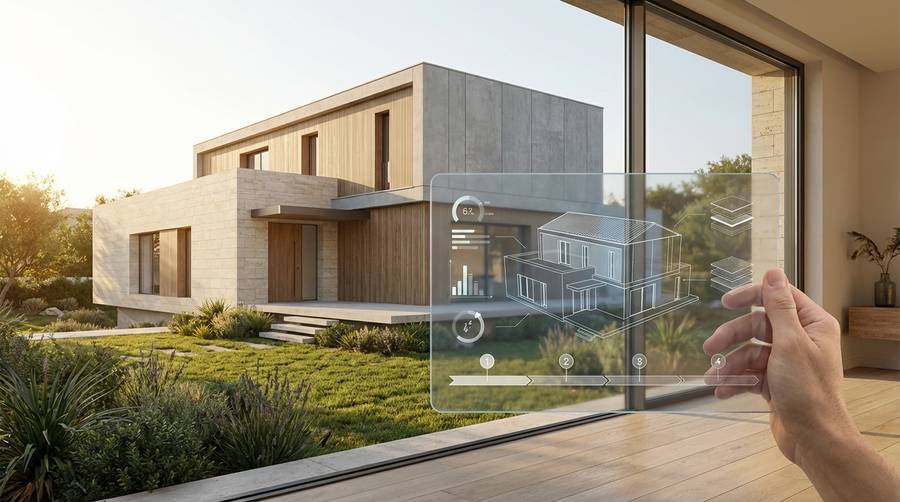
- BIM and digital twin: models used for design coordination, cost control and O&M handover.
- Transparent fixed-price contracts: with defined change-control clauses.
- Warranties and quality checks: factory QA records and on-site commissioning tests.
For a practical overview of integrated delivery and BIM, see Casa prefabricada: ventajas y guía llave en mano.
Practical comparison: prefabricated house vs traditional house
Project and construction timelines: closed schedules vs uncertainty
Prefabricated: typical timeline for a medium-size single-family home (150–200 m²) delivered by an experienced supplier in Spain is 6–9 months from design freeze to handover when plot and permits are ready. Factory work and on-site assembly occur in parallel, which shortens exposure to weather.
Traditional: comparable projects commonly take 12–24 months on-site. Unpredictable factors include subcontractor scheduling, on-site changes and weather.
- Actionable tip: lock design decisions early for modular projects to avoid costly late design changes.
Cost and budget control: fixed price, deviations and hidden variables
Prefabricated: many suppliers offer fixed-price turnkey options. This improves budget certainty but requires rigorous definition of scope (finishes, services, site works). Unexpected groundworks or connection costs can still arise.
Traditional: often begins with an estimated budget and faces higher risk of change orders. Labour shortages or scope creep increase final costs.
- Actionable tip: ask for an itemized cost breakdown and an explicit contingency for site-specific risks (soil, access, utilities).
Build quality and durability: factory tolerances vs in-situ variability
Factory production supports repeatable quality, better airtightness and controlled installations of insulation and windows. However, long-term performance depends on design detailing and materials selection as much as the production method.
Actionable tip: require factory QA reports and thermal bridge studies as part of contract deliverables.
Materials and systems: technical advantages and limits
Industrialized concrete: robustness, insulation and logistics
Advantages: prefabricated concrete elements deliver structural robustness, good thermal mass and fire performance. They are well-suited for coastal or high-humidity sites and can integrate high-performance insulation layers.
Limitations: heavier elements increase logistics complexity and foundation demands. Lead times for molds and transport must be planned.
Light timber frame: speed, sustainability and thermal behaviour
Advantages: light timber systems offer excellent build speed, low embodied carbon and good thermal performance when combined with continuous insulation. They also simplify dry-installation services.
Limitations: require careful detailing against moisture and pests and often need third-party certification for long-term durability.
Steel frame: design flexibility, strength and relative costs
Advantages: steel framing is precise, allows larger spans and flexible interior layouts. It performs well in seismic areas and is compatible with rapid factory production.
Limitations: higher embodied carbon than timber (unless recycled steel used) and thermal bridging needs mitigation through thermal breaks and insulation strategies.
Sustainability and energy efficiency with BIM and digital twin
How the digital twin optimizes Passivhaus design and reduces carbon footprint
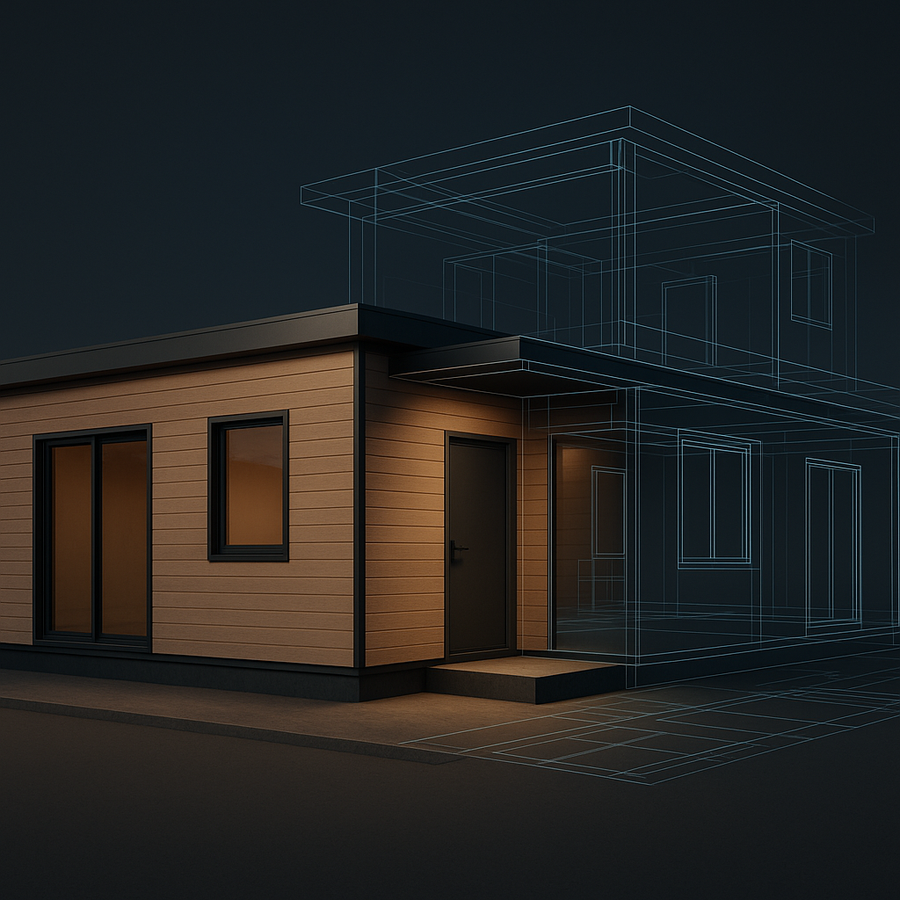
BIM-enabled simulations allow teams to test orientation, shading, insulation thickness, window performance and mechanical ventilation strategies early. A digital twin can carry these parameters into construction and operation, enabling real measured performance closer to design intent (e.g., airtightness and energy use).
Measurements and real metrics: consumption, emissions and life-cycle data from BIM
When linked to procurement and factory data, BIM models can produce reliable embodied carbon estimates and operational energy predictions. In practice, projects that use a digital twin and Passivhaus principles report 40–70% lower heating demand than standard builds in similar climates.
Using BIM and a digital twin turns assumptions into verifiable performance targets — reducing the gap between predicted and actual energy use.
Advantages and risks: reliable simulations vs dependency on assumptions
Simulations are only as good as the inputs: inaccurate occupancy or system efficiency assumptions can mislead. Reliable outcomes require post-occupancy monitoring and iterative updates to the digital twin.
Turnkey process with BIM: from plot search to handover
Clear phases: plot search, design, manufacture, assembly and delivery
- Phase 1 — Plot assessment: legal and geotechnical due diligence, orientation analysis.
- Phase 2 — Design & approvals: schematic design, planning permissions and detailed BIM model.
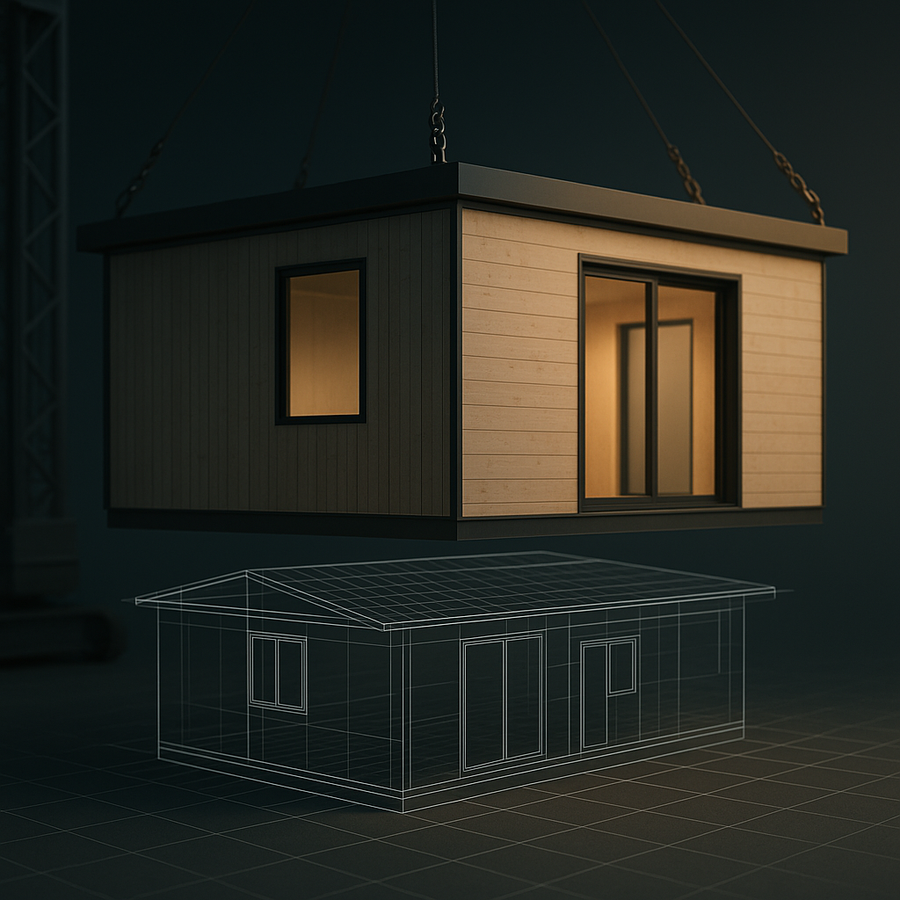
- Phase 3 — Fabrication: production of modules/panels in factory; component QA recorded in BIM.
- Phase 4 — On-site assembly: short on-site works for foundations and sealing; systems commissioning.
- Phase 5 — Handover & operations: delivery of a digital twin with maintenance information.
What BIM/digital twin brings to each stage: coordination, traceability and QA
Design: clash detection and performance simulation. Fabrication: direct transfer of shop drawings and material lists. Assembly: traceability of batch numbers, commissioning records and test results captured in the model.
Risks and mitigations in turnkey contracts: schedules, guarantees and reviews
Turnkey contracts concentrate responsibility but demand robust contract language. Insist on:
- Clear milestone definitions and acceptance criteria.
- Penalties for missed deadlines and remedies for defects.
- Defined process for changes and a conservative contingency allowance.
Financing for self-building and modular homes in Spain
Mortgage and loan options for autopromoters: requirements and specifics
Banks increasingly offer construction mortgages adapted to modular builds. Typical features include staged disbursements linked to milestones and the requirement for a detailed project plan, permits and a qualified contractor. Some lenders now accept BIM models as part of the appraisal package.
Impact of fixed price and shorter timelines on bank valuation
A fixed-price turnkey contract and a shorter construction timeline reduce lender risk and can improve financing terms. However, banks still require conservative contingency assessments for site works.
Practical advice to improve financial viability
- Prepare full documentation: permits, structural reports, BIM model summary and contractor guarantees.
- Engage early with lenders: get pre-approval and confirm acceptable disbursement triggers.
- Itemize site works: separate price the plot-related costs (foundations, connections) to avoid surprises.
Practical guide to decide: real cases and comparative metrics
Case study 1 — Modular concrete home: timelines, cost and satisfaction
Project summary: 180 m² Mediterranean-style house using prefabricated concrete panels, turnkey delivery.
- Timeline: 8 months from construction start to handover.
- Cost: fixed-price contract with a 5% contingency; final cost aligned with contract (no major variations).
- Satisfaction: high thermal comfort and minimal defects at 12-month review.
Key lesson: concrete panels are ideal for coastal climate durability and deliver stable long-term maintenance costs.
Case study 2 — Timber frame house: energy performance and operating costs
Project summary: 140 m² light timber-frame home designed to near-Passivhaus standard, with mechanical ventilation and high-performance windows.
- Timeline: 6 months from design freeze to occupation.
- Energy: measured heating demand 45–55% lower than similar traditional homes in the same area.
- Costs: slightly lower upfront material costs, faster assembly reduced labor expenses.
Key lesson: timber frame combines speed and low embodied carbon, with strong operational savings when airtightness and ventilation are well executed.
Decision checklist for self-builders: priorities, constraints and red flags
Use this checklist to align choices with your priorities:
- Priority: schedule → prefabricated options with clear assembly timelines.
- Priority: lowest initial cost → compare full lifecycle costs; some traditional builds appear cheaper upfront but can cost more in time and change orders.
- Constraint: irregular plot or complex geometry → hybrid approaches or traditional builds may be more suitable.
- Red flags: suppliers unwilling to provide QA records, missing BIM coordination, vague warranty terms.
Closing: balanced summary and next steps for self-builders
Summary of key pros and cons to make an informed choice
Pros of prefabricated/modular: time predictability, better factory QA, potential fixed-price contracts and strong energy performance when paired with BIM and Passivhaus strategies. Cons: need for early decisions, potential logistical/site constraints and dependency on supplier coordination.
How to evaluate offers: technical, economic and sustainability criteria
When comparing proposals, score each on:
- Technical completeness (BIM model, QA records, materials data).
- Economic transparency (itemized costs, contingencies, milestone payments).
- Sustainability evidence (embodied carbon estimates, measured energy performance or simulation outputs).
For practical steps on designing an industrialized home, consult our step-by-step guide Vivienda industrializada: guía para autopromotores.
Recommended resources and next steps with an integrated platform
- Ask suppliers for a sample BIM deliverable and a digital twin handover template.
- Request references and post-occupancy performance data from at least two completed projects.
- Engage an independent technical advisor to review turnkey contracts and milestones.
If you want a practical walkthrough of options for your plot — including realistic timelines, a budget estimate and a BIM-based performance projection — contact a platform that offers integrated turnkey delivery and digital twin handover.
Next step: compare at least two turnkey offers with required BIM deliverables and a clear allowance for site works before making a decision.
Call to action: Ready to compare tailored turnkey options and a BIM-based performance forecast for your plot? Reach out for a no-obligation assessment that maps costs, schedule and energy targets.