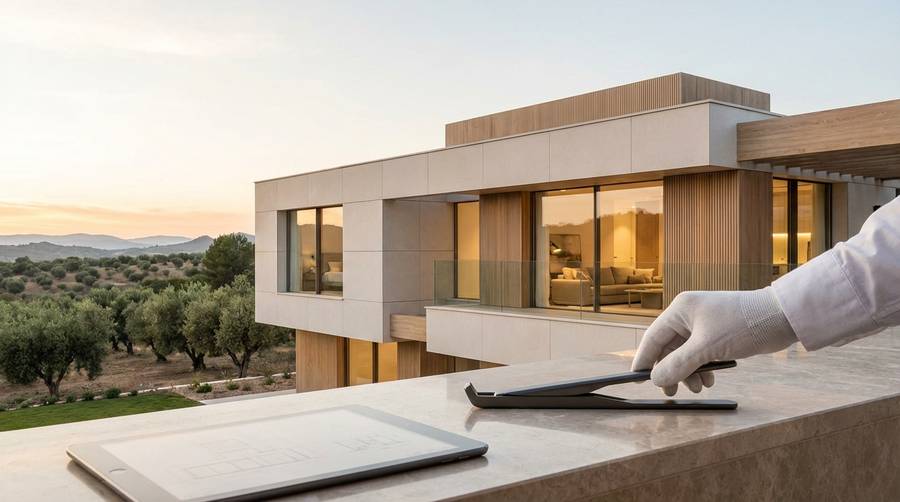
Steel Frame Homes in Spain: 6 Reasons to Choose Them
1. Overview: Why Steel Frame is transforming residential housing
Hook: If you’re planning to self‑build in Spain, choosing the right structural system decides schedule, budget and long‑term comfort. Steel Frame is no longer niche — it’s a proven route to faster delivery, predictable costs and high energy performance.
What Steel Frame is and how it fits industrialized housing
Steel Frame refers to a lightweight structural system built from cold‑formed steel profiles. Panels, floors and roof elements are manufactured in factory conditions, then assembled on site. That industrialized approach shifts time and quality control to the workshop. For autopromoters in Spain this means fewer on‑site variables and a tighter path from design to keys.
Quick comparison: Steel Frame vs traditional, concrete and timber frame
- Traditional masonry/concrete: high thermal mass, longer wet‑works schedule, higher on‑site labor variability.
- Timber frame (light wood): excellent thermal performance and low embodied carbon, but constrained by local timber supply/pricing and durability considerations in wet climates.
- Steel Frame: precise tolerances, fast assembly, high strength-to-weight ratio and strong compatibility with modern finishes and large openings.
Key benefits covered in this article
We’ll focus on three practical pillars: speed and closed timelines, cost predictability and sustainability/energy performance. Each section gives metrics, real‑world practices and steps you can act on as an autopromoter.
2. Speed of execution and reliable closed schedules
One of the most tangible benefits of Steel Frame is compressed timelines. Faster builds reduce interim financing costs and let families move in sooner.
Project phases and realistic timelines in Spain (example 2024–2026)
- Design & permits: 3–6 months (depends on municipality)
- Factory production of modules/panels: 4–8 weeks
- On‑site assembly: 2–6 weeks for a typical 120–200 m² single‑family home
- Finishes and commissioning: 4–8 weeks
Aggregate delivery from permit to keys: commonly 6–9 months after permits are granted when managed as a turnkey project. That contrasts with 12–18+ months for many traditional builds.
How factory control and prefabrication minimize on‑site delays
Factory conditions remove weather delays, improve repeatability and yield better tolerances. Critical services — window installation, airtightness membranes, pre‑installed insulation — are completed under quality control. On site the build sequence is simple: foundation, lift panels, connect services, seal and finish. That predictability reduces coordination failures and rework.
Impact on turnkey delivery and client satisfaction (real metrics)
In a recent case from a Spanish project delivered in 2024, the client moved in 7 months after permit approval. Metrics:
- Factory production: 6 weeks
- On‑site assembly: 18 days
- Cost variance vs budget: +1.7%
- Client satisfaction (surveyed): 92% satisfied with timing and finish
Shorter, reliable schedules reduce financing interest and decision fatigue—two hidden costs often overlooked by autopromoters.
3. Cost and fixed budgets: predictability for self‑builders
Cost certainty is the decisive factor for many autopromoters. Steel Frame projects are well suited to fixed‑price contracts when the design and scope are locked early.
Cost breakdown: Steel Frame vs traditional
Typical cost items and orientation (per m², indicative ranges for Spain 2024–2026):
- Foundations & slab: €350–600/m²
- Steel Frame structure + envelope: €450–850/m²
- Windows and external finishes: €200–450/m²
- Interior finishes & services: €400–900/m²
Comparatively, masonry builds often show larger variance driven by wet trades and longer schedules. The Steel Frame premium in structure can be offset by lower labor and shorter site duration.
Reduced risk: fixed‑price contracts and change control
To lock cost predictability, require:
- A complete technical pack before factory order (drawings, specs, finishes).
- An explicit change control process with clear pricing and approval timelines.
- Milestone payments tied to factory stages and final commissioning.
This approach limits the common “scope creep” that inflates budgets in traditional projects.
Financing options and mortgages for self‑building in Spain
Autopromoters can access:
- Construction-to-permanent mortgages (drawdowns during construction and a single mortgage at completion).
- Specific loans for self‑build/autopromotion offered by Spanish banks and alternative lenders.
- Private bridge finance for land acquisition, replaced by mortgage at completion.
Bank underwriting focuses on technical solidity and turnkey contracts. Having a factory partner and a fixed‑price agreement materially improves lender confidence.
4. Energy efficiency and sustainability: lowering operating carbon
Steel Frame systems support excellent thermal performance and modern low‑energy strategies when detailed correctly.
Compatibility with Passivhaus and envelope best practices
Steel structures are compatible with high‑performance envelopes. Key requirements:
- Continuous insulation: avoid thermal bridges at connections with factory‑designed details.
- Airtightness: factory membranes and site sealing to achieve n50 targets.
- Thermal bridging control: use thermal breaks and insulated connectors.
With proper detailing, a Steel Frame home can reach Passive House levels of demand and comfort.
Materials and processes that cut embodied carbon
Although steel has higher upfront embodied carbon than timber, industrialized production reduces waste and rework. Strategies to reduce lifecycle emissions:
- Specify recycled steel content and local production where possible.
- Combine steel with low‑carbon materials for finishes (low‑carbon concrete, responsibly sourced wood cladding).
- Design for compactness and efficient servicing to minimize material use.
Passive and active systems to integrate
Recommended combinations for Spanish climates:
- High‑performance glazing: low‑e coatings and thermally broken frames for large south‑facing glass.
- Mechanical ventilation with heat recovery (MVHR): essential for airtight homes.
- Solar thermal or PV: PV for electricity and solar thermal for hot water reduce operational carbon quickly.
5. Architectural flexibility and premium finishes
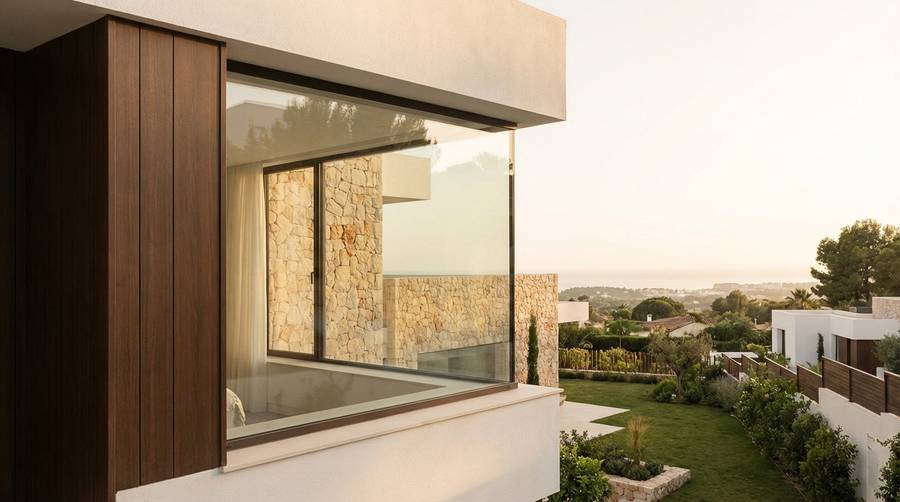
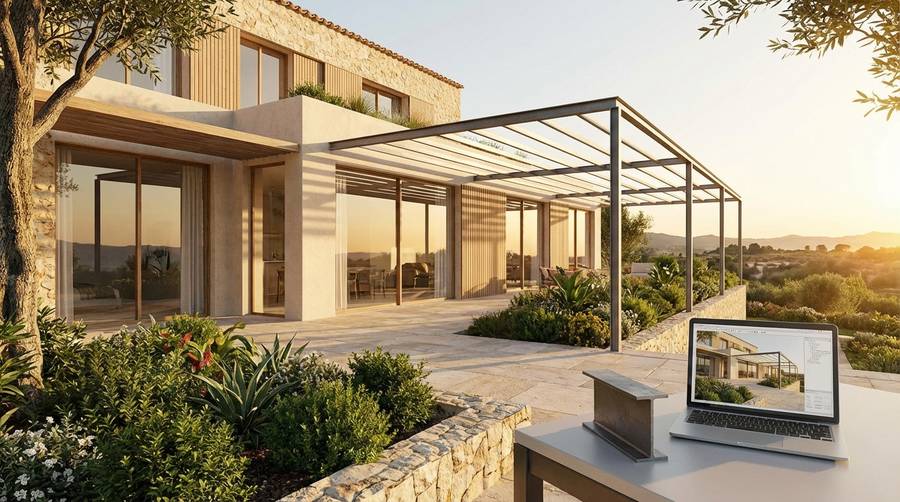
Steel Frame supports contemporary Mediterranean architecture: large spans, generous windows and fine finishes.
Design freedom for Mediterranean facades and large openings
The strength of steel allows for slimmer profiles and larger cantilevers. For Mediterranean style homes, that enables:
- Wide glazed openings to terraces without bulky supporting walls.
- Clean cantilevered eaves and minimalist overhangs for solar control.
- Integration of terraces and indoor‑outdoor living typical in Spanish homes.
Integrating natural materials: stone, wood and exposed concrete
Steel Frame is a neutral carrier for premium cladding. Practical tips:
- Use ventilated facades for natural stone or terracotta to ensure durability.
- Apply timber rainscreens for warmth; maintain service gaps behind cladding.
- Consider board‑formed concrete for plinths or feature walls for contrast and thermal mass.
Interior customization and modular living solutions
Because structure is independent from finishes, interiors can be reconfigured over time. Prefabricated partition modules and service cores speed up fit‑out and simplify future changes for growing families.
6. How to move forward: turnkey process, warranties and success stories
To make your project low‑risk and high‑value, opt for a clear turnkey pathway and insist on documented guarantees.
Full journey: from finding land to key handover (key steps)
- Land assessment: check topography, access, utilities and local regulations.
- Concept & budget verification: brief, target cost, initial site constraints review.
- Technical design pack: structural, MEP, finishes — sign‑off before factory order.
- Permits & approvals: coordinate with local architects and town hall.
- Factory production & QA: track production milestones and QC reports.
- Site assembly & finishes: foundation, assembly, commissioning and handover.
Choosing a provider who handles the full chain reduces coordination gaps. If you want a detailed checklist for each step, request the technical pack early and use it to obtain comparable fixed quotes.
Warranties, certifications and aftercare autopromoters should request
- Structural warranty: minimum 10 years recommended, depending on supplier.
- Waterproofing and airtightness guarantees: documented blower‑door tests and membrane warranties.
- Energy performance certification: EPC and (if applicable) Passivhaus confirmation.
- After-sales service: defined response times for defects in the first 12–24 months.
These items protect your investment and provide leverage with lenders and insurers.
Mini case study: turnkey Steel Frame home — timeline, cost and satisfaction
Project snapshot (Spain, 2024): 160 m² single‑family home built with a Steel Frame system.
- Permit to keys: 8 months
- Total fixed price: €320,000 (including land development and finishes)
- Net energy demand: 20 kWh/m²·yr (MVHR + high insulation)
- Client rating: 4.7/5 for delivery and finishes
Key takeaways: early technical definition and a reputable factory partner were decisive to meet budget and performance targets. For more technical insights into steel solutions, read our Steel Frame guide and the article on residential steel structures.
Conclusion: Is Steel Frame right for your Spanish self‑build?
Steel Frame offers a balanced proposition for autopromoters who value speed, cost certainty and modern energy performance. It supports Mediterranean architecture, allows premium finishes, and is compatible with Passivhaus‑level strategies when detailed correctly.
If your priorities are a predictable timeline, a closed budget and a high‑comfort home that performs well over its lifecycle, Steel Frame deserves serious consideration. For practical next steps, ask suppliers for a detailed technical pack, fixed‑price milestones and airtightness/thermal test targets.
See a recent project to visualise finishes and timelines.
Call to action: If you’re evaluating options, contact a turnkey provider to request a comparative quote and a production timeline tailored to your plot — early data reduces risk and improves lender confidence.
Artículos relacionados