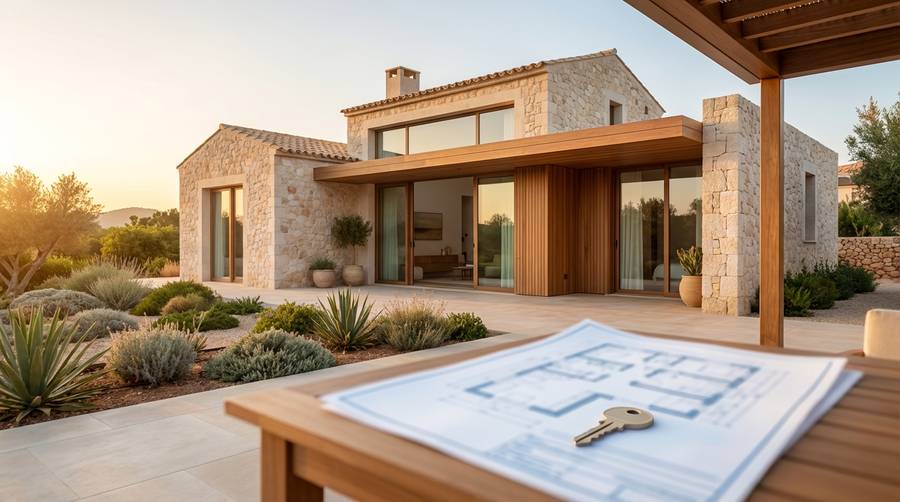
No-Downpayment Financing for Industrialized Housing
1. Quick overview before you start: what ‘no down payment’ means
Hook: Want to build a modern, energy-efficient home without saving a large down payment first? Financing a modular or industrialized house without an upfront deposit is possible — but only with the right preparation and product choice.
What ‘no down payment’ means for industrialized housing and self-builders
In practice, “no down payment” or no-entry financing means the lender does not require the borrower to put their own cash as an initial contribution to the project. Instead, the mortgage or loan covers the land and construction costs through staged disbursements, guarantees or third-party collateral.
Key distinction: lenders still expect evidence of project viability, quality standards and a plan to cover contingencies. It is not a zero-risk process.
Primary advantages and risks for Spanish self-builders (2026)
- Advantages: faster access to homeownership, preserved savings for contingencies, ability to lock prices with a turnkey contract.
- Risks: higher effective interest, stricter lender oversight, potential requirement for alternative guarantees if no personal equity is available.
- Mitigation: choose industrialized systems (concrete modules, timber frame, steel frame) and a turnkey supplier with proven delivery metrics.
Documentation and initial requirements lenders typically ask for
- Detailed budget and a fixed-price turnkey contract (contractor and builder responsibilities).
- Project schedule with milestone dates and delivery guarantees.
- Technical memory and plans signed by architect and structural engineer.
- Land title, planning permissions and any soil or topography reports.
- Personal financials: income proofs, tax returns, credit history.
Banks value predictability above all: fixed price, short on-site time and certified standards make a loan without a down payment feasible.
2. Why industrialized housing makes no-downpayment financing feasible
Cost predictability and fixed price: the lender’s strongest argument
Industrialized housing companies typically offer a fixed-price, turnkey model. For banks, that translates into a lower margin of error in cost forecasts. When a contract guarantees a final price and scope, the lender can underwrite the project with fewer contingencies.
Shorter construction times and closed-site delivery reduce risk
Traditional builds can run for many months on site with weather and coordination delays. Industrialized projects move significant work off-site into a controlled factory environment. The result: closed-site delivery and predictable milestone dates, which reduce the probability of cost overruns and lien exposure for the lender.
Materials and standards that improve valuation and bank acceptance
Modern systems used in Spain — industrialized concrete, light timber framing, and steel frame — are accepted in formal market valuations when documented correctly. Lenders evaluate:
- Thermal performance (Passivhaus-level or equivalent certifications).
- Structural durability and material warranties.
- Manufacturer track record and past delivery times.
Tip: include energy performance certificates and product warranties in the mortgage file to improve appraisal values.
3. Financing models you can use to build without a cash deposit
Self-build mortgages and bridge loans: when to choose each
Self-build mortgage (hipoteca autopromoción): a mortgage product adapted for construction where funds are released as the build progresses. Suitable when you combine land and construction under a single financing vehicle.
Bridge loan (préstamo puente): short-term credit used to finance land purchase or initial works until long-term financing is arranged. It can be combined with staged mortgage conversion.
Staged financing tied to certified milestones
Lenders typically disburse funds after independent verification of a milestone (foundation complete, structure closed, utilities connected). This offers a path to no-downpayment financing if the lender accepts the turnkey contract and the builder’s guarantee as sufficient collateral.
- Certification: use an independent quantity surveyor or architect certifier.
- Disbursement schedule: align contract payments with bank milestones to avoid cash shortfalls.
Alternatives: rent-to-buy, cooperatives and mixed financing
If traditional banking is restrictive, alternatives include:
- Rent-to-buy schemes: pay rent with an option to purchase when financing is secured.
- Housing cooperatives: pooled resources and collective guarantees can reduce individual entry requirements.
- Mixed financing: combine a smaller bank loan with private investors or family guarantees.
4. How to prepare a robust application that maximizes your chances
Economic plan and technical brief: the data banks want
Provide a concise file containing:
- Fixed-price turnkey contract with supplier warranties.
- Detailed cost breakdown (land, materials, labor, contingencies).
- Construction timeline and payment schedule.
- Energy strategy and predicted running costs (thermal envelope, ventilation strategy, photovoltaic if any).
Make it easy to digest: create a one-page executive summary with clear numbers for the underwriter.
Case studies: real metrics that convince banks
Use short case studies from previous projects to demonstrate delivery capacity. Include metrics such as:
- Factory production time (e.g., 6–10 weeks for modules).
- On-site assembly time (e.g., 4–8 weeks to enclosure and weather-tight).
- Final delivery vs planned schedule variance (aim for ±5% deviation).
- Cost adherence (percentage of projects delivered within fixed price).
These metrics show lenders that the industrialized model reduces uncertainty compared to one-off traditional builds.
Guarantees and alternative collateral to replace a down payment
When you don’t provide cash, lenders look for substitutes:
- Third-party guarantees or family-backed collateral.
- Mechanisms within the turnkey contract: penalty clauses if the builder fails to deliver.
- Retention accounts or escrow for part of the lender’s protection.
5. Comparison: costs and risks of no-downpayment vs providing an entry
Impact on monthly payments, total credit cost and rates
Financing without a down payment often increases the loan-to-value (LTV). Higher LTVs typically carry higher interest rates or additional fees. Expect:
- Higher monthly payments due to greater principal financed.
- Potentially stricter loan-to-income checks.
- Added requirement for mortgage insurance or guarantees.
Risks for the promoter and mitigations for modular housing
Main risks include cost inflation, delivery delays, and insufficient collateral value if the appraisal is conservative. Mitigations:
- Use fixed-price turnkey contracts with clear delivery penalties.
- Document energy certifications and manufacturer warranties to support appraisals.
- Choose proven industrialized suppliers with verified references.
Illustrative numerical example
Assume:
- Land value: €120,000
- Turnkey construction: €280,000 (fixed price)
- Total project cost: €400,000
- Scenario A — 20% down: borrower provides €80,000; financed = €320,000.
- Scenario B — no down: financed = €400,000 (subject to lender approval and guarantees).
At the same nominal interest rate, Scenario B increases monthly payments and total interest significantly. However, if Scenario B secures slightly higher rates plus an insurance fee, the immediate advantage is using savings for contingency, energy upgrades or tax-efficient investments.
6. Next steps: choose an offer, negotiate and start
Practical checklist to compare financing offers
- Interest rate (fixed vs variable) and associated fees.
- LTV limits and whether they accept staged disbursement.
- Required guarantees or mortgage insurance.
- Flexibility on early repayment and refinancing terms.
- Documentation requirements and expected processing time.
How to integrate a turnkey contract with a self-build mortgage
Align the contract’s payment milestones with the bank’s disbursement schedule. Add an independent certifier clause for each milestone. Ensure the contract includes a delivery date, penalties for delays and product warranties.
Consider escrow or a retention mechanism to protect both parties: the bank can release funds into escrow and authorize payments upon certified completion.
Final recommendations for self-builders
- Assemble a compact professional team: architect experienced in industrialized systems, a structural engineer, and a project manager.
- Choose suppliers with documented delivery metrics and energy performance evidence (aim for near-Passivhaus or equivalent).
- Negotiate clear clauses in the turnkey contract for quality, timeline and warranties.
- Prepare a sharp summary file for the bank highlighting predictable aspects of industrialized housing.
For further practical guidance on the process of industrialized housing and financing options, see Vivienda industrializada: guía para autopromotores.
Conclusion
Bottom line: No-downpayment financing for industrialized homes in Spain is achievable when you combine a fixed-price turnkey supplier, clear milestone-based financing and strong documentation that demonstrates predictability and energy performance. The industrialized model’s speed and standardized quality make lenders more comfortable underwriting projects without a traditional entry.
If you are planning a self-build, start by preparing a concise, metric-driven file and seek lenders experienced in construction loans. Bringing professional certifiers and a turnkey contract to the table is often the difference between a declined and an approved application.
Call to action: If you want help preparing a lender-ready package or comparing self-build mortgage offers, contact our advisory team to review your project and documentation.
Artículos relacionados