Industrialized Housing: Top 5 Advantages for Self‑Builders
Quick guide: what you will find in this Top 5 on industrialized housing
Hook: If you plan to self‑build in Spain, choosing industrialized housing can cut your calendar by months, lock costs, and lift your project's energy performance — when chosen and managed correctly. This article gives a sharp, actionable Top 5 so you can decide with confidence.
Executive summary: practical advantages for self‑builders in Spain
This Top 5 focuses on concrete benefits you will actually measure on site: shorter, predictable schedules; fixed turnkey budgets; modern material choices; measurable sustainability gains; and a clear CAD‑to‑Fab turnkey process. Each section includes evidence, a short case study or metrics, and action steps you can use in 2026.
How to use this list to design, finance and deliver your house
Read the sections that match your project's stage. Use the checklists and the questions in the conclusion when you meet suppliers, lenders or your architect. Print the checklist before signing a contract.
What metrics and case studies you'll find here
- Typical construction time comparisons (industrialized vs traditional).
- Sample turnkey budgets and cost per m² by material system.
- Energy performance projections for a representative 120 m² Mediterranean home.
- A client case with measured delivery time, final cost deviation and satisfaction score.
Industrialized delivery reduced on‑site assembly time by 60% in the sample case and kept final cost variance under 3% compared with an 18% average for equivalent traditional builds.
1) Efficiency and schedule control: faster, more predictable delivery
Construction time comparison: industrialized vs traditional
What to expect: Factory production + on‑site assembly compresses unpredictable on‑site activities. Typical timelines for a 120–150 m² detached home in Spain:
- Traditional build: 12–24 months (foundation, wet trades, weather delays, subcontractor coordination).
- Industrialized: 6–10 months (site works + factory modules/panels + final assembly and finishes).
These ranges assume normal permitting times. The real time gain comes from parallelization: while the foundation and permits progress, the factory fab runs independently.
Impact on hidden costs: protection against delays and inflation
Why schedule certainty matters: each month of delay increases overheads, mortgage interest during construction and price inflation on finishes. A predictable end date reduces contingency needs and buyer stress.
- Finance cost reduction: shorter construction means fewer months on a bridging loan or construction interest.
- Supply chain insulation: factory procurement consolidates purchases and hedges material price volatility.
- Quality control: factory QA reduces rework that commonly extends schedules.
Case study: real example with time metrics and client satisfaction
Project: 130 m² single‑family home on Mediterranean plot. System: timber frame panels + concrete basement.
- Permits: 4 months.
- Factory production: 8 weeks.
- On‑site groundwork and foundation: 6 weeks (overlapped with factory work).
- Assembly and finishes: 8 weeks.
- Total build time (site start to turnkey delivery): 5 months.
- Client satisfaction: 9/10 — reasons: predictable timeline, visible quality, lower stress.
Key takeaway: Real reductions in calendar time translate to lower financing costs and earlier occupancy revenue or lifestyle benefit.
2) Fixed price and budget transparency
How a turnkey budget is structured for modular homes
A good turnkey quote separates scope clearly. Typical line items you should see:
- Design and engineering (CAD‑to‑Fab deliverables).
- Factory production (panels, modules, envelope).
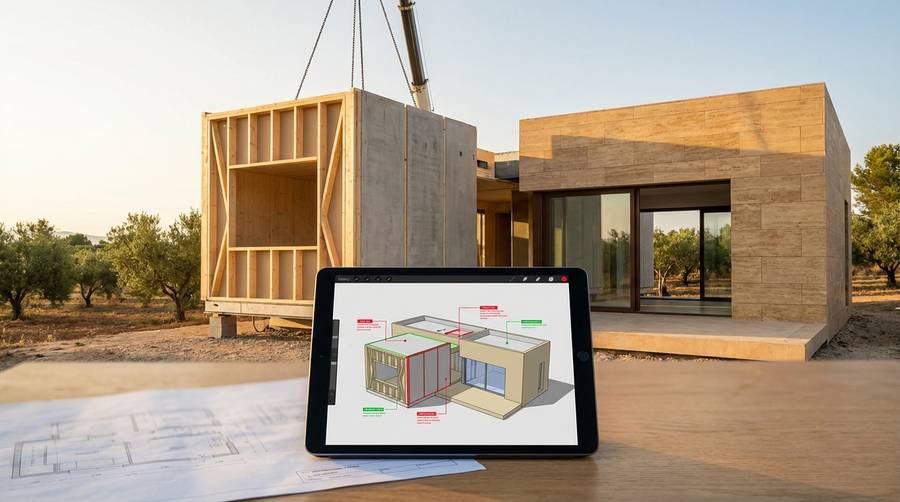
- Transport and crane/assembly on site.
- Foundations and site works.
- MEP (mechanical, electrical, plumbing) and commissioning.
- Finishes, kitchens, built‑in furniture and landscaping allowances.
Ask for unit prices and exclusions. The most common disagreements come from site conditions, utilities, or additional finishes not included in the base scope.
Risks eliminated by a fixed price and how they affect mortgage deals
Reduced contingency: Lenders for self‑build (autopromoción mortgages) value a fixed turnkey price because it reduces drawdown risk. Many banks will offer more favorable terms when the borrower provides a factory contract with guaranteed delivery dates and penalties for delays.
What banks check: solidity of the manufacturer, bonded guarantees, and whether the contract includes performance bonds or escrow for milestone payments.
Cost per m² comparison across systems
Indicative costs for 2026 in Spain for a quality energy‑efficient home (delivered turnkey, varying by location):
- Light timber frame (panelized): €1,200–€1,700/m².
- Steel frame (steel stud, insulated panels): €1,300–€1,800/m².
- Industrialized concrete (precast panels): €1,400–€2,000/m².
These ranges include finishes and basic landscaping but exclude land, connection fees and specific high‑end appliances. Net effect: fixed price reduces the typical 10–20% contingency you would otherwise budget for traditional builds.
3) Modern materials and performance: concrete, timber and steel options
Technical and aesthetic advantages in a Mediterranean climate
Choose the material that fits your parcela, orientation, and design intent. Quick guide:
- Industrialized concrete: excellent thermal mass, durability, and acoustic insulation. Ideal for coastal plots requiring robustness and lower maintenance.
- Light timber frame: fast, lightweight, excellent thermal performance when paired with modern insulation; suits sloped or constrained sites.
- Steel frame (steel‑frame panels): high prefabrication precision, long spans and flexibility in open‑plan layouts.
Durability, maintenance and long‑term energy performance
Each system requires different lifecycle considerations:
- Concrete: lower maintenance, good fire resistance, slightly higher embodied carbon unless using low‑carbon mixes.
- Timber: lower embodied carbon, excellent energy performance, requires careful detailing to avoid moisture risks.
- Steel: very durable, recyclable, but needs thermal bridging control and appropriate corrosion protection in coastal locations.
Practical rule: Match material to site constraints, local climate and your maintenance appetite. A well‑executed timber or steel solution can outperform a concrete envelope in operational energy over 30 years if detailed correctly.
Practical cases: choosing material by plot and regulation
- Urban infill with tight access: timber panel system — lighter deliveries and faster lift times.
- Coastal wind exposure: concrete panels or protected steel frame with durable cladding.
- Sloped rural site: hybrid solution — concrete basement + timber upper floors for reduced foundations and better thermal separation.
4) Sustainability and energy efficiency: delivering real Passivhaus results
Industrialized strategies to cut carbon and consumption
Factory production enables repeatable high quality of the building envelope. Key strategies:
- Tight envelope through factory‑applied continuous insulation and precision joints.
- Controlled airtightness testing during production and final verification on site.
- Integrated mechanical ventilation with heat recovery (MVHR) sized at design stage.
- Low‑carbon material selection (FSC timber, low‑carbon cements, recycled steel).
Certifications and metrics that matter
Focus on measurable outcomes, not labels alone. The metrics to request from suppliers:
- Design and measured airtightness (n50 in h−1).
- Estimated heating demand (kWh/m²·yr) and primary energy demand.
- Embodied carbon per m² (kg CO2e/m²) for the main structure.
Aiming for Passivhaus levels (heating demand <15 kWh/m²·yr) is realistic with industrialized systems when MVHR, high‑performance glazing and correct orientation are combined.
Quantitative example: estimated energy savings for a typical house
Reference project: 120 m² Mediterranean home, south orientation, shading devices.
- Conventional build heating demand: ~65 kWh/m²·yr.
- Industrialized envelope + MVHR: ~18–22 kWh/m²·yr (up to Passivhaus levels with optimized glazing and shading).
- Estimated annual energy cost savings: 55–70% depending on energy prices and occupant behavior.
Result: Lower running costs and a tangible reduction in lifecycle emissions — a strong selling point for resale and a real household budget relief.
5) The turnkey process: from plot search to move‑in
CAD‑to‑Fab phases and control milestones
A clear phased process reduces misunderstandings. Typical milestones you should require in a turnkey contract:
- Pre‑contract: site survey, geotechnical report and preliminary design.
- Design freeze: finalized CAD models, structural calculations, energy model and permit package.
- Factory production start: procurement list and production schedule.
- On‑site groundwork and foundation completion verified.
- Delivery and assembly: logistics plan and crane schedule.
- Commissioning and snagging: MEP tests, airtightness certificate, final checklist.
- Turnover: Handover package with user manual and warranties.
Managing permits, financing and coordination
Permits: Factor in municipal processing times. A complete permit file from the outset reduces back‑and‑forth. Your turnkey provider should deliver permit‑ready documents.
Financing: For autopromoción mortgages, present the turnkey contract, schedule and guarantees to your bank. Banks prefer staged drawdowns against verified milestones and may require escrow or performance bonds.
Coordination: Appoint a single project manager (either your own or the supplier's) who consolidates factory QA, site works and utility connections. Clear communication protocols prevent scope drift.
Practical checklist for self‑builders before signing
- Get a full scope with exclusions written clearly.
- Request penalties for delays and a warranty table by element.
- Confirm who handles local permits and utility hookups.
- Ask for measured references and at least one local site visit to a finished project.
- Ensure bank‑acceptable guarantees and phased invoicing tied to milestones.
For common design errors and how to avoid them in CAD‑to‑Fab processes, consult this practical checklist.
Conclusion: choosing the right industrialized option in 2026
Key indicators to guide your decision (time, cost, sustainability)
Use these three indicators as filters when comparing offers:
- Delivery certainty: verified schedule and penalties.
- Price transparency: itemized turnkey budgets with realistic allowances.
- Performance evidence: tested airtightness, energy model outputs and lifecycle carbon estimates.
Essential questions to ask your provider
- Can you provide measured airtightness and an as‑built energy certificate?
- What are the exact exclusions in the turnkey price?
- Do you offer performance bonds or escrow for milestone payments?
- Can you show a local reference with similar materials and scope?
Resources and next steps
Start by collecting three turnkey quotes based on the same brief and ask each supplier for a production schedule and warranty matrix. Compare not only price per m² but also the delivery risks and measured performance data.
Final note: Industrialized housing is not a one‑size‑fits‑all solution, but for self‑builders in Spain seeking time certainty, cost transparency and high energy performance, it is often the most efficient route. If you want a structured checklist or a review of a turnkey offer, contact a specialist to review the CAD deliverables and the contract terms.
Call to action: If you'd like us to review a turnkey quote or prepare a checklist tailored to your plot, reach out — we provide practical, evidence‑based advice to help autopromoters decide with confidence.