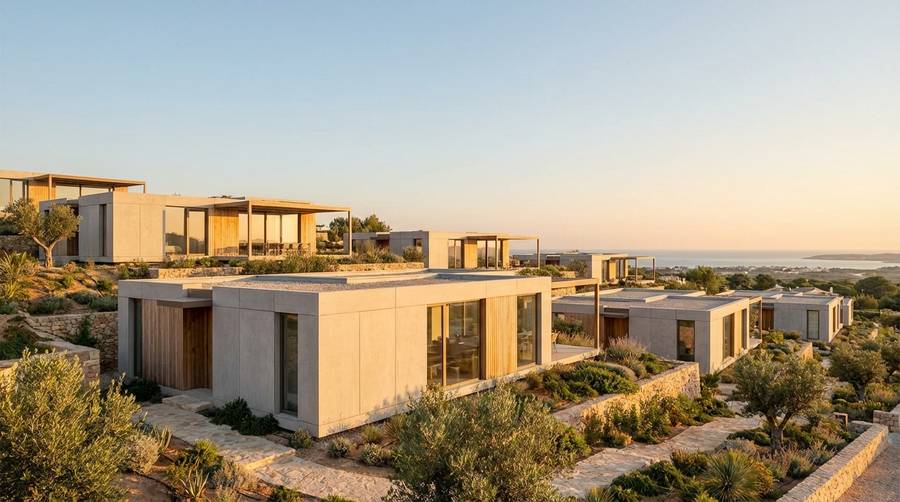
Industrialized Housing: 6 Reasons to Choose Modular Homes
Imagine signing a fixed-price contract and walking into your finished home months earlier than a traditional build—with fewer surprises. For autopromotores in Spain, industrialized housing (modular and prefabricated systems) is no longer an experiment: it is a repeatable path that reduces risk, shortens timelines and improves energy performance. This article gives you six concrete reasons to consider industrialized housing, backed by metrics, practical checklists and decision tools aimed at families and small promoters.
Industrialized construction can cut on-site work time by up to 60% and reduce delivery uncertainty—two factors that change the financial calculus of self-building.
Why industrialized housing answers Spain’s housing crisis
Quick panorama (2026): supply gap, long lead times, and rising costs. Urban pressure, scarce buildable plots and rising labour costs keep delivery times and uncertainty high. Industrialized housing tackles supply constraints by decoupling factory production from constrained sites.
Short snapshot: demand, build times and costs (2026)
- Demand pressure: persistent shortage in mid-range family homes in peri-urban areas.
- Average lead times: traditional single-family new build: 10–18 months on site; industrialized approach: 3–8 months on site plus 2–4 months factory production.
- Cost trends: modular projects typically show lower variance around the contract price due to factory controls and documented BOMs (bill of materials).
How industrialization reduces risk for self-builders
- Predictability: fixed bills of materials and production schedules reduce scope creep.
- Quality control: repeated factory QA lowers rework risk versus variable on-site trades.
- Weather-proofing: shorter on-site exposure reduces delays from bad weather.
How to use this article to decide
This guide is structured to help you: compare timelines, evaluate financing options, choose materials, assess sustainability and sign a robust turnkey contract. Use the checklists and case metrics to benchmark offers from manufacturers and suppliers.
1. Reduced timelines: faster and more controlled delivery
Average times compared: modular vs traditional (quantified examples)
Example A — Single-family home (120 m²):
- Traditional: design to handover 14–20 months; on-site critical path ~10–14 months.
- Industrialized: design to handover 8–10 months; on-site critical path 2–4 months; factory lead 2–3 months.
Example B — 6-unit small promotion:
- Traditional: 18–30 months total; phasing and on-site coordination extend timelines.
- Industrialized: 10–14 months total; parallel factory production allows staged deliveries.
Impact on housing availability and indirect costs
- Shorter carrying costs: quicker delivery reduces interim financing interest and temporary housing expenses.
- Market timing: faster completions let you respond more nimbly to demand peaks.
- Lower indirect risk: less time exposed to inflation on materials and labour.
Key factors that enable faster delivery
- Factory workflows: repeatable, documented assembly lines produce consistent modules.
- Parallelism: site groundwork and factory production run concurrently.
- Logistics and sequencing: just-in-time component delivery reduces on-site storage and coordination complexity.
2. Predictable costs and financing for self-builders
Fixed price contracts: what they usually include and how to secure them
Typical inclusions: factory production, structural envelope, standard finishes, mechanical systems, onsite assembly and basic commissioning. Always verify detailed exclusions: foundations, utility connections, taxes, and landscaping.
Clauses to demand:
- Clear BOM and unit pricing for variations.
- Defined change order process with capped rates.
- Delivery windows with liquidated damages for missed milestones.
- Factory QA reports and third-party inspections as acceptance criteria.
Mortgage and financing options for autopromoción and modular models
Spanish banks increasingly recognise modular projects. Financing models include:
- Construction mortgage adapted to phases: staged draws tied to factory completion and on-site assembly milestones.
- Autopromoción mortgage: loans for self-builders that accept factory contracts as proof of progress.
- Bridge loans plus long-term mortgage: short-term financing for construction, followed by conversion to a residential mortgage once delivered.
Practical cases: total cost examples and payback horizons
- Family home 120 m²: total project cost (incl. land prep) comparable to traditional in many regions, with lower contingency reserves—amortisation depends on mortgage terms but earlier move-in accelerates household savings.
- 6-unit promotion: lower time-to-market increases yield by enabling faster sale cycles; reduced uncertainty attracts buyers faster.
3. Modern materials and systems that improve durability and comfort
Technical comparison: industrialized concrete, light timber frame, and steel frame
- Industrialized concrete: high thermal mass, excellent fire resistance, long lifespan; best for coastal or high-exposure sites.
- Light timber frame: rapid assembly, excellent thermal performance when combined with airtightness strategies; lighter foundations reduce groundwork costs.
- Steel frame (steel stud): high precision, long spans and adaptable layouts; requires careful thermal bridging design.
Performance: thermal, acoustic and maintenance
Thermal: factory-controlled insulation installation and airtightness testing deliver consistent U-values and lower energy consumption.
Acoustic: multi-layer façades and specialized junction details reduce transmission; material choice and detailing determine final performance.
Maintenance: prefabricated envelopes designed in factory conditions tend to require fewer corrective repairs in early years.
Choosing by climate, location and budget
- Mediterranean coast: concrete and hybrid solutions for thermal mass and durability against humidity.
- Interior and cooler zones: timber frame with high insulation and airtightness to maximise efficiency.
- Budget vs longevity: balance initial cost with lifecycle energy and maintenance forecasts; request LCC (life-cycle cost) simulations from suppliers.
4. Real sustainability: energy efficiency and carbon reduction
How industrialized construction facilitates Passivhaus and certifications
Factory precision supports airtightness and continuous insulation—two pillars of Passivhaus. Manufacturers can deliver tested façade assemblies and preinstalled mechanical ventilation systems (MVHR), simplifying certification.
Where carbon is reduced most in the project
- Reduced rework and waste: controlled production minimizes offcuts and rejects.
- Optimised logistics: fewer truck visits and consolidated deliveries lower transport emissions.
- Material selection: engineered timber and low-carbon concrete formulations reduce embodied carbon where appropriate.
Recyclable materials and circular strategies in real projects
Leading projects integrate recyclable insulation, separable connections for future deconstruction and take-back schemes for offcuts. Ask suppliers for an EPD (Environmental Product Declaration) and documented reuse strategies.
5. Turnkey process: clear phases from plot to handover
Typical turnkey phases and promoter responsibilities
- Feasibility and site survey (promoter provides plot): geotechnical study, connections, local regulations.
- Design development and fixed-price proposal.
- Factory production (structural modules, façade, systems).
- Site preparation (foundations, utilities) executed in parallel.
- Delivery, assembly, commissioning and final handover.
Permits, geotechnical needs and a sample schedule
Start permits early: planning and building permits typically determine the critical path. A typical integrated schedule for a single-family turnkey project in Spain:
- Weeks 0–8: permits and design approval.
- Weeks 6–20: factory production.
- Weeks 16–24: site works and foundation.
- Weeks 20–26: assembly and commissioning.
Checklist: what to demand in the contract and how to supervise
- Detailed scope and exclusions, explicit milestone dates, and penalties.
- Third-party inspection rights and delivery acceptance tests.
- Documented warranties for structure, envelope and MEP (mechanical/electrical/plumbing) systems.
- Clear responsibilities for groundworks, connections and taxes.
6. Case studies: real metrics and client satisfaction
Case 1 — Mediterranean family home (120 m²)
- Timeline: 9 months from contract to handover. On-site assembly: 3 weeks.
- Cost certainty: fixed-price contract with ≤3% variation due to pre-agreed change order rates.
- Client feedback: high satisfaction with thermal comfort and speed; main recommendation—early engagement on finishes selection.
Case 2 — Small promotion, 6 units
- Timeline: 12 months from feasibility to delivery for all units.
- Efficiency: shared repetitive modules reduced per-unit costs by ~8% compared with single bespoke builds.
- Lessons: centralised procurement and early parking/logistics planning were decisive to avoiding assembly delays.
How to interpret satisfaction indicators
Key metrics to compare offers:
- On-time delivery rate (percentage of projects delivered within the contractual window).
- Variation rate (average contract change as % of contract value).
- Post-handover defects per 100 m² in the first year.
Practical conclusion: deciding and next steps for self-builders
Executive summary: when to choose industrialized housing
- Choose industrialized housing if you prioritise predictability, speed and energy performance.
- It scales efficiently for small promotions and single-family homes with repeatable designs.
- Request LCC and QA documentation to validate long-term value.
Quick decision checklist for families and small promoters
- Do you need delivery within 12 months? — industrialized likely fits.
- Can you accept a fixed package with limited bespoke changes? — industrialized favours this model.
- Have you budgeted for groundwork and utility connections separately? — confirm exclusions in the turnkey offer.
Resources to continue
Read our deep-dive analyses to broaden context: Vivienda industrializada: el futuro viable en España for economic impact and Vivienda modular: estrategia contra la crisis de vivienda for trends through 2030.
If you're ready to compare offers: gather three factory proposals, request BOMs, fixed timelines and measurable QA reports. Use the checklists in this article during your evaluation and insist on milestone-linked payments. When in doubt, ask for third-party inspections and documented warranties.
Interested in a realistic budget and timeline for your plot? Contact a specialist to request a tailored turnkey proposal—real figures will transform assumptions into decisions.
Artículos relacionados
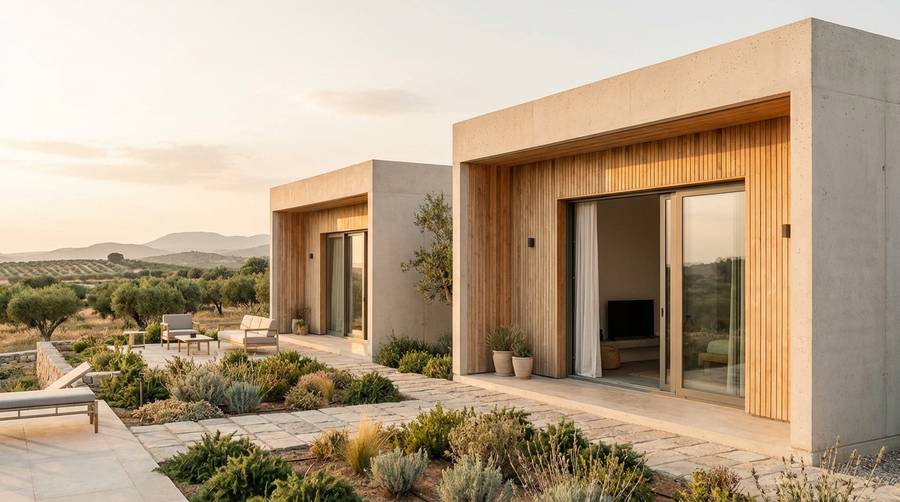
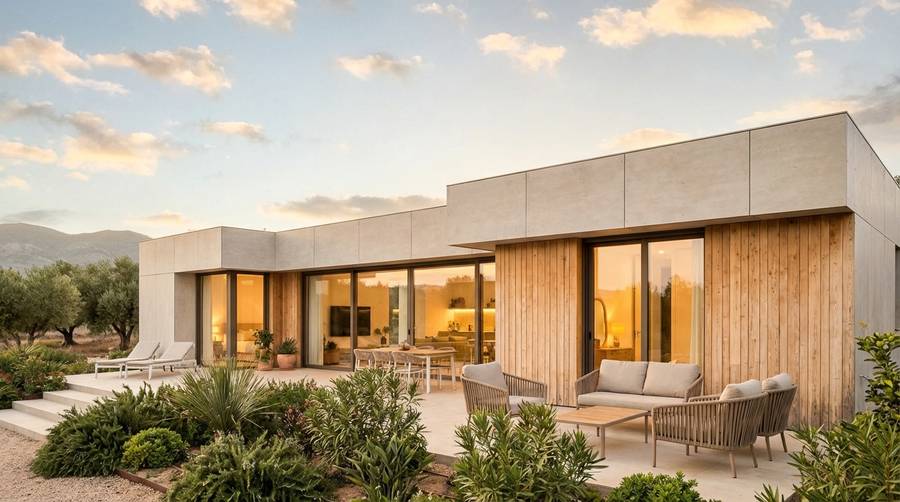
Modular Housing Success: A Spanish Family’s Real Case
A Spanish family faced rising rents and scarce homes — they built a modern, energy-efficient modular house on budget and on time. This case study details design choices, materials, financing, metrics and repeatable steps for autopromoters in Spain.