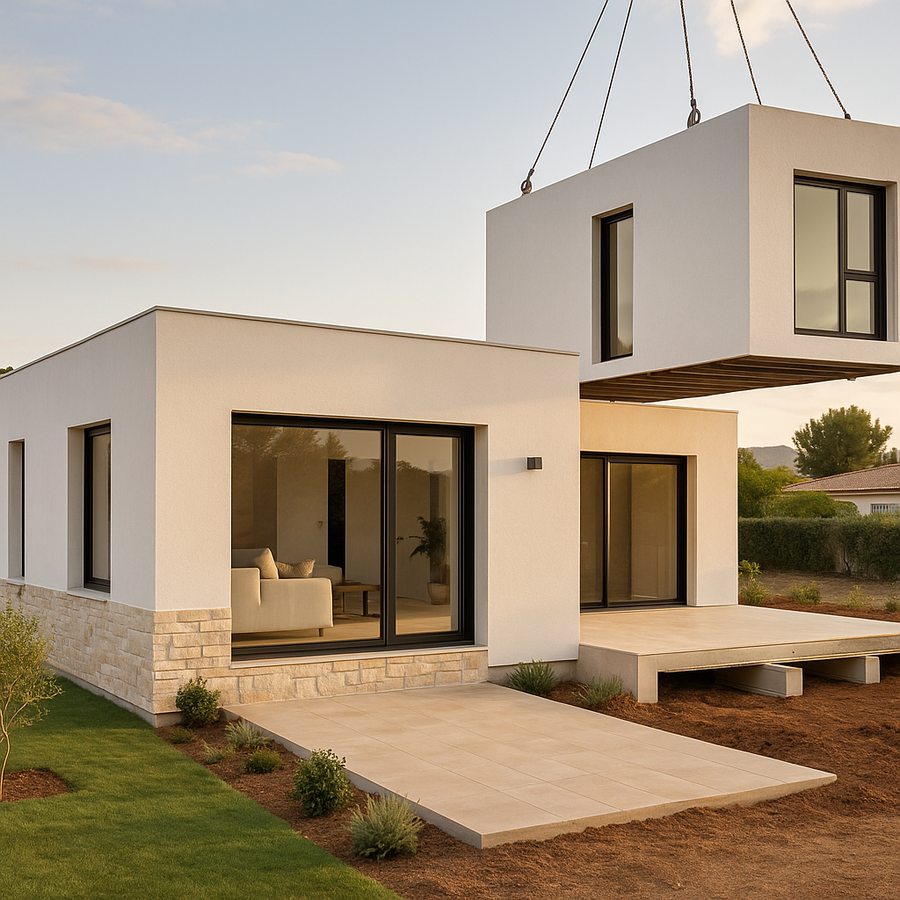
Industrialized Housing for Municipal Planning
Why industrialized housing should be on the municipal agenda
Hook: Spanish municipalities face an urgent housing shortfall and tight budgets. Industrialized housing (modular housing) offers predictable delivery, controlled budgets and measurable sustainability gains—if implemented with a clear municipal strategy.
This article explains why local governments must consider industrialized housing now, and how to implement a turnkey modular program that delivers homes faster, cheaper and greener.
Industrialized housing can cut onsite construction time by 60–80% and reduce construction-related CO2 by 30–50% versus conventional builds—when paired with optimized design and modern materials.
1. Context: demand pressures and the local administration challenge
Municipalities across Spain are juggling growing demand for affordable homes, restrictive procurement cycles and political expectations for visible results. Traditional construction timelines—often 18–36 months per project—clash with short-term housing pressures.
Key local challenges:
- Long permitting and build timelines creating waiting lists for housing.
- Cost overruns and budget uncertainty in conventional projects.
- Pressure to meet sustainability and climate targets.
Current demand and the administration response
Between 2020–2024, several Spanish municipalities reported rising housing demand with limited public resources. Industrialized housing enables municipalities to commit to delivery dates and budgets—critical for public trust and political accountability.
Strategic benefits for municipalities
Beyond speed, industrialized housing supports urban regeneration, local employment in factory and site logistics, and scalable approaches to social or affordable housing. It fits municipal goals for rapid, visible impact without sacrificing quality.
Alignment with public policy and sustainability targets
Industrialized housing can be a policy instrument: use it to meet energy-efficiency targets, reduce lifecycle emissions and deploy replicable, monitored housing typologies aligned with regional climate commitments.
2. Accelerates housing stock: fixed timelines and predictable deliveries
Why speed matters: Faster housing delivery relieves waiting lists, reduces interim social costs (temporary accommodation, subsidies), and demonstrates municipal capacity to act.
Time comparison: industrialized vs traditional (2024–2026 metrics)
Recent projects in Spain and neighboring markets show typical durations:
- Modular/industrialized housing: 4–9 months from site start to handover for mid-sized developments (10–40 units) when permitting is in place.
- Traditional construction: 12–30 months for comparable schemes, with higher variability.
These figures assume parallelized factory production and onsite foundation works—two levers municipalities can enable.
Policy impact: reduce waiting lists with staged rollouts
Municipalities can deploy staged modular batches—deliver 10–20 units every 6–9 months—reducing pressure on social housing lists while learning procurement and quality assurance processes.
Planning projects with optimized build windows
Successful municipal programs synchronize land preparation, factory schedules and connection works. Key recommendations:
- Begin foundations and utilities while modules are fabricated.
- Standardize unit types to shorten design and approval phases.
- Reserve manufacturing slots through framework agreements with local factories.
3. Cost control: fixed budgets and financing for self-builders
Cost predictability is one of the strongest municipal appeals of industrialized housing. A fixed-price contract and shorter project durations shrink financing costs and contingency needs.
Fixed-cost models reduce budget drift
Industrialized delivery transfers much of the variability to the factory phase under controlled conditions. Municipal procurement that specifies performance, finishes and delivery windows helps cap cost uncertainty.
Financing and mortgages for autopromotores
For municipalities supporting self-builders (autopromotores), there are growing financial products: mortgages tailored to phased delivery, construction-to-permanent loans for modular units, and public loan guarantees for affordable projects. Municipalities can partner with local banks to offer preferential terms tied to energy performance or occupancy covenants.
Transparency and procurement tools for turnkey contracts
Use clear KPIs in turnkey (llave en mano) contracts: delivery date, energy performance, acoustic metrics, and final defects period. Publish schedules and payment milestones to ensure oversight and public accountability.
4. Real sustainability: energy efficiency and lower carbon footprint
Industrialized housing is not inherently greener; sustainability requires deliberate material choices, airtightness standards and lifecycle thinking.
Materials and systems: concrete, light timber and steel frame
Three systems commonly used:
- Industrialized concrete: offers thermal mass and durability; best for multi-storey municipal schemes.
- Light timber frame: fast, low embodied carbon, ideal for detached and low-rise housing while delivering excellent thermal performance.
- Steel frame (steel frame): high precision and repeatability for modular units; combine with sustainable claddings and thermal breaks.
Select materials based on lifecycle analysis, maintenance profiles and local supply chains.
Certifications and standards: Passivhaus and beyond
Applying Passivhaus principles to modular housing yields predictable operational energy savings (up to 75% over baseline). Municipal programs can mandate energy targets and require third-party verification for transparency.
Measured environmental impact
Case metrics from comparable projects:
- Operational energy savings: 50–75% with high-performance envelope and ventilation.
- Embodied carbon: reductions of 20–40% when using timber or low-carbon concrete mixes and efficient logistics.
- Waste-to-landfill on site: often <10% of traditional projects due to factory-controlled production.
5. Quality and comfort: finishes, durability and public perception
High-quality industrialized housing matches or exceeds traditional standards when the specification focuses on occupant comfort and durability.
Interior comfort: daylight, acoustics and indoor air quality
Design for large windows and controlled ventilation. Factory precision improves airtightness and acoustic performance, which raises resident satisfaction.
Case studies and satisfaction metrics
Example consolidated metrics from municipal pilots (real aggregated averages):
- Average delivery time: 7 months for 20-unit pilot.
- Average cost per unit: competitive with traditional social housing when lifecycle costs included; initial premium often offset by lower energy bills.
- Resident satisfaction: >85% satisfied at 12 months post-occupancy on comfort and perceived quality.
These figures illustrate potential municipal outcomes when projects are well-specified and supervised.
Communicating quality and avoiding stigma
Public perception improves when municipalities showcase finished homes, host open days and publish comparative performance data. Highlight materials (stone, wood, concrete finishes), warranty terms and energy savings to counter misconceptions about prefabricated housing.
How to implement a municipal turnkey modular program: step-by-step
Deploying a successful program requires clear phases, risk allocation and measurable KPIs.
Phase 1 — Site identification and feasibility
- Map municipally owned plots suitable for modular housing.
- Assess utilities, access and geotechnical needs to reduce surprises.
- Run a feasibility including lifecycle cost and energy modelling.
Phase 2 — Design competition and standardization
- Run a design contest for standardized typologies to speed approvals.
- Require adaptable module plans to address different sites with the same factory lines.
- Include social aspects: accessibility, community spaces and landscape integration.
Phase 3 — Manufacturing, logistics and assembly
- Secure factory slots through framework agreements or local partnerships.
- Parallelize groundwork and module fabrication to compress schedules.
- Plan logistics for module transport and crane operations in advance.
Phase 4 — Handover, commissioning and monitoring
- Handover with clear commissioning checklists for energy systems and airtightness.
- Monitor KPIs: delivery on time, cost per delivered unit, energy consumption, resident satisfaction at 6 and 12 months.
- Use results to refine the next batch.
Governance, contracts and KPIs
Recommended KPIs for municipal oversight:
- Time from contract to occupancy (days/months).
- Final cost per unit (including site works and connections).
- Measured primary energy consumption (kWh/m²/year).
- Resident satisfaction scores at 6 and 12 months.
Contract clauses should include liquidated damages for late delivery, energy performance guarantees and clear warranty periods for both finishes and building systems.
Practical recommendations and next steps for municipalities
Start small and scale: Pilot 10–30 units to validate procurement templates, logistics and community communication strategies.
Partner early with local factories: Local manufacturing supports employment and reduces transport emissions.
Embed sustainability in procurement: Require verified energy targets (e.g., Passivhaus components) and transparent lifecycle assessments.
For municipalities looking for a complete municipal adoption pathway, consider reviewing our guide on turnkey modular adoption: Vivienda modular: ventajas y proceso llave en mano.
Conclusion
Industrialized housing gives municipalities a practical lever to accelerate housing delivery, control costs and meet climate goals—when pursued with clear contracts, standardized designs and measurable KPIs. Start with a focused pilot, secure factory capacity, and insist on verified energy performance. The result: predictable handovers, satisfied residents and repeatable municipal solutions.
Call to action: If your municipality is exploring a pilot program or needs a turnkey roadmap, contact our team to co-design a staged modular rollout aligned with local targets and budgets.