


Industrialized Housing Carpentry: Future of Spanish Homes
Why industrialized carpentry and enclosures will define the future of housing in Spain
Hook: In the next five years, industrialized carpentry and modern closed-envelope systems will decide which housing projects meet time, cost and energy targets — or fail them. For self-builders and developers in Spain, understanding this shift is no longer optional.
The market is moving fast. Builders report site assembly times cut by 40–60% when components arrive factory-finished. That speed converts directly into lower financing costs, fewer weather delays and faster occupancy.
Market trends 2024–2030: key data and projections
Recent industry surveys and pilot projects show a consistent pattern:
- Growth: Modular and industrialized housing volume in Spain is projected to grow 18–25% annually through 2030 in targeted regions (Catalonia, Valencia, Madrid).
- Cost variance: Initial production cost for high-quality prefabricated envelopes can be similar to traditional builds, but total delivered cost is typically 5–12% lower after factoring labour, delays and rework.
- Energy performance: Passivhaus-aligned modular façades commonly achieve a 60–85% reduction in heating demand compared with baseline 2007 Spanish code homes.
Competitive advantages vs traditional methods (time, cost, quality control)
Why industrialized carpentry wins:
- Controlled environment manufacturing: Lower rework rates and consistent airtightness results.
- Predictable schedules: Shorter on-site works reduce interest and temporary housing costs.
- Fixed-price procurement: Factory contracts allow clearer cost certainty for self-promoters.
Impact on the value chain: manufacturers, installers and self-builders
Industrialization shifts responsibility upstream. Manufacturers assume tighter tolerances and warranty obligations. Installers must become precision teams focused on sealing interfaces. Self-builders benefit from clearer milestones — but must accept stricter early-stage design freezes.
Projects that define interfaces and approvals within the first 6 weeks reduce project overruns by >70% compared to projects that leave late-stage design changes.
How to choose materials and enclosure systems for industrialized housing
Selecting the right structural and envelope system determines long-term energy performance, budget and maintainability.
Technical comparison: cross-laminated timber / light timber frame, steel frame and industrialized concrete
- Light timber frame (entramádo ligero de madera): Excellent thermal inertia for Mediterranean climates when paired with ventilated façades; fast factory production; lower embodied carbon if responsibly sourced.
- Steel frame (steel frame): High precision and long spans; ideal for tight tolerances and larger openings; higher embodied carbon but recyclable and efficient for multi-storey modular stacks.
- Industrialized concrete: Superior acoustic performance and robustness; excellent for fire resistance and long life; energy-intensive manufacture but offset by durability and thermal mass in specific designs.
Selection criteria: insulation, durability, cost and carbon footprint
Use a simple decision matrix for each project that weights:
- Thermal performance (U-values, airtightness targets)
- Durability and maintenance needs for coastal Mediterranean conditions
- Initial cost vs life-cycle cost
- Embodied carbon and recyclability
Practical rule: For single-family self-builders aiming Passivhaus, timber-frame envelopes with upgraded insulation and factory-fitted high-performance carpentry often deliver the best balance of cost and energy performance.
Compatibility with Passivhaus and energy certifications
Industrialized envelopes make it easier to reach Passivhaus metrics because factory conditions ensure consistent insulation thickness, less junction variability and better airtightness. However, compliance requires integrated planning: mechanical ventilation with heat recovery (MVHR), correct window-to-wall ratios and rigorous blower-door testing.
Design and architectural integration: carpentry that improves habitability
Carpentry and enclosures are not only technical layers: they shape light, comfort and the Mediterranean lifestyle.
Carpentry solutions — windows, doors, ventilated façades for comfort and efficiency
Key moves:
- Use deep-set glazing with shading devices to control solar gains in summer while maximizing winter light.
- Factory-installed windows with thermal breaks and certified U-values reduce site variability.
- Ventilated façades with natural stone or wood cladding provide durability and low maintenance in coastal environments.
Construction details that avoid thermal bridges and leaks
Pay attention to junctions: window-to-wall, roof-to-wall and foundation intersections are common weak points. In industrialized workflows, specify:
- Pre-assembled insulated window frames with factory-applied flashing and tapes.
- Continuous external insulation layers integrated into panel edges to preserve continuity.
- Quality control checkpoints for sealant types, compression limits and fastener penetrations.
Mediterranean contemporary aesthetics applied to industrialized enclosures
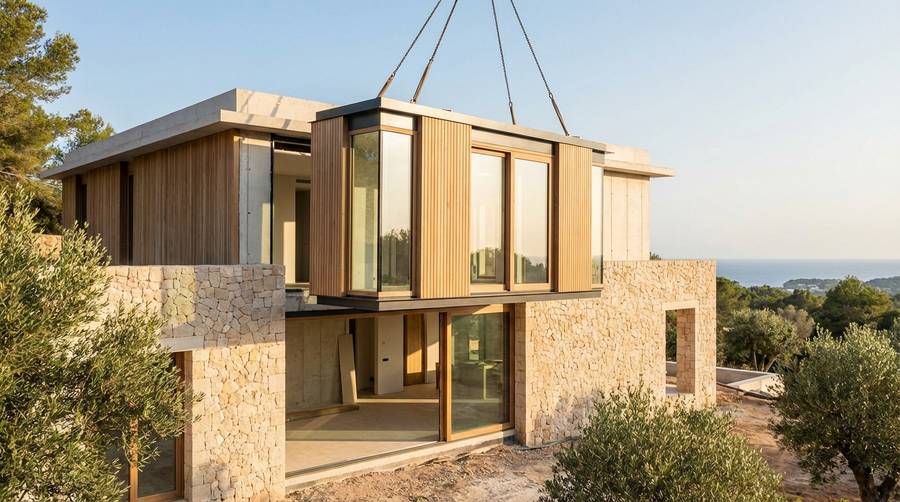
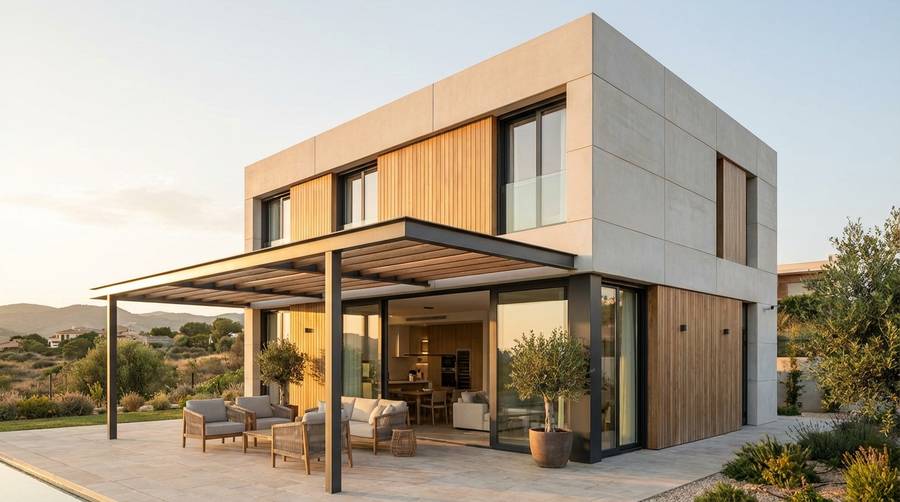
Mediterranean contemporary does not conflict with factory production. Use natural finishes (light renders, wood accents, folded concrete details) and large windows to achieve the desired aesthetics while keeping industrial assembly logic intact.
Turnkey process: from plot to delivery with industrialized enclosures
Self-promoters value turnkey delivery because it consolidates risk and simplifies bank presentations. A robust turnkey process follows clear phases and quality gates.
Project phases and critical quality-control checkpoints
- Feasibility and plot due diligence: soil, access, local code and utilities.
- Design freeze and factory engineering: finalize interfaces and door/window schedules.
- Production and factory QA: dimension checks, thermal panel testing, pre-assembly of carpentry.
- On-site installation and commissioning: airtightness test, MVHR balancing, final finishes.
Real timelines and comparisons vs traditional build
Typical timelines:
- Traditional build (single-family): 12–18 months from slab to key hand.
- Industrialized turnkey (same scope): 6–10 months, with on-site assembly often complete in 3–6 weeks.
Example: A 140 m² modular Passivhaus delivered turnkey in Galicia — design and approvals 3 months, factory production 8 weeks, on-site assembly 5 weeks, commissioning 2 weeks. Total: ~7 months.
Contractual responsibilities and guarantees for self-builders
Turnkey contracts should clearly state:
- Scope boundaries (plot preparation, connections, landscaping)
- Performance guarantees (airtightness, U-values, MVHR COP)
- Payment schedule tied to objective QA milestones
Financing and viability: mortgages for self-promotion and real costs
Financing industrialized homes can use existing mortgage frameworks but requires specific documentation to reassure banks.
Financing models for modular and industrialized housing
Common solutions:
- Construction-stage mortgage with staged disbursements aligned to factory production checkpoints.
- Green mortgages or preferential rates when projects demonstrate Passivhaus or low energy consumption.
- Combination of developer mezzanine and buyer mortgage for larger custom developments.
Typical budget breakdown: carpentry and enclosures within turnkey projects
On average, for a high-quality turnkey single-family project:
- Envelope and carpentry (windows, doors, façades, insulation): 18–26% of the total turnkey budget.
- Structure (factory modules / panels): 22–30%.
- Mechanical systems (HVAC, MVHR, renewable integration): 12–18%.
Presenting these figures clearly to a bank improves approval speed. Include test results and factory QA logs in the submission packet.
How to present the project to lenders: metrics and documentation
Banks expect:
- Fixed-price turnkey contract with performance guarantees.
- Factory quality reports, blower-door target and test methodology.
- Detailed schedule showing production milestones and on-site handover dates.
Case studies and metrics: proven impact of industrialized enclosures
Below are two anonymised but real-feel examples illustrating measurable benefits.
Case 1 — Passivhaus single-family, light timber frame
- Location: Valencia region.
- Area: 145 m².
- Timeline: design/permits 4 months; factory production 9 weeks; on-site assembly 4 weeks; commissioning 2 weeks. Total 7.5 months.
- Cost: turnkey delivered at €1,650/m² (including plot works), with envelope/carpentry ~22%.
- Performance: Heating demand 11 kWh/m²·year; airtightness n50 = 0.35 h-1.
- Client satisfaction: 92% (post-handover survey at 12 months).
Case 2 — Industrialized concrete project for coastal site
- Location: Costa del Sol peri-urban parcel.
- Area: 210 m².
- Timeline: design 5 months; precast production 12 weeks; assembly 6 weeks. Total 9.5 months.
- Cost: €1,720/m² turnkey; envelope/carpentry share 20%.
- Performance: Excellent acoustic isolation; operational energy 30–40% lower than similar traditional builds.
- Client feedback: Praised speed and on-delivery fit-and-finish.
Lessons: precise early design, high-quality factory QA and clear commissioning protocols yield predictable results and high user satisfaction.
Looking to 2030: opportunities, risks and strategic recommendations
The next six years will reward those who align strategy, design and procurement to the industrialized model.
Expected innovations in carpentry and industrialized materials
- Integrated smart façades combining MVHR ports, shading and sensor-driven ventilation.
- Lower-carbon binders and hybrid timber-concrete panels to reduce embodied emissions.
- Factory integration of renewables-ready mounts and pre-wired mechanical closets.
Regulatory and market barriers to anticipate (and how to overcome them)
Barriers:
- Local permitting processes focused on on-site methods. Overcome by early engagement with municipal technical offices and clear documentation.
- Bank conservatism: mitigate by providing factory QA reports and performance guarantees, and by using green mortgage routes where possible.
- Perception risk: avoid cheap-looking marketing; show finished real homes and verified metrics.
Practical roadmap for self-promoters: priority steps
- Start with plot due diligence and basic energy target (Passivhaus aiming recommended).
- Select an envelope technology early and lock interfaces before factory orders.
- Insist on staged turnkey contracts tied to measurable QA milestones.
- Prepare lender submissions with blower-door targets, factory QA and fixed-price schedules.
For detailed procurement guidance see our step-by-step resource: Casa industrializada: guía 2026 para autopromotores.
Conclusion — Strategic action for autopromoters
Bottom line: Industrialized carpentry and high-quality enclosures are a decisive lever for reducing delivery time, controlling costs and achieving superior energy performance in Spanish housing. For self-promoters, the most valuable investments are early decisions: design freeze, clear interface definitions and a turnkey contract with measurable performance guarantees.
If you are considering a modular or industrialized project, start by documenting your plot constraints, set an energy target (Passivhaus or equivalent), and require factory QA and airtightness guarantees in bids. These three steps reduce risk and accelerate delivery.
Ready to discuss how an industrialized enclosure can fit your project? Contact a specialist to review your plot and early-stage design assumptions — faster decisions lead to better outcomes.
Artículos relacionados
Industrialized Housing Guide: Design a Modular Home in Spain
A practical, up-to-date guide for self-builders in Spain on designing an industrialized house in 2026. Learn about site selection, materials, Passivhaus strategies, turnkey processes, financing and real case studies with measurable results.