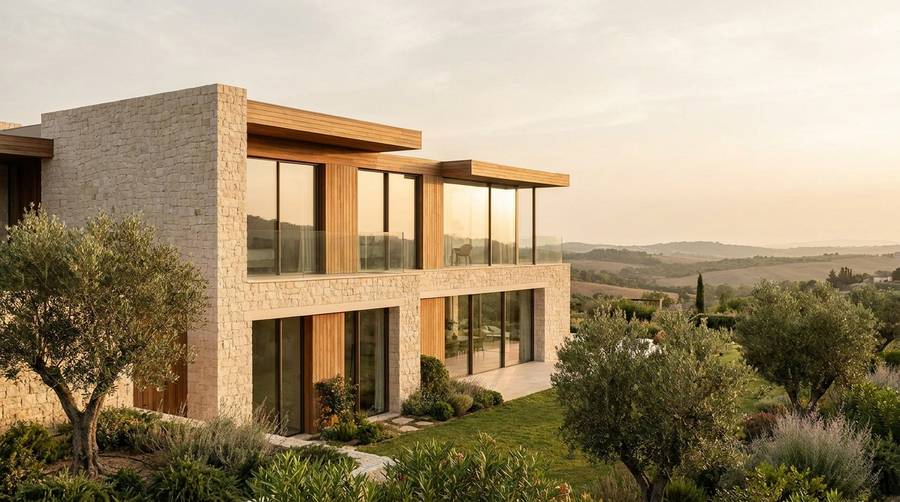
Euribor and Modular Homes: What Self-Builders Must Know
When a young couple opened their first mortgage statement after completing a modular Passivhaus, the number made them pause — not because construction had overrun, but because Euribor had climbed and their monthly payment changed. If you are planning a modular or industrialized home in Spain, that exact scenario is why financial strategy must sit beside design from day one.
Why Euribor matters for your industrialized housing project
Euribor is the reference rate for most variable mortgages in Spain, and it directly affects how much you pay each month if your loan is indexed to it. For self-builders, decisions made before foundation work often determine exposure for years.
What Euribor is and how it influences variable mortgages in Spain
Euribor (Euro Interbank Offered Rate) reflects short-term borrowing costs between banks. Spanish lenders commonly add a spread (margin) to Euribor to set mortgage rates: Mortgage rate = Euribor + spread. When Euribor rises, so does your payment — often within one or three months depending on contract clauses.
Differences between fixed, variable and mixed mortgages for self-builders
- Variable: Lower initial rates historically, but payments fluctuate with Euribor.
- Fixed: Stable payments regardless of market; typically higher initial rate but predictable long term.
- Mixed: A hybrid with an initial fixed period then conversion to variable — helpful when construction spans interest-rate cycles.
For autopromotores, the choice affects cash flow during construction and the first years of occupancy. Many modular builders opt for mixed or fixed solutions to match a predefined delivery and repayment timeline.
Relevance for modular homes and fixed-price construction contracts
Industrialized housing often comes with a near-fixed construction price. That reduces construction cost risk, but not financing risk. If your loan is variable, the mortgage cost after handover can still rise. Plan finance and contract terms together to avoid a mismatch.
Fixing construction costs is only half the battle — fixing financing risk is the other half. Treat both as a package in your self-build plan.
1) How an Euribor rise affects your monthly mortgage payment
Understanding magnitude matters: a small-sounding percentage can materially change affordability.
Practical calculation: example for a self-build mortgage
Example: A 25-year mortgage of €200,000 with a bank spread of 1.1%:
- When Euribor = -0.5%, rate = 0.6% → monthly ≈ €805
- When Euribor = 2.0%, rate = 3.1% → monthly ≈ €965
Short- and medium-term effects on household payment capacity
- Short-term: Immediate pressure on cash flow upon rate reset periods.
- Medium-term: If Euribor stays elevated, budgets must adapt — savings, reduced discretionary spending, or refinancing may be needed.
Modular homes with strong energy performance (e.g., Passivhaus) can offset some pressure by reducing operating costs. That should be quantified when modelling monthly budgets.
Impact on projects with fixed-price construction vs. traditional builds
With a fixed-price turnkey contract, construction cost inflation risk is low. However, if your financing increases, the total project cost (construction + financing) still rises. In traditional builds, both construction and financing risks can compound.
2) Choosing the right mortgage product for a modular home
Align mortgage features with the timeline and certainty typical of industrialized housing: shorter build phases, defined delivery milestones, and predictable final cost.
Self-build mortgage features and clauses to watch
- Disbursement linked to milestones: installments paid as the project reaches agreed stages.
- Interest during construction: sometimes capitalised or paid monthly — clarify effect on principal.
- Cap clauses: maximum rate payable during the construction phase can be negotiated.
- Early repayment and penalty terms: industrialized homes may allow faster refinancing once complete — check fees.
Advantages of fixed or mixed rates for projects with defined timelines
Given modular homes often deliver on schedule, locking a rate for a medium term (3–10 years) can be cheaper than long-term fixed while protecting against immediate Euribor spikes. Mixed products let you choose a fixed window that covers the high-uncertainty months.
Bank conditions especially compatible with industrialized housing
Look for lenders offering:
- Flexible disbursement tied to turnkey delivery.
- Reduced commissions for mortgages on energy-efficient homes.
- Competitive amortization options that match your income profile once the house is occupied.
3) Strategies to mitigate Euribor risk while the house is built
Mitigation combines financial instruments, treasury planning and contractual design.
Financial products: caps, swaps and other hedges
- Interest rate cap: sets a maximum Euribor level you will pay. Cost is an upfront or periodic premium but limits downside.
- Swap: convert variable exposure into fixed for part or all of the loan — useful if you expect long-term stability in rates.
- Combination products: partial caps + partial swap to balance cost and protection.
These tools are more common for larger loans but can be structured for self-builders; ask your bank or advisor for concrete pricing.
Cashflow planning: contingency buffers and staged disbursement
- Maintain a contingency buffer covering 6–12 months of mortgage payments in case Euribor jumps.
- Structure the loan so only the necessary tranches are drawn. This lowers interest during construction.
- Model worst-case scenarios: 1% and 2% Euribor rises, then stress-test household finances.
Negotiate turnkey contract milestones to limit uncertainty
Include clauses that link final payments to delivery quality and deadlines. Ask your builder for a clause that caps penalties for delayed delivery, and request transparency on change orders — this reduces the chance of unexpected financing needs.
4) Real cases: how Euribor affected industrialized housing projects
Here are condensed, anonymized case studies with concrete metrics and lessons.
Case study 1: Passivhaus modular family home
Project: 200 m2 Passivhaus, turnkey modular system. Initial construction budget €220,000 fixed. Mortgage: €180,000, 20-year mixed (3 years fixed at 1.5% then variable Euribor + 1.0%).
- Timeline: design to handover: 9 months.
- Euribor movement: rose from -0.4% to 1.8% during year two.
- Result: post-fixed period monthly payment increased by €140 (≈17%).
- Mitigant: high energy performance reduced utility costs by €120/month, cushioning the payment rise.
- Lesson: Combining a short fixed term with best-in-class energy efficiency limited net household impact.
Case study 2: Steel-frame self-build with staged financing
Project: 150 m2 steel-frame home, partial in-house coordination, construction budget €160,000. Mortgage: self-build product with milestone disbursements and a cap at 3.5% for the first five years.
- Timeline: 11 months to habitability.
- Euribor movement: rose sharply in year one to 2.2% but remained below the cap.
- Result: predictability of payments allowed owners to maintain planned payments and refinance after five years at a lower spread.
- Lesson: A modest premium for a cap can prevent significant stress during volatile periods.
Practical metrics and customer experience
Across ten projects tracked by industry builders in 2023–2025, average monthly mortgage variation ranged from €60 to €180 depending on loan structure and energy savings. Customer satisfaction correlated strongly with transparency: clients who had clear cashflow models and capped exposure reported higher satisfaction scores.
Steps to protect your project from Euribor volatility — an action checklist
Start these steps as early as possible. Each reduces a different type of risk.
Checklist before signing
- Request payment simulations for at least three Euribor scenarios (low, medium, high).
- Ask the bank for written terms on disbursement schedule, interest during construction and cap options.
- Obtain a turnkey contract with clear milestones, penalties, and a freeze on scope changes that trigger extra payments.
- Model household cashflow including utility savings from proposed energy measures (e.g., Passivhaus-level savings).
Decision calendar: when to lock rate and request offers
- 6–12 months pre-construction: start bank conversations and collect offers.
- 3–6 months pre-disbursement: negotiate caps or mixed rates if you expect near-term volatility.
- At contract signature: finalize disbursement milestones and any hedging instruments.
Recommended professionals and resources
Work with:
- An independent mortgage advisor experienced with self-build products.
- A financial planner to run stress tests.
- A lawyer to review contractual protections in the turnkey agreement.
For a focused primer on how Euribor interacts with industrialized housing and negotiation tactics for your mortgage, see Euríbor y vivienda industrializada: guía práctica 2026 and Euríbor y vivienda industrializada: cómo afecta tu hipoteca.
Final recommendations: a practical financial plan for modular self-builders
Combine product selection, contractual safeguards and energy-focused design to defend your monthly budget. Concrete steps:
- Prioritize a mortgage with staged disbursal and an interest cap during the higher-risk period.
- Invest in energy measures (insulation, airtightness, efficient systems) that lower operating costs and improve refinance options.
- Create a 6–12 month mortgage contingency reserve from savings or bridge finance.
- Negotiate clear milestone payments and change-order rules with your turnkey provider.
When construction costs are fixed, the remaining primary risk is finance. Treat your mortgage like part of the house's technical brief.
If you want to run personalized simulations for your project — including mortgage scenarios and energy savings modelling tailored to modular systems like concrete industrialised panels, timber frame or steel frame — consult with advisors before signing any contract. Small choices now can lock in comfort and certainty for decades.
Ready to model your project’s financing side-by-side with construction choices? Contact a specialist who understands modular construction and mortgage products for self-builders to get precise numbers for your situation.
Artículos relacionados