Euribor and Modular Housing: 5 Ways to Reduce Mortgage Risk
Euribor movements can change your monthly life — and your decision to build a modular home
When Euribor rises unexpectedly, families face sudden payment stress — but the way you build can cut that risk. This article explains in practical terms how Euribor affects mortgages for self-builds in Spain and gives five actionable reasons industrialized housing reduces exposure and improves the bankability of your project.
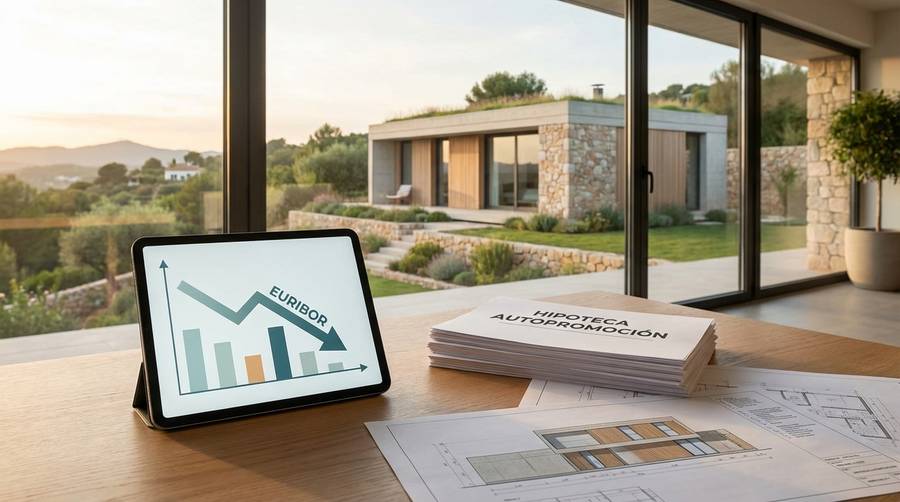
In a recent cycle, a 1% rise in Euribor increased the monthly payment on a 200,000€ variable-rate loan by roughly 100–120€ — small on paper, big over years and critical when budgeting a build.
1. Why Euribor matters to anyone planning to build
What Euribor is and how it shows up in variable and mixed mortgages
Euribor is the Euro interbank offered rate used as a reference for many variable and mixed mortgages in Spain. Banks add a fixed differential to Euribor to set your interest rate. For self-builders financing a project with a variable or mixed product, any movement in Euribor modifies the referenced rate at each review date and therefore the monthly installment.
Recent trends and their practical impact on short- and medium-term planning
After years of low rates, volatility has returned. Short-term spikes matter more for projects with construction phases: if your mortgage reviews during active construction or immediately after handover, a jump in Euribor can raise costs while your budget is still stretched or before rental/sales income begins.
How to read increases and decreases for autopromoters
- Rises: Expect higher interest outgoings and pressure on cash flow.
- Dips: Provide breathing room, but avoid relying on temporary lows when planning.
- Action: Model best-case and stress-case scenarios (+1% and +2% vs current Euribor) when asking the bank for pre-approval.
2. How Euribor directly alters your mortgage payment — a clear calculation
Practical formula: differential + Euribor = contractual rate (example)
Example: Your bank offers Euribor + 1.25% with a 30-year amortization on a 200,000€ loan. If Euribor is 0.5%, your rate = 1.75%. If Euribor rises to 1.5%, your rate = 2.75%.
Effect of periodic reviews and volatility on family budgets
Revisions typically happen annually or semi-annually. Each revision can produce a meaningful change in the monthly installment. For our example loan, a 1% Euribor increase raises monthly payment by approximately 100–120€ — cumulative over years and particularly relevant if the family must sustain construction expenses or bridge loans.
Common risks for self-builders and how to quantify them
- Timing risk: Mortgage reviews falling during the build phase — quantify by mapping review dates against construction milestones.
- Refinancing risk: If the property is not yet habitable, banks may withhold conversion to a permanent mortgage.
- Cost overrun risk: Model a 10–15% contingency and an interest-rate shock scenario to see worst-case cash needs.
3. Five reasons industrialized housing reduces mortgage risk
This is the core actionable section: industrialized construction isn’t just about speed; it materially changes financing risk for autopromoters.
1) Controlled build time: less exposure to interest rate windows
Why it matters: Shorter, predictable construction reduces the period during which a project is vulnerable to interest-rate shifts. Banks and insurers view predictable timelines favorably.
Actionable tip: Request a detailed production and delivery calendar from your supplier and map it against mortgage review dates. Prefer turnkey contracts with penalty clauses for delays.
2) Fixed price contracts raise predictability
Industrialized manufacturers typically offer fixed-price, turnkey models. This removes the risk of incremental raw-material inflation affecting the final contract value — a key worry for lenders.
Actionable tip: Insist on a contract that itemizes scope and clarifies what’s included (infrastructure, finishes, energy systems). Keep a 5–10% negotiation buffer for unforeseen site-specific costs.
3) Higher energy performance reduces operating costs
Modern industrialized homes can be built to Passivhaus or similar standards. Lower energy bills mean lower operational risk and higher disposable income — an indirect but measurable factor for loan servicing capacity.
Actionable tip: Include projected energy costs in your loan file. Present estimated annual savings versus a conventional build to strengthen affordability calculations.
4) Modern materials shorten onsite works
Systems like industrialized concrete panels, steel frame, or light wood framing (entramado ligero) accelerate completion of the thermal envelope and services. Faster envelope completion reduces weather-related delays and cost uncertainty.
Actionable tip: Ask suppliers for lead-time guarantees and documented track records. Banks like documented performance histories when assessing construction risk.
5) Better chance of delivering a 'turnkey' property that improves tasability
Properties delivered complete are easier to value and more likely to secure stable appraisals. Appraisers can price finished, energy-efficient homes with less discount than half-built or bespoke traditional projects.
Actionable tip: Use detailed finish schedules and third-party certifications (energy certificates, occupancy permits) to expedite valuation and conversion to a standard mortgage.
4. Mortgages and financing options for modular self-builds in Spain
Types of financing: construction loans, autopromoter mortgages, bridge loans
Common products include:
- Construction loan (préstamo obra): Disbursed in tranches linked to milestones.
- Autopromoter mortgage: Designed for self-builds; conversion to a mortgage for the final property may depend on completion proofs.
- Bridge financing: Short-term loans to buy the plot or cover initial costs.
What banks typically require for an industrialized project
Key documents that smooth approval:
- Land deed or reservation contract.
- Detailed turnkey contract with manufacturer, including price, schedule and penalties.
- Architect’s project or certified plans and energy performance targets.
- Budget and cash-flow plan with contingencies.
Clauses to negotiate to protect against delays and price changes
Negotiate these points with your bank and supplier:
- Deliverable-linked draws with independent certification.
- Price-variation clauses limited or excluded for the buyer's protection.
- Clauses requiring suppliers to provide completion certificates (certificado de fin de obra) and warranties.
5. Case studies and technical comparisons that matter
Case A: A Passivhaus modular home — time, final cost and energy outcomes
Summary (anonymized, representative): A 150 m² Passivhaus-style modular home completed in Spain in 9 months from contract signing to handover. Initial budget: 260,000€ turnkey. Final cost: 270,000€ (3.8% overrun due to parcel-specific foundation works). Energy bill: 180€/year (estimated) vs 1,200€/year for an equivalent traditional build.
Key takeaways: fast delivery reduced exposure to a mid-project Euribor increase; high energy efficiency boosted affordability in bank models.
Technical comparison: total cost and schedule vs a traditional build
- Traditional build: 14–24 months, budget variability often 10–20%, higher interest exposure during construction.
- Industrialized modular: 6–12 months, typical budget variability 0–6% if contractually fixed, lower cumulative financing cost due to shorter construction period.
Client satisfaction and lessons to avoid budget drift
Clients report higher satisfaction when contracts explicitly include finishes, supplier guarantees, and a clear handover checklist. The best projects document every change order and keep a contingency percentage untouched unless formally approved.
6. A practical action plan to decide and finance your modular home
Checklist before applying for mortgage financing
- Secure the plot with a formal reservation or deed.
- Obtain a turnkey quote from a reputable industrialized housing supplier with a delivery calendar.
- Prepare a documented budget including contingency (5–15%).
- Collect an architect’s report and an energy performance target (if aiming Passivhaus).
Strategies to reduce Euribor impact: product choices and protections
Ways to reduce exposure:
- Choose a mixed mortgage with a fixed period for the first years to cover the construction/recent post-handover window.
- Ask for pricing floors or caps where available, or short fixed-rate periods followed by variable terms.
- Include insurance or rate-swap-like products only if they clearly reduce peak payment risk.
Turnkey steps to delivery and how to document the project for the bank
Typical step sequence:
- Plot acquisition and permits.
- Turnkey contract and technical specifications.
- Production, manufacture and factory quality control reports.
- Onsite assembly and final certifications (energy, habitability).
For the bank, submit milestone certificates, photos, compliance reports and final occupancy permit to trigger conversion from construction loan to permanent mortgage.
Practical close: If you’re considering a modular, industrialized route, start by requesting a turnkey schedule and a fixed-price quote before you commit your land. Map those dates against expected Euribor review windows and model a stress test (+1% to +2%).
For a deeper dive on how Euribor interacts with prefabricated home financing details, see this companion guide: Euríbor y vivienda industrializada: guía práctica 2026.
Ready to move forward? Gather the plot details and a turnkey quote, then ask your lender for a conditional approval based on stress-tested scenarios. Small preparation now reduces financing risk later and keeps your build on schedule.
Artículos relacionados