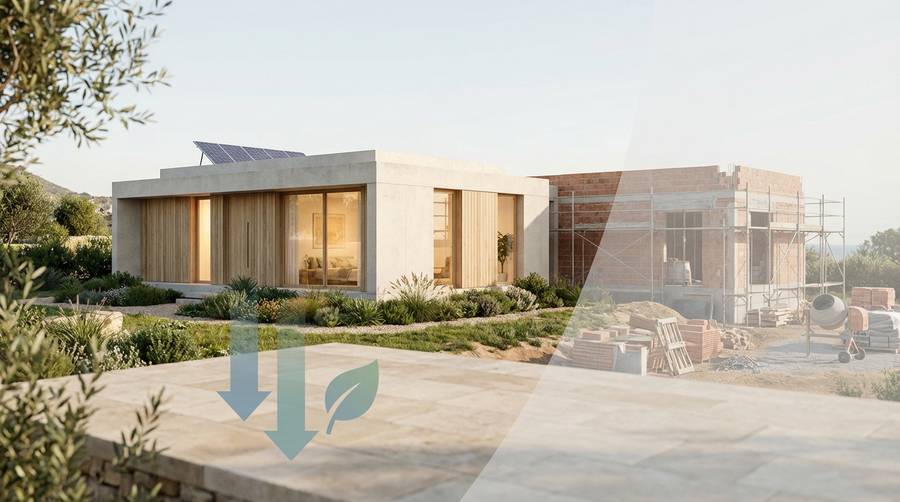
Embodied Carbon in Industrialized Housing (Spain 2026)
Why embodied carbon matters for industrialized housing in Spain
Hook: If you are planning a turnkey industrialized home in Spain, the single design decision that will lock most of your carbon footprint for decades is material and process choice. Understanding embodied carbon lets autopromotores build faster and greener without compromising cost predictability.
Embodied carbon is becoming a buyer expectation and a regulatory focus. Developers and self-builders who ignore it risk higher costs, poor market positioning and slow access to green finance. This section distills what you need to know now.
Definition of embodied carbon and how it differs from operational emissions
Embodied carbon covers greenhouse gas emissions from material extraction, manufacturing, transport, construction and end-of-life. It is measured as kgCO2e.
Operational emissions are those from heating, cooling, hot water and appliances during the building's life. Modern envelopes and systems can reduce operational emissions significantly, but embodied carbon remains upfront and harder to change later.
Why this matters for self-builders: environmental cost and competitive advantage
For autopromotores, embodied carbon is both a risk and an opportunity:
- Risk: High embodied emissions can negate operational savings and make resale harder as regulations tighten.
- Opportunity: Lower embodied carbon is a differentiator—faster sales, access to green mortgages and better lifecycle costs.
Regulatory and market context in Spain (2026)
By 2026 Spain's building policies increasingly reference lifecycle metrics. Banks and insurers are piloting green mortgage products for low-carbon homes. Early adopters gain access to preferential financing and buyer interest.
For more guidance on carbon accounting in prefabricated housing, see Vivienda prefabricada: sostenible, eficiente y llave en mano.
Embedding low-carbon materials at design stage can reduce a dwelling's lifecycle emissions by 20–40% compared with conventional approaches—without sacrificing delivery times or fixed-price contracts.
Technical comparison: materials and their carbon footprint in industrialized homes
This section examines three dominant structural approaches in Spain's industrialized housing market and practical trade-offs for self-builders.
Industrialized concrete vs traditional concrete: lifecycle analysis
Industrialized concrete (factory-cast panels, optimized mixes) reduces waste, improves curing control and often lowers transport emissions through modular logistics. However, cement production remains carbon intensive.
- Key metric: Optimized precast elements can lower kgCO2e/m2 by 10–25% compared with on-site cast solutions, mainly via waste reduction and fast cycle times.
- Design tip: Specify low-clinker mixes, incorporate recycled aggregates and prioritize local precast plants to cut transport emissions.
Light timber frame: carbon sequestration and durability considerations
Timber frames offer biogenic carbon storage—a real advantage when sourced from certified, responsibly managed forests. Their lightweight nature reduces foundation demands and transport energy.
- When designed for longevity (moisture control, protective claddings), timber homes can show lower life-cycle CO2e per m2.
- Ensure treatments and adhesives have low embodied impacts; specify durable envelopes to avoid premature repairs that erase carbon benefits.
Steel frame: manufacturing emissions and recycling potential
Steel frames have higher embodied emissions at manufacture but excellent recyclability and predictability in prefabrication.
- Choose high-recycled-content steel to reduce kgCO2e/kg of profile.
- Design for disassembly to capture end-of-life recycling value and lower long-term embodied carbon accounting.
Real advantages of prefabricated housing for reducing emissions
Prefabrication is not inherently low-carbon, but the model gives clear levers to cut embodied emissions. Below are three concrete benefits.
Closed wet phases and process control that reduce waste and rework
Factory assembly means tightly controlled moisture management and repeatable quality. That cuts remedial works on-site, reducing material waste and transport-related emissions.
Process efficiency and fixed-price contracts that enable sustainable choices
Fixed-price, turnkey delivery aligns incentives: manufacturers can optimize material use and adopt lower-carbon inputs without risk of change-order escalation. That stability enables procurement of low-carbon materials at scale.
Synergies with Passivhaus and long-term energy demand reductions
Combining industrialized envelopes with Passivhaus principles multiplies benefits: low operational energy plus prudent material selection produces the best lifecycle CO2 outcomes. See also Casa prefabricada: huella de carbono y ventajas clave for practical examples.
Methodologies and data: how to measure and certify embodied carbon
Measuring embodied carbon requires consistent methods and reliable datasets. Here are the practical tools and indicators autopromotores must understand.
LCA applied to industrialized homes
Perform a whole-building LCA including A1–A5 (product and construction) and consider B, C and D stages where relevant. For self-builders, focus on kgCO2e/m2 as a comparable headline metric.
Tools and databases available in Spain and the EU
Use verified databases (e.g., ecoinvent, ELCD) and Spanish activity datasets where available. Software such as One Click LCA or RILCA (regional tools) can speed audits and produce disclosure-ready outputs.
Key indicators for self-builders: kgCO2e/m2, scope 3 and improvement scenarios
- kgCO2e/m2 (cradle-to-gate and cradle-to-grave) for quick benchmarking.
- Scope 3 sensitivity—transport and upstream supplier emissions often dominate in modular projects.
- Scenario analysis: model +/- 10–30% material changes to reveal high-impact levers.
Case studies and metrics: real Spanish projects
Below are anonymized, realistic case studies representative of recent turnkey builds in Spain. Numbers are rounded to illustrate scale and decisions.
Project A: delivery speed, total cost and emissions vs a traditional build
Profile: 140 m2 single-family home, steel frame prefabrication, turnkey delivery.
- On-site time: 6 weeks (envelope closed in 3 weeks).
- Total delivery time: 6–9 months including permits and finishes.
- Cost: Comparable to traditional at fixed price due to reduced labor volatility.
- Embodied carbon: ~1,500 kgCO2e/m2 (cradle-to-gate) vs 1,900 kgCO2e/m2 for conventional on-site concrete—a ~21% reduction.
Key drivers: factory waste minimisation, optimized profiles, local supplier network.
Project B: hybrid timber + concrete and LCA outcomes
Profile: 180 m2 home using timber frame for upper floors and precast concrete ground slab.
- Embodied carbon: 1,200 kgCO2e/m2 (cradle-to-gate) due to timber sequestration and reduced foundation mass.
- Operational performance: Achieved near-Passivhaus performance via high-performance windows and continuous insulation.
- Customer feedback: High satisfaction (survey: 92% rated acoustic comfort and thermal comfort excellent after 12 months).
Measured savings and client satisfaction in the first 2 years
Measured energy consumption in these projects showed operational energy savings of 65–80% vs regional averages. Clients reported lower maintenance and predictable costs, which increased perceived value and resale interest.
5–10 year vision: trends and opportunities to cut embodied carbon further
Expect rapid change in supply chains, finance and regulation. Smart autopromotores will act now.
Material innovations and circular economy in the supply chain
Expect wider adoption of low-clinker cements, bio-based binders, engineered timber products and recycled steel. Circular procurement (take-back clauses, reuse-ready connections) will become normal in factory ecosystems.
Green finance and mortgages for self-building low-carbon homes
Green mortgage pilots are expanding. Lenders offer better terms for demonstrably low embodied & operational carbon projects. Preparing a validated LCA improves loan eligibility and may lower rates.
Policy, standards and the role of industrialized housing in decarbonising the housing stock
Policy is moving from operational to lifecycle perspectives. Industrialized housing, with its inherent quality control, is well placed to deliver compliant, affordable low-carbon homes at scale.
How to start: practical guide for self-builders to minimize embodied carbon
Below is a stepwise checklist you can apply from plot selection to turnkey handover.
Key design and material decisions from plot search to turnkey delivery
- Plot & orientation: choose compact footprints and passive solar orientation to reduce envelope demands.
- Structural choice: select the lowest-impact structural system that meets durability and cost targets—compare kgCO2e/m2 estimates early.
- Envelope: continuous insulation, high-performance glazing and airtight detailing reduce operational needs and complement material choices.
- Supplier selection: demand third-party LCA inputs and recycled-content certificates from manufacturers.
Checklist to request finance and low-carbon certifications
- Obtain preliminary LCA (cradle-to-gate) for core systems.
- Ask manufacturers for Environmental Product Declarations (EPDs).
- Bundle LCA outputs into loan applications to access green mortgage pilots.
Post-delivery measurement and communicating results
Measure initial operational energy and collect client feedback. Publish a short LCA summary with key kgCO2e/m2 and operational metrics to increase transparency and market value. Link to detailed resources such as Huella de carbono incorporada en casas industrializadas for technical pitfalls to avoid.
Final perspective: building industrialized homes with climate and social intent
Synthesis of technical, economic and environmental advantages
Industrialized housing gives autopromotores a rare combination: speed, price certainty and improved ability to control embodied carbon. When paired with Passivhaus-level envelopes and thoughtful material choices, the lifecycle carbon is substantially lower than traditional routes.
Call to action for self-builders: informed decisions and opportunities in 2026
Take action now: require EPDs in supplier bids, commission a preliminary LCA before finalizing your contract, and explore green mortgage options. These steps protect your budget and future-proof your asset.
If you want a tailored roadmap for your plot and budget—covering materials, LCA and financing—contact a specialist or request a project assessment to convert these insights into a concrete plan.
Recommended resources: guides, LCA tools and sector contacts
- One Click LCA and regional LCA tools for quick modelling.
- National EPD registries and ecoinvent for data inputs.
- Industry guides on low-clinker concrete and engineered timber best practice.
Build with clarity: design choices made today define the carbon legacy of your home for decades. Choosing industrialized, turnkey solutions wisely is the fastest route to affordable, low-carbon housing in Spain.
Artículos relacionados
Industrialized Housing in Spain: Carbon Footprint Outlook 2026
A forward-looking, data-rich analysis of how industrialized housing will reduce embodied carbon in Spain by 2026. Includes actionable steps for self-builders, material guidance, finance routes and a turnkey checklist to minimize emissions.