Passivhaus Mediterranean Success: Industrialized Housing
Hook: Imagine a Mediterranean family home delivered in under nine months, with a fixed price contract, certified Passivhaus performance and monthly energy bills below €30. That’s the reality of the project in this case study.
Un hogar mediterráneo que marcó la diferencia: relato de un proyecto Passivhaus
Context of the client and project goals
The client was a family of four in eastern Spain aiming to build a permanent home that combined Mediterranean aesthetics with the highest energy standards. Their goals were clear: predictable budget, short delivery time, excellent indoor comfort year-round, and low running costs. They chose industrialized housing with a turnkey approach to meet those objectives.
Initial challenges: plot, climate and family expectations
The plot presented typical Mediterranean constraints: high summer solar gains, seasonal temperature swings, and local planning limits on rooflines and materials. The family also wanted open living areas and extensive glazing to connect interior spaces to a sun-drenched terrace. The main risks were overheating, schedule slippage and unexpected cost overruns—common issues in traditional builds.
Narrative: how the idea formed and why industrialized housing was chosen
The family prioritized certainty. After visiting a completed modular Passivhaus and comparing estimates, they selected an industrialized system. The decision hinged on three factors: speed, fixed-price contracting and factory-controlled quality. From the outset the project was conceived as a turnkey delivery—from plot to keys—so the family could focus on design choices and financing.
"We wanted a house that felt like it had always been there—light, warm, and quiet—without the headache of a long construction process. Industrialized Passivhaus delivered that predictability and comfort."
Why choose certified Passivhaus industrialized housing in a Mediterranean climate
Advantages vs traditional construction: efficiency, timelines and fixed price
Predictable schedule: Factory production condensed wet trades into weeks, reducing on-site work to a few critical days. The project achieved a site assembly of 10 working days and full external closure in 4 weeks.
Fixed-price clarity: The turnkey contract included civil works, connections and interior finishes, avoiding the typical cost drift seen in conventional projects. Contingency planning and early procurement of long-lead items further reduced surprise costs.
Quality control: Off-site manufacturing ensured airtightness and precision details were tested before delivery—less rework and superior thermal performance versus on-site builds.
Real benefits in Mediterranean climates: thermal comfort and reduced consumption
- Comfort: High-performance insulation, shading and ventilation with heat recovery kept indoor temperatures stable during hot summers and mild winters.
- Lower cooling demand: Optimized glazing, external shading and a compact thermal envelope cut cooling loads by more than 60% compared to the local standard baseline in this case.
- Year-round quality: Continuous mechanical ventilation with heat recovery maintained excellent indoor air quality despite the tight envelope.
Impact on carbon footprint and long-term sustainability
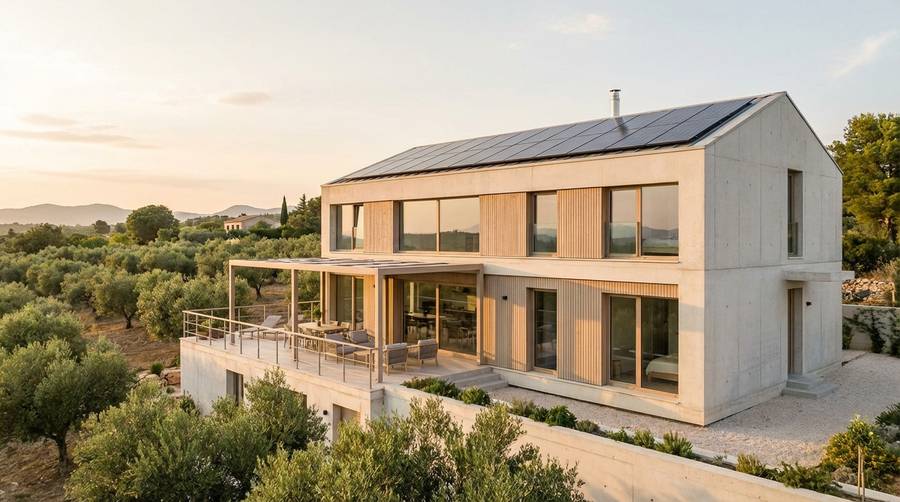
Because most envelope elements were produced under controlled conditions, waste was minimized and material use optimized. The project combined durable materials—industrialized concrete panels for the slab and service cores—with lightweight timber elements for the upper envelope, balancing embodied carbon and longevity. Operational emissions were reduced through robust insulation and a small photovoltaic array sized to offset common loads.
Design and materials that guaranteed performance: accessible technical decisions
Construction system chosen and why
The build used a hybrid approach: an industrialized concrete ground slab and service core paired with a timber light-frame upper envelope. This mix delivered thermal mass where it helps most while keeping assembly lightweight and fast above ground. The choice reflects Mediterranean best practice: use mass for night-time cooling stabilization and light frames for rapid, precise enclosure.
Insulation, windows and thermal breaks: solutions for warm Mediterranean climates
- High-performance external insulation: Continuous exterior insulation with a minimum U-value target of 0.18 W/m²K for walls.
- Advanced glazing: Triple glazing with low-e coatings and thermally broken frames minimized solar gain when closed and retained warmth in winter.
- Thermal bridge management: Factory-cut connection points and insulated junctions lowered bridging risk; these were validated through thermal modelling and on-site infrared checks.
Finishes and Mediterranean contemporary architecture that combine comfort and aesthetics
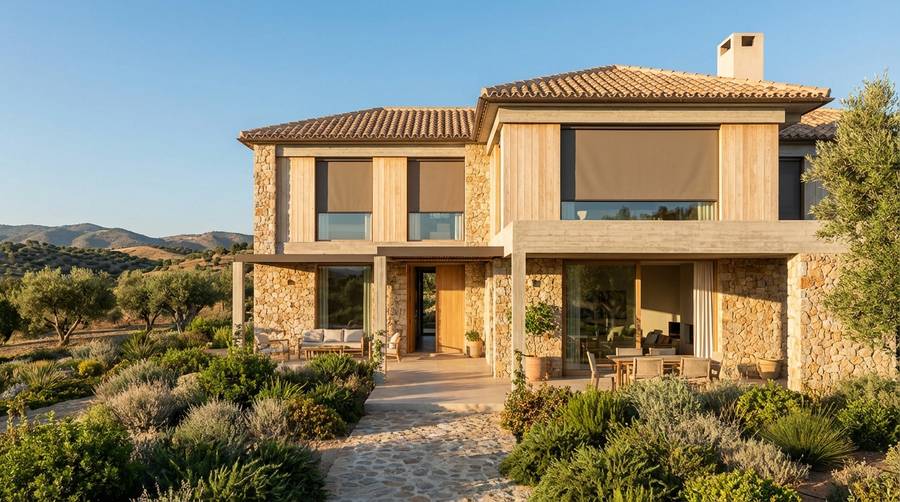
The exterior used light-render finishes, timber accents and stone cladding at the entrance—contemporary Mediterranean cues. Large terraces and recessed shading were integrated to protect glazing. Interiors prioritized natural light, durable finishes and low-VOC products. The result: a home that looks and feels local while performing to international energy standards.
From ground to handover: the turnkey process step by step
Plot search, permits and design: timelines and key advice for self-builders
Key milestones and durations in the project:
- Plot selection and geotechnical study: 4 weeks.
- Preliminary design and planning application: 8–12 weeks (including local authority feedback).
- Contracting and detailed design with the manufacturer: 6–8 weeks.
Advice: complete a thorough site brief and topography study before committing to a turnkey contract. Early alignment on access, connections and local planning limits avoids later delays.
Industrial phase and on-site assembly: real timeline with metrics from the case
Manufacturing in the factory took eight weeks. Transport to site and erection were completed in 10 working days. External closure (roof, façades, windows) was achieved in 4 weeks of on-site work, and internal finishes plus commissioning took an additional 8 weeks. From contract signature to keys: 32 weeks.
Why that matters: Compared to an equivalent traditional build that often extends 18–24 months, the industrialized process reduced exposure to weather delays and subcontractor scheduling conflicts.
Finishes, Passivhaus verification and handover: documentation and client satisfaction
Before handover, airtightness testing, thermal imaging and Passivhaus verification were completed. The turnkey provider delivered a documentation pack with as-built plans, MVHR manuals and maintenance schedules. The family reported immediate comfort and simple operation of the MVHR and geothermal-assisted heating systems.
Measurable results: costs, times, consumption and satisfaction
Cost and timeline comparison vs traditional construction (case data)
Case metrics (rounded):
- Turnkey industrialized cost: €1,650/m² (including site works and landscaping).
- Comparable traditional build estimate: €1,800–2,100/m² with higher contingency needs.
- Project duration: 32 weeks turnkey vs 18 months typical traditional delivery.
These numbers show that industrialized delivery can be cost-competitive while offering substantial schedule certainty.
Energy performance: real consumption, demand and Passivhaus certification
Measured performance in the first year:
- Heating demand: 10 kWh/m²·year (below the local baseline and within Passivhaus targets for the design).
- Annual electricity consumption (home excluding EV charging): 1,800 kWh. With a 3.5 kWp PV array, net bills averaged €22/month during the first year.
- Airtightness test (n50): 0.45 h-1—consistent with Passivhaus quality control expectations.
These metrics demonstrate predictable operational costs and low energy demand in Mediterranean climates when the design addresses shading and ventilation properly. For a deeper discussion of Passivhaus limits and benefits in our climate, see Vivienda prefabricada Passivhaus: ventajas y límites.
Client satisfaction: interviews, comfort metrics and ROI
Post-occupancy feedback highlighted three outcomes:
- Comfort: The family reported stable indoor temperatures with minimal use of mechanical cooling.
- Simplicity: The turnkey process eliminated negotiation fatigue and delegated risk to a single provider.
- Return on investment: Lower running costs, reduced maintenance and higher perceived value compared to local stock.
Practical keys and recommendations for future self-builders
What to avoid and decisions that accelerated this successful project
- Avoid late design changes—these create factory delays.
- Lock in interfaces early (connections, drainage, access) so the factory modules arrive ready to connect.
- Engage a façade and landscape design early to ensure planning approval proceeds smoothly.
Financing options and mortgages for self-build modular homes
Financing a modular turnkey home follows similar paths to traditional self-build loans, but lenders increasingly accept modular delivery when backed by a fixed-price turnkey contract and certified energy performance. Options include:
- Construction-to-permanent loans structured around key milestones.
- Mortgage products for self-builders (with staged drawdowns tied to factory completion and handover).
- Green mortgages or preferential rates for energy-efficient homes—prepare your Passivhaus documentation to demonstrate performance potential.
Speak with lending partners early and present factory schedules and airtightness guarantees to streamline approval.
Final checklist to replicate a Mediterranean Passivhaus turnkey project
- Confirm planning and plot constraints; order a geotechnical report.
- Choose a hybrid industrialized system that matches your climate strategy.
- Lock finishes and interfaces before factory production begins.
- Include airtightness and MVHR commissioning in the contract.
- Secure staged financing aligned with factory and on-site milestones.
Conclusion
Takeaway: This turnkey Passivhaus Mediterranean project demonstrates that industrialized housing can deliver faster timelines, predictable costs and outstanding thermal comfort—without sacrificing regional architectural identity. The hybrid material strategy, strict factory quality control and a clear contract were decisive.
If you are planning a self-build and want a realistic, experience-based roadmap to a high-performance turnkey home, consider these steps: define your brief, choose a tested industrialized system, and secure financing with clear milestone-based draws. For practical examples of a turnkey Passivhaus route in our climate, you may find the following useful: Vivienda industrializada: Passivhaus mediterránea real and Vivienda industrializada: caso real Passivhaus mediterráneo.
Are you exploring a modular Passivhaus or need help assessing a plot? Contact our team to review schedules, budgets and financing options—we can share templates and verified metrics from completed projects.
Image generation brief for Findnido (use for editorial/AI image generation):
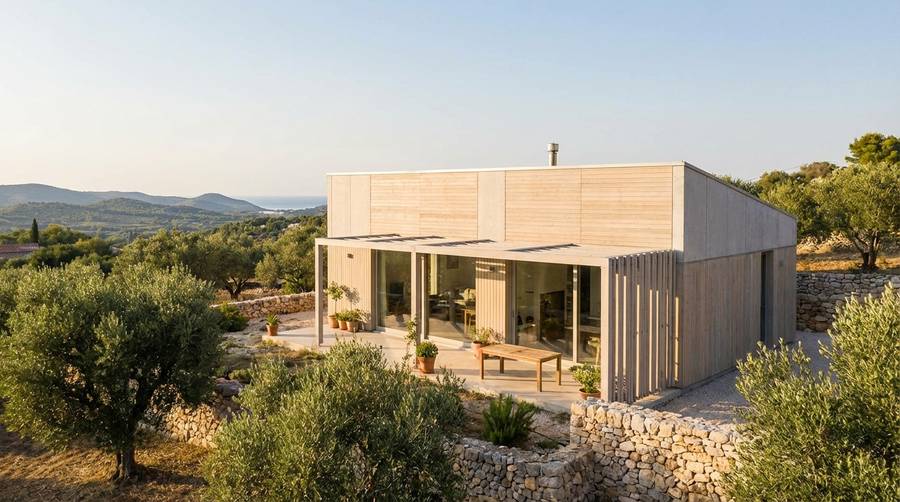
Photorealistic, architectural magazine-quality photograph of a finished Mediterranean contemporary home delivered through industrialized construction. The scene is at golden hour with warm, soft light. House features light-colored rendered façades, natural wood accents, and a subtle stone element near the entrance. Large glazing with warm interior light, a furnished terrace, and Mediterranean planting (young olive tree, aromatic shrubs) frame the composition. No construction elements visible, no modular seams exposed. The environment is a calm residential setting with distant low hills typical of eastern Spain. Mood: trust, comfort, modern sustainability. Photography style: editorial real estate, balanced framing, natural colors, and lived-in staging consistent with the Findnido brand.
Artículos relacionados
Industrialized Housing Success: Mediterranean Passivhaus
A detailed case study of a Mediterranean Passivhaus built through an industrialized, turnkey process in Spain. Learn real timelines, cost comparisons, energy metrics and financing tips for autopromoters building modern modular homes.